The Handkerchief as Couture: A Study in Global Heritage and Artisanal Mastery
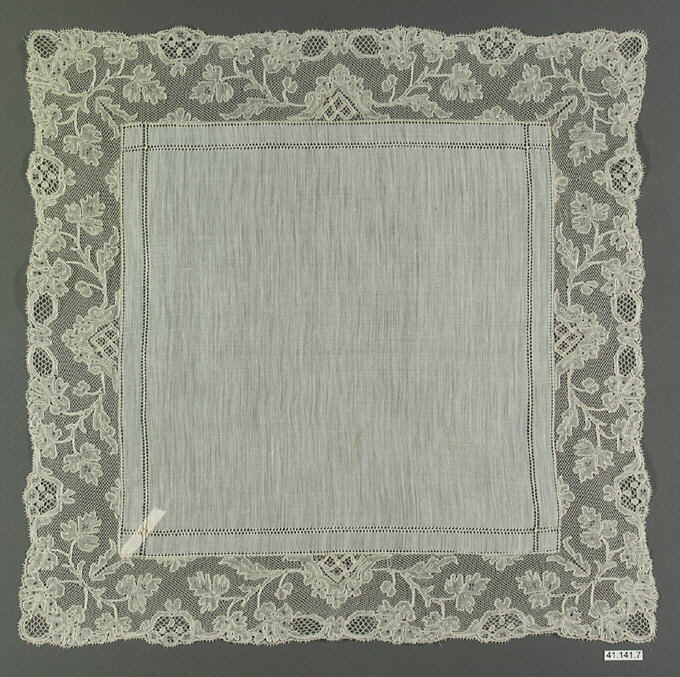
In the lexicon of fashion, few objects are as deceptively simple yet profoundly complex as the handkerchief. At Katherine Fashion Lab, we approach this accessory not as a utilitarian square of fabric, but as a canvas for some of the world’s most demanding textile arts. Our standalone study focuses on a singular artifact—a handkerchief that embodies a confluence of global heritage and artisanal rigor. Constructed from fine linen and adorned with Mechlin lace, Bobbin lace, and drawnwork, this piece transcends its functional origins to become a masterclass in couture. It is a testament to the enduring dialogue between material, technique, and cultural memory, demanding a nuanced analysis of its construction, provenance, and place within the haute couture ecosystem.
Materiality and the Foundation of Linen
The choice of linen as the foundational textile is neither arbitrary nor purely nostalgic. Linen, derived from the flax plant, possesses a tensile strength and a natural luster that synthetic fibers cannot replicate. In this handkerchief, the linen is of a mid-weight, tightly woven variety, offering a crisp hand that provides the necessary structural integrity for the intricate embellishments. The fabric’s slight irregularities—a hallmark of artisanal production—create a subtle, organic texture that catches light differently with each fold. This is not a sterile, machine-perfect surface; it is a living material that breathes and moves. For Katherine Fashion Lab, linen represents a return to a pre-industrial ethos, where the quality of the raw material dictates the potential of the finished piece. The fabric’s natural off-white hue, unbleached and untreated, serves as a neutral backdrop, allowing the lace and drawnwork to command full visual attention.
The Architecture of Mechlin Lace
At the periphery of the handkerchief, a border of Mechlin lace establishes the first layer of narrative complexity. Originating from the city of Mechelen in present-day Belgium, Mechlin lace is distinguished by its fine, continuous thread and the use of a flat, cordonnet—a thicker thread that outlines the pattern. In this piece, the lace features a repeating motif of stylized floral sprigs, each petal and leaf delineated with mathematical precision. The ground, or réseau, is a delicate hexagonal mesh, so translucent that it appears to float above the linen. This transparency is achieved through a technique known as point de Paris, where the threads are twisted and woven without a supporting grid. The effect is one of ethereal lightness, a counterpoint to the solidity of the linen. Mechlin lace demands an extraordinary level of skill: a single mistake in the tension can cause the entire pattern to warp. The presence of this lace on a handkerchief—an object meant for intimate, daily use—elevates the accessory from the mundane to the ceremonial. It is a whisper of the Flemish courts, where such lace was a symbol of wealth and cultural sophistication.
Bobbin Lace: The Sculpture of Thread
Interspersed with the Mechlin border are panels of Bobbin lace, executed in a contrasting, slightly heavier thread. Where Mechlin lace is defined by its airy net, Bobbin lace is a study in dense, sculptural form. The technique involves braiding and twisting multiple threads, each wound around a wooden bobbin, over a pricked pattern on a pillow. The result is a series of raised, three-dimensional motifs—in this case, geometric diamonds and stylized leaves—that create a tactile topography. The bobbin-lace elements are not merely appliquéd; they are integrally worked into the linen’s edge, with the linen threads themselves being incorporated into the lace structure. This technique, known as point de raccroc, requires the lacemaker to pierce the linen with a fine needle and attach the bobbin threads directly, blurring the boundary between fabric and embellishment. The interplay between the flat, matte linen and the raised, lustrous bobbin lace generates a dynamic contrast of light and shadow. From a couture perspective, this is not decoration—it is the deliberate construction of volume and depth on a two-dimensional surface.
Drawnwork: The Art of Negative Space
The center of the handkerchief is dominated by a field of drawnwork, a technique that inverts the logic of lace. Instead of adding thread, drawnwork subtracts it. A grid of warp and weft threads is carefully extracted from the linen, leaving a skeletal framework. The remaining threads are then bundled, twisted, and stitched into intricate patterns—here, a series of concentric circles and radiating spokes reminiscent of a spider’s web. This is a labor-intensive process that demands an intimate understanding of the fabric’s grain. The drawnwork creates a zone of translucency within the solid linen, allowing light to filter through in a controlled, geometric manner. It is a meditation on absence and presence, on what is removed versus what is retained. In global heritage, drawnwork is found from the highlands of Peru to the villages of eastern Europe, yet here it is executed with a precision that speaks to a specific lineage of European needlework, likely from the regions of Saxony or Silesia. The pattern’s symmetry and repetition evoke a sense of ritual order, transforming the handkerchief into a talismanic object.
Global Heritage and the Couture Imperative
To analyze this handkerchief solely through its technical merits would be to miss its broader cultural resonance. The combination of Mechlin and Bobbin lace with drawnwork on linen is a synthesis of distinct geographic traditions. Mechlin lace is a product of the Low Countries’ mercantile networks; Bobbin lace flourished in the courts of France and Italy; drawnwork has roots in both European folk art and Middle Eastern tulle bi telli (metal-thread embroidery). This handkerchief is not a pastiche but a deliberate curation of global heritage, each technique chosen for its specific textural and visual contribution. For Katherine Fashion Lab, this represents a couture imperative: to honor and preserve these endangered skills while recontextualizing them for a contemporary audience. The handkerchief becomes a portable museum, a repository of knowledge that is both tactile and intellectual. It challenges the fast-fashion paradigm by demanding that the wearer engage with the object’s biography—the hours of handwork, the regional dialects of thread, the patience required to create a single square inch of lace.
Conclusion: The Handkerchief as a Statement of Value
In a standalone study, this handkerchief reveals itself as a microcosm of couture’s highest ideals. It is not a commodity to be discarded but an heirloom to be passed down, its value inscribed in every stitch. The linen provides the canvas, the Mechlin lace offers a breath of lightness, the Bobbin lace introduces sculptural weight, and the drawnwork invites contemplation of space and absence. Together, they form an object that is both intimate and monumental. For the discerning collector or the connoisseur of textile arts, this handkerchief is a quiet manifesto: a declaration that beauty, heritage, and craftsmanship are not relics of the past, but essential currencies of the future. At Katherine Fashion Lab, we see in this piece a blueprint for how couture can remain relevant—not through novelty, but through depth. It is a reminder that the most powerful statements in fashion are often the smallest, and the most enduring.