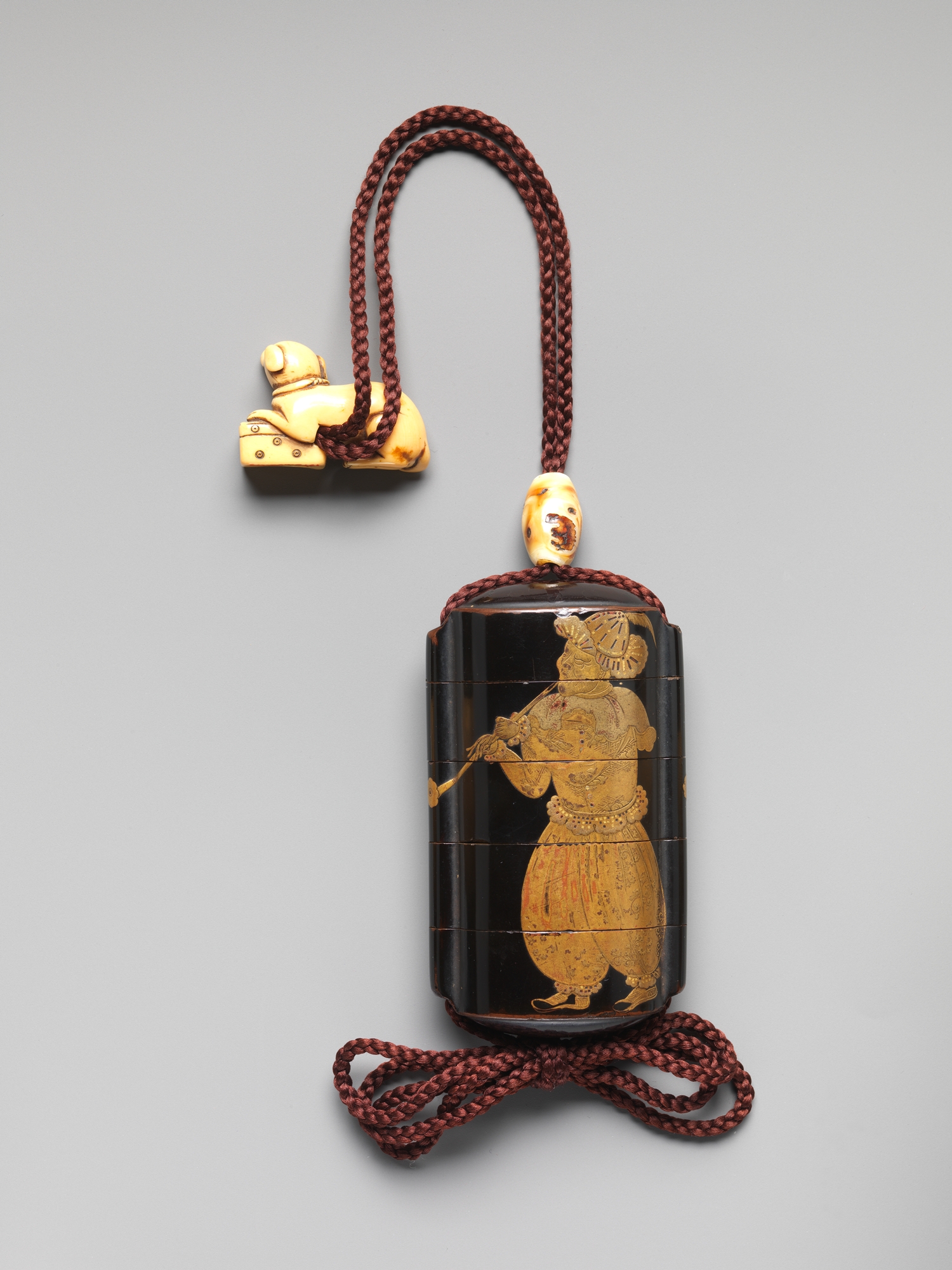
Heritage Analysis: The Inrō with Portuguese Figures
This report presents a strategic heritage analysis of a singular artifact: an Inrō with Portuguese Figures from Japan, crafted from lacquered wood with gold hiramaki-e and cut-out gold foil application on a black ground, accompanied by an ivory netsuke in the form of a dog and an antler bead ojime. This object, held within the Katherine Fashion Lab archive, serves as a critical lens through which to examine the intersection of cultural symbolism, historical adornment, and spiritual meaning. For the 2026 high-end luxury market, this Inrō offers profound lessons in narrative power, material mastery, and the articulation of identity through portable luxury.
Symbolic Power: The Foreign as Status and Transgression
The Portuguese as Emblems of Global Reach
The depiction of Portuguese figures on a Japanese Inrō from the late 16th to early 17th century is not merely decorative; it is a deliberate statement of symbolic power. During the Nanban trade period (1543–1614), Portuguese merchants and missionaries were exotic, powerful, and threatening. By inlaying these foreign figures in gold on a black lacquer ground, the Japanese elite transformed a potential threat into a symbol of cosmopolitan sophistication. The gold hiramaki-e technique—where powdered gold is sprinkled onto wet lacquer—elevates the Portuguese from mere humans to luminous, almost divine, entities. This reflects a strategic appropriation: the wearer claims the power of global connection, signaling access to rare goods, knowledge, and networks.
Hierarchy of Materials as Power Statement
The material choices themselves constitute a hierarchy of power. Gold foil cut-outs (kirikane) on black lacquer create a stark, high-contrast visual that commands attention. In high-end luxury, such contrasts—between matte and gloss, dark and light—are foundational to signaling exclusivity. The black ground, achieved through labor-intensive polishing of urushi lacquer, represents the void from which power emerges. The gold figures, floating on this void, suggest that the wearer’s authority transcends the mundane. For 2026, luxury brands can learn from this: the symbolic power of a product lies not only in what it depicts but in how it is depicted. The tension between foreign and familiar, light and dark, creates a narrative of controlled power.
Historical Adornment: The Inrō as Portable Identity
The Functional Object as Social Armor
The Inrō was originally a practical container for seals and medicines, suspended from the obi (sash) by a netsuke and secured by an ojime. However, in the Edo period, it evolved into a primary vehicle for personal branding. The Inrō with Portuguese Figures was not merely a pouch; it was a wearable declaration of the owner’s worldliness, wealth, and aesthetic refinement. The ivory netsuke—carved as a dog—adds another layer of meaning. In Japanese culture, the dog symbolizes loyalty, protection, and the warding off of evil. This netsuke, paired with the Portuguese motif, creates a protective narrative: the loyal dog guards the exotic, powerful figures, suggesting the wearer is both adventurous and secure.
Adornment as a System of Codes
Historical adornment in Japan operated on a strict system of sartorial codes. The size, material, and motif of an Inrō communicated the wearer’s rank, clan affiliation, and personal taste. The use of gold and the depiction of Portuguese figures would have been restricted to the highest samurai and merchant classes. The antler ojime—a humble material compared to gold or ivory—introduces an element of restraint. This juxtaposition of opulent gold and natural antler mirrors the Japanese aesthetic of wabi-sabi, where imperfection and naturalness are valued. For 2026 luxury strategy, this teaches that true exclusivity lies in the orchestration of contrasts: high and low, artificial and organic, foreign and domestic.
Spiritual Meaning: The Lacquer as Sacred Vessel
Urushi as a Conduit for the Sacred
The lacquer used in this Inrō is not merely a finishing material; it is a sacred substance in Japanese culture. Urushi lacquer is derived from the sap of the Toxicodendron vernicifluum tree, and its application was considered a meditative, almost ritualistic, practice. The black ground represents the primordial darkness from which all form emerges—a concept rooted in Shinto and Buddhist cosmologies. By applying gold figures onto this sacred black, the artisan creates a microcosm of the universe: the luminous (gold) rising from the void (black). This spiritual dimension elevates the Inrō from a commodity to a talismanic object.
The Netsuke as Spiritual Guardian
The ivory netsuke in the form of a dog holds specific spiritual resonance. In Japanese folk religion, dogs are believed to guide souls, protect against malevolent spirits, and ensure safe passage. The dog’s placement at the top of the Inrō, where it secures the cord, symbolically guards the contents—both physical and spiritual. The antler ojime, made from deer antler, further invokes nature spirits. Deer are considered messengers of the gods in Shinto. Together, the dog and antler create a protective triad: the dog (loyalty), the antler (nature), and the gold figures (transcendence). For 2026 luxury, this suggests that objects should be designed as spiritual companions, not just accessories. The narrative of protection and transcendence adds emotional depth that justifies premium pricing.
2026 High-End Luxury Strategy: Lessons from the Inrō
Narrative Exclusivity Through Cultural Fusion
The Inrō with Portuguese Figures is a masterclass in cultural fusion as a luxury strategy. For 2026, high-end brands should embrace the strategic exoticism of borrowing motifs from other cultures—not as appropriation, but as a deliberate narrative of global citizenship. This requires deep research and respect for the source culture. The Inrō succeeds because the Portuguese figures are not caricatures; they are rendered with the same technical precision as Japanese motifs. Luxury brands must invest in heritage authenticity: collaborating with artisans who understand the symbolic weight of the imagery they employ.
Material Storytelling as Brand Architecture
The combination of lacquered wood, gold foil, ivory, and antler creates a material hierarchy that tells a story. Each material has its own provenance, craft history, and symbolic meaning. For 2026, luxury brands should move beyond “precious materials” and toward narrative materials. The choice of antler for the ojime, for instance, introduces an element of humility that makes the gold more striking. This principle can be applied to modern luxury: a handbag might pair exotic leather with untreated wood, or a watch might combine high-tech ceramic with ancient jade. The tension between materials creates emotional resonance.
Portable Luxury as Identity Amplification
The Inrō was designed to be worn, touched, and seen. It was portable identity. In an era of digital saturation, 2026 luxury consumers crave physical objects that amplify their personal narratives. The Inrō teaches that a luxury item must function as a conversation piece, a talisman, and a status marker simultaneously. Brands should design products that invite storytelling: a hidden motif, a rare material, a historical reference. The dog netsuke, for example, could be reinterpreted as a charm or pendant that the owner can remove and carry separately. This modularity extends the object’s life and meaning.
Spiritual Sustainability as Market Differentiator
The spiritual dimension of the Inrō—its role as a sacred vessel—offers a powerful counterpoint to fast luxury. For 2026, high-end brands can differentiate themselves by emphasizing spiritual sustainability: objects designed to be cherished, repaired, and passed down. The Inrō’s lacquer can be re-polished, its netsuke replaced, its ojime re-strung. This aligns with the growing demand for circular luxury. By positioning products as heirlooms with spiritual significance, brands create emotional durability that transcends trends.
Conclusion
The Inrō with Portuguese Figures is not a museum relic; it is a strategic blueprint for 2026 high-end luxury. Its symbolic power lies in the deliberate fusion of foreign and domestic, its historical adornment teaches the art of coded messaging, its spiritual meaning elevates the object beyond commodity, and its material mastery sets a standard for narrative-driven design. For Katherine Fashion Lab, this analysis confirms that the most enduring luxury objects are those that balance opulence with restraint, exoticism with authenticity, and functionality with talismanic power. As the 2026 market moves toward deeper emotional engagement, the Inrō stands as a timeless guide to creating objects that are not just worn, but lived with.