Deconstructing Elegance: The Couture Analysis of Madame Marsollier and Her Daughter at Katherine Fashion Lab
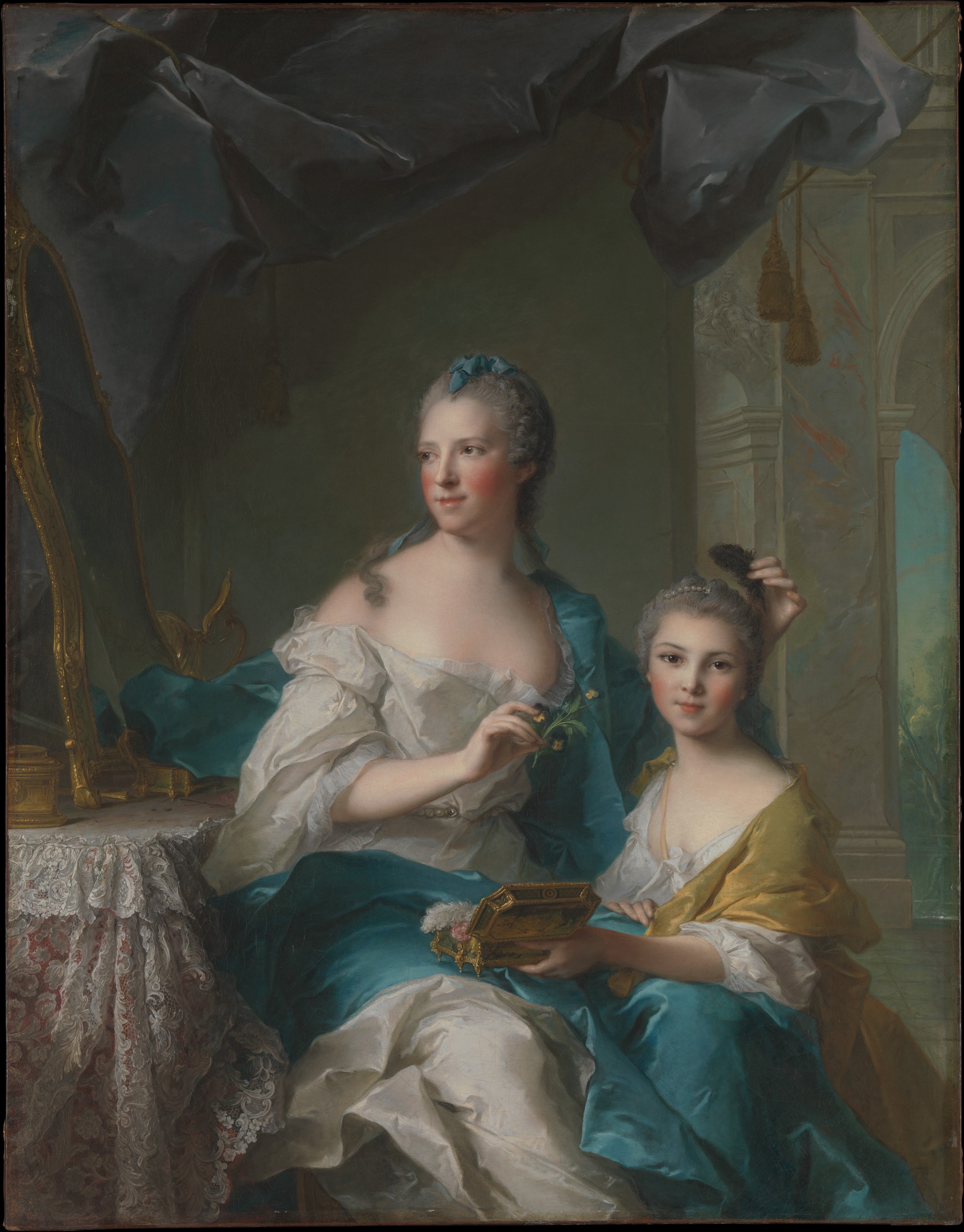
In the hallowed corridors of art history, few portraits capture the nuanced interplay of maternal authority, filial devotion, and sartorial power as deftly as the oil-on-canvas masterpiece Madame Marsollier and Her Daughter. At Katherine Fashion Lab, we approach this work not merely as a visual artifact but as a living document of Global Heritage—a standalone study that dissects the fabric of 18th-century French aristocracy while resonating with contemporary haute couture principles. This analysis transcends the canvas, extracting the threads of design philosophy, textile symbolism, and cultural narrative that define the Marsollier legacy.
The Canvas as a Couture Blueprint
The portrait, rendered in rich oils, presents Madame Marsollier and her daughter in a moment of poised intimacy. The mother, draped in a gown of deep sapphire silk, commands the composition with a posture that speaks to generations of lineage. Her daughter, a mirror of youthful grace, wears a frock of ivory muslin, embroidered with delicate floral motifs. To the trained eye of the fashion curator, this is not a static scene but a strategic tableau—a declaration of social capital, economic mobility, and aesthetic mastery. The artist’s brushstrokes mimic the hand of a master tailor: each fold of fabric is a pleat, each shadow a dart, each highlight a seam finish.
From a couture perspective, the painting exemplifies structural precision. Madame Marsollier’s bodice is engineered with a rigid stomacher, a precursor to the boned corsetry that would dominate Western fashion. The daughter’s softer silhouette, conversely, anticipates the neoclassical shift toward fluidity and naturalism. This duality—control versus release, tradition versus innovation—mirrors the tension within any high-fashion collection. Katherine Fashion Lab identifies this as a dialectical design principle: the mother anchors the heritage, while the daughter embodies the evolution.
Textile Narratives: Silk, Muslin, and Global Trade
The materials depicted in Madame Marsollier and Her Daughter are not arbitrary; they are commodities of a globalized 18th-century economy. The mother’s sapphire silk, likely imported from Lyon or China, signifies wealth derived from international trade routes. Its lustrous sheen, captured by the painter’s deft use of light, suggests a fabric of exceptional quality—a status symbol akin to today’s limited-edition luxury fabrics. The daughter’s muslin, a lightweight cotton from India, reflects the colonial appetite for exotic textiles. This juxtaposition of silk and muslin is a tactile metaphor for the mother-daughter dynamic: the former is heavy with history, the latter airy with promise.
At Katherine Fashion Lab, we analyze this through the lens of sustainable luxury. The painting implicitly critiques the ephemeral nature of fashion by immortalizing these fabrics in oil. The silk, though sumptuous, is static; the muslin, though delicate, endures through artistic documentation. This challenges contemporary designers to consider longevity over disposability. The Global Heritage context further enriches this narrative: the Marsollier family’s wardrobe is a microcosm of cross-cultural exchange, where French tailoring meets Indian weaving, and Chinese silks drape European bodies. For the modern couturier, this underscores the necessity of ethical sourcing and cultural appreciation—not appropriation—in crafting a collection.
Color Palette as Emotional Cartography
The chromatic choices in this portrait are a masterclass in psychosocial storytelling. Madame Marsollier’s sapphire blue is a color of authority and depth, associated with the Virgin Mary in religious iconography and with royalty in secular contexts. It anchors the composition, drawing the viewer’s eye to her face and hands—the sites of agency. Her daughter’s ivory and pale rose ensemble, by contrast, evokes innocence and nascent femininity. The warm undertones of the rose echo the mother’s flushed cheeks, suggesting a genetic and emotional bond.
From a fashion lab perspective, this palette serves as a color theory case study. The high contrast between the mother’s deep blue and the daughter’s light neutrals creates a visual hierarchy that guides the narrative. In haute couture, such deliberate color blocking is a tool for directing attention to key design elements—a neckline, a sleeve, a drape. The painting also employs tonal harmony: the mother’s blue is echoed in the daughter’s subtle blue sash, while the daughter’s rose reappears in the mother’s rouge. This repetition reinforces unity without monotony, a principle applicable to cohesive collection planning.
Silhouette and the Politics of Movement
The silhouettes in Madame Marsollier and Her Daughter are not merely aesthetic but political. Madame Marsollier’s gown, with its wide panniers and tight bodice, restricts movement—a physical manifestation of aristocratic restraint. Her daughter’s simpler frock, with a higher waistline and softer skirt, allows greater freedom. This shift from the rigid to the relaxed mirrors the broader societal transition from the ancien régime to the Enlightenment, where women’s fashion began to reflect ideals of liberty and naturalism.
For the couture analyst, this is a lesson in ergonomic design. The mother’s garment prioritizes spectacle over comfort, a hallmark of ceremonial dress. The daughter’s attire, while still elegant, prioritizes practicality—a nod to the emerging bourgeoisie. Katherine Fashion Lab interprets this as a functional duality: high fashion must balance the aspirational with the wearable. The portrait’s standalone study status amplifies this, as it isolates the sitters from their broader courtly context, forcing the viewer to focus on the garments themselves as protagonists.
Accessories and Adornment: The Language of Detail
No couture analysis is complete without examining the accessories. Madame Marsollier wears a pearl necklace and a lace fichu, both symbols of refinement. The pearls, with their luminous sheen, suggest purity and wealth; the lace, meticulously painted, demonstrates the artist’s attention to texture. Her daughter wears a simple ribbon in her hair, a token of youth. These details are strategic embellishments that elevate the garments from mere clothing to costume.
In the context of Global Heritage, these accessories also hint at trade networks: pearls from the Persian Gulf, lace from Flanders. The painting thus becomes a cartography of luxury, mapping the flow of goods across continents. For the modern designer, this underscores the importance of provenance in branding. A Katherine Fashion Lab collection would honor this by incorporating artisan techniques from diverse cultures—hand-beading from India, pleating from Japan—while ensuring ethical partnerships.
Conclusion: A Legacy for Contemporary Couture
Madame Marsollier and Her Daughter is more than a portrait; it is a couture manifesto. Through its meticulous rendering of fabric, color, and silhouette, it offers a blueprint for designers seeking to merge heritage with innovation. At Katherine Fashion Lab, we view this work as a timeless study in the art of dressing—a reminder that fashion, at its highest form, is a dialogue between past and future, self and society. The Marsollier women, frozen in oil, challenge us to create garments that tell stories, that honor global traditions, and that transcend the fleeting trends of the season. In their elegance, we find our own.