Executive Summary: Auricular Archives and Future Resonance
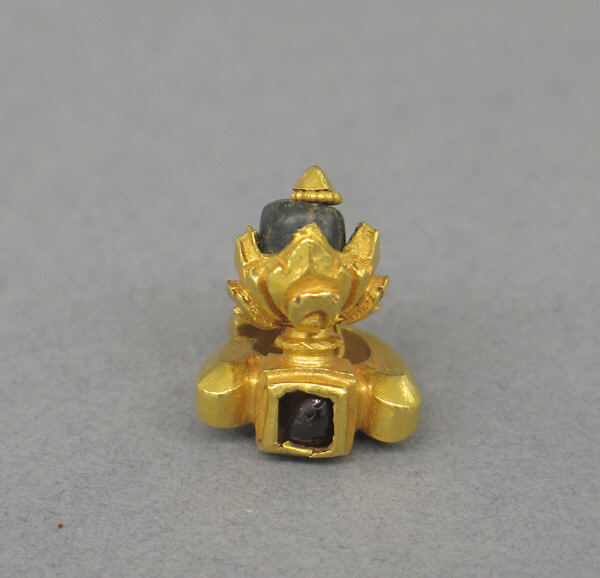
This analysis examines a pair of Javanese gold ear clips with blue bead and red stone, positioning them not merely as artifacts but as concentrated nodes of cultural intelligence. For Katherine Fashion Lab, such objects are foundational to a heritage-driven luxury strategy. They serve as tangible archives, encoding principles of symbolic power, dualistic cosmology, and sophisticated adornment that directly resonate with the Lab's ongoing investigation into bifurcated narratives—as exemplified by the Mirror with Split-Leaf Palmette study. This paper will deconstruct the object's intrinsic symbolism, place it within the context of historical bodily practice, and extrapolate its core principles into a forward-looking 2026 luxury strategy centered on spiritual materiality and narrative depth.
Deconstruction: The Cosmology of a Composite Object
The immediate power of these ear clips lies in their material and chromatic composition. Gold, in the Javanese courtly tradition, is far more than a display of wealth; it is the metal of permanence, immortality, and spiritual potency (kesaktian). It is a skin of the divine, a conductor of metaphysical energy. The pairing of a blue bead—likely a deep, celestial lapis lazuli or cobalt glass—with a red stone, potentially ruby or spinel, is a deliberate cosmological statement.
Symbolic Power and Chromatic Dualism
This blue-red dichotomy is a fundamental symbolic code across Austronesian and Indic-influenced Southeast Asia. Red embodies terrestrial power, blood, life force (semangat), courage, and the feminine principle (Shakti). Blue represents the celestial, the cosmic ocean, transcendence, wisdom, and the masculine (Shiva). Together, they create a state of dynamic equilibrium, a microcosm of the universe worn upon the body. This is not mere decoration; it is a declarative act of aligning the wearer with cosmic order (Rta or dharma). The ear, as a gateway for sound and wisdom (Vedic śruti), becomes the ideal site for this potent amalgamation, suggesting the wearer is in receipt of and in balance with both earthly authority and spiritual knowledge.
Historical Adornment as Bodily Cartography
In the historical context of Javanese courts, such ear clips were part of a precise grammar of adornment that mapped social, spiritual, and political status onto the human form. Adornment (perhiasan) was a technology of the self and the state. The weight and quality of gold denoted rank. The specific placement on the ear—lobe versus cartilage—could indicate lineage or marital status. The use of sacred chromatics transformed the body into a living, breathing mandala. This practice echoes the Lab's study of the Mirror with Split-Leaf Palmette, where one side presents an idealized, eternal order (the polished silver mirror with gold palmettes—perfection, reflection, the celestial plane) and the other engages with the narrative of mortality and legacy (the stone sarcophagus—earth, time, story). The ear clips perform a similar function: they are at once a perfect, abstract cosmological diagram (blue/red, sky/earth) and a deeply personal, lived artifact of social and spiritual identity.
Strategic Integration: From Javanese Cosmology to 2026 Luxury Code
The intellectual and symbolic density of this object provides a robust framework for evolving Katherine Fashion Lab's luxury proposition beyond superficial heritage referencing. The 2026 consumer seeks depth, authenticity, and spiritual alignment in luxury—products that are "intelligent" and narratively charged.
Principle 1: Spiritual Materiality
Move beyond material rarity to material intentionality. Every component must carry a coded meaning. Gold is not just 24-karat; it is narrativized as the "conductor," the eternal medium. Stones are selected not only for carat but for their historical-symbolic lexicon: rubies for semangat (vital force), sapphires for wicaksana (wisdom), pearls for the liminal space between ocean and land. This creates a product theology that consumers can study and embody.
Principle 2: Narrative Bifurcation & The Dual Object
Directly inspired by the ear clips' dualism and the mirror/sarcophagus study, we propose the strategy of The Dual Object. A 2026 collection could feature pieces that possess two states, two narratives, or two interfaces. A cuff that is rigorously geometric on one side (the "public mandala") and engraved with a personal, textural narrative on the inner wrist (the "private chronicle"). A ring where the setting rotates to reveal a celestial stone (blue) for day and a terrestrial stone (red) for evening. This design philosophy operationalizes the Javanese cosmological balance and the archaeological insight of split narratives, offering wearers a sophisticated tool for personal expression and symbolic play.
Principle 3: Adornment as Cartography, Reimagined
Modern "bodily cartography" involves mapping contemporary identity layers—digital, emotional, aspirational—onto the body through adornment. Collections can be structured not by type (necklace, ring) but by Energetic Placement: pieces designed for "Gateways" (ears, lips), "Centers" (chest, nape), or "Anchors" (wrists, ankles), each with a distinct material and symbolic brief. This systematizes the ancient Javanese practice for a modern context, providing a bespoke framework for client advisors to co-create a personal "symbolic ecosystem" with the client.
Conclusion: The Heritage Algorithm
The Javanese ear clips are a masterclass in condensed meaning. For Katherine Fashion Lab, such artifacts are not motifs to be copied but algorithms to be learned. The algorithm here is: [Sacred Material + Chromatic Dualism + Bodily Cartography = Symbolic Power]. By inputting this algorithm with contemporary materials, concerns, and design excellence, the Lab can output a luxury proposition of unparalleled depth. The 2026 strategy, therefore, is to become a house known not just for what its pieces are made of, but for the legible, resonant intelligence with which they are made. It transforms the wearer from a consumer into a curator of personal cosmology, continuing the ancient Javanese tradition of adornment as a deliberate, powerful act of world-making. This is the ultimate historical resonance: not repeating the past, but speaking its sophisticated language in the dialect of the future.