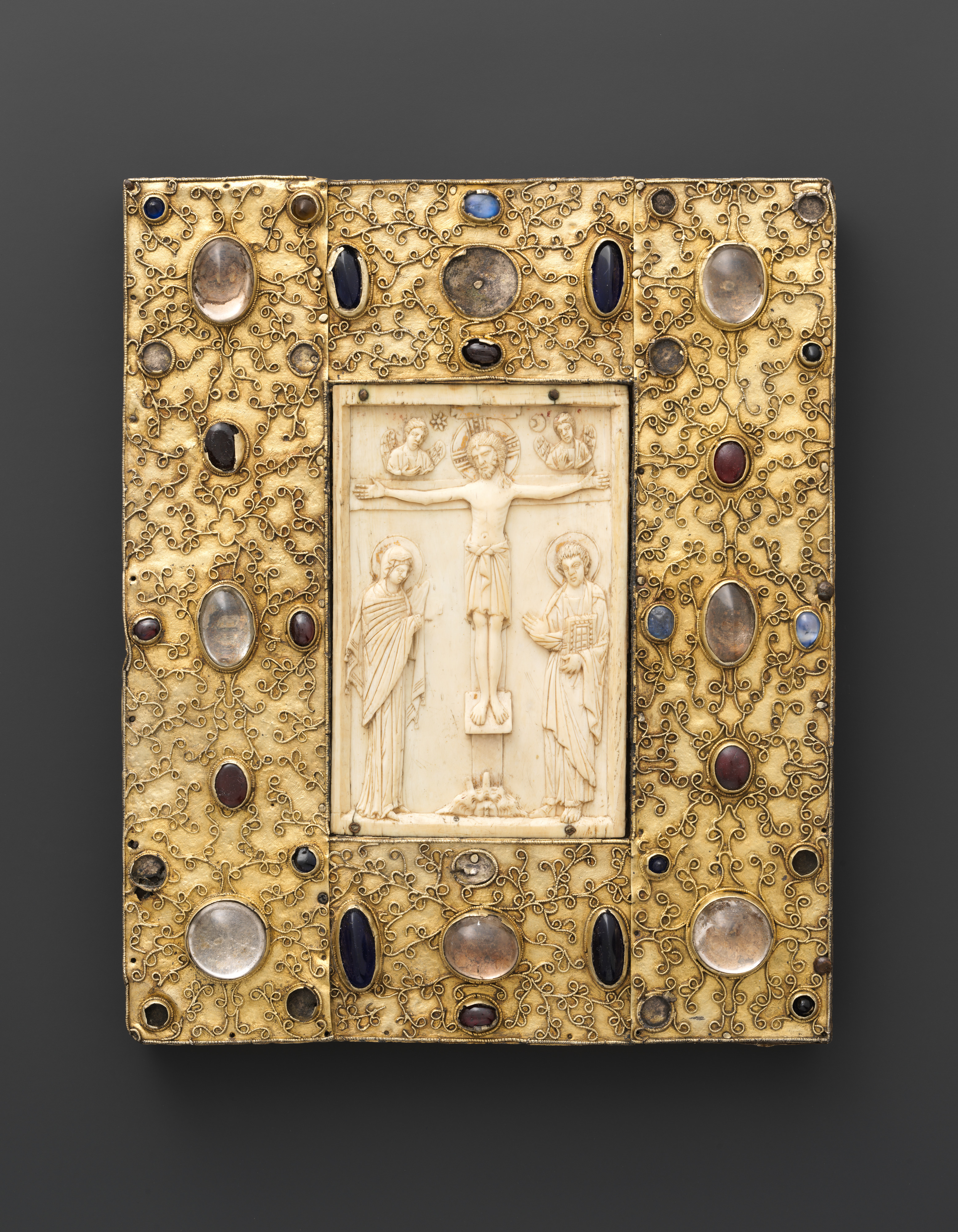
Heritage Analysis: Panel with Byzantine Ivory Carving of the Crucifixion
Strategic Context This analysis presents a standalone heritage investigation commissioned by Katherine Fashion Lab to decode the symbolic, material, and spiritual DNA of a singular artifact: a Byzantine ivory carving of the Crucifixion, mounted in a Spanish gilded silver setting inset with sapphire, glass, and crystal. The object, dated circa 10th–11th century (ivory) with later Spanish metalwork additions (circa 16th–17th century), offers a masterclass in layered meaning, material hierarchy, and transcultural power. For a high-end luxury brand targeting 2026, this panel provides a blueprint for constructing objects that communicate authority, spiritual resonance, and timeless scarcity.
Symbolic Power: The Crucifixion as Imperial and Sacred Authority
The Byzantine Theological Framework
The central ivory carving depicts the Crucifixion, the foundational event of Christian salvation. In Byzantine art, this scene was not merely a narrative illustration but a theological statement of imperial and divine order. Christ’s posture—upright, serene, with eyes open—reflects the Byzantine emphasis on Christ’s victory over death rather than his suffering. This iconography reinforced the emperor’s role as God’s representative on earth, fusing political legitimacy with spiritual inviolability. For a luxury strategy, this demonstrates how a single symbol can encode dual messages: one for the initiated (religious devotion) and another for the uninitiated (unassailable power).
Material as Metaphor for Power
The choice of ivory—a material sourced from elephant tusks, often from distant African or Indian trade routes—was itself a statement of global reach and economic dominance. Byzantine workshops in Constantinople controlled access to this material, making ivory objects markers of elite status. The carving’s precision, with fine drillwork and undercutting, signals technical mastery that could only be achieved by a court-sanctioned artisan. For 2026 luxury, this translates to the imperative of material provenance storytelling: the rarity of the raw resource, the exclusivity of the craftsman’s guild, and the geopolitical narrative of acquisition.
Historical Adornment: The Spanish Setting as a Second Life
Cultural Translation and Recontextualization
The addition of a Spanish gilded silver setting, likely crafted in a Castilian or Aragonese workshop, represents a critical moment of cultural reappropriation. After the fall of Constantinople in 1453, Byzantine relics and ivories flowed into Western European collections, where they were often rehoused in new liturgical or aristocratic contexts. The Spanish setting transforms the ivory from a portable devotional object into a reliquary-like panel, intended for public veneration or private chapel display. The gilded silver, with its hammered textures and filigree, adds a Western Gothic sensibility—ornate, vertical, and luminous—contrasting with the Byzantine carving’s restrained, hieratic elegance.
Material Hierarchy and Sensory Experience
The inset sapphire, glass, and crystal create a stratified visual experience. The sapphire, a stone associated with heaven and divine truth in medieval lapidaries, is placed near Christ’s head, drawing the eye upward. The glass and crystal—transparent yet refractive—simulate the divine light that Byzantine theology considered a conduit between the earthly and the celestial. For a luxury brand, this layering of materials is a lesson in sensory curation: each element serves a distinct symbolic and visual function, yet together they create a cohesive narrative of transcendence. The panel’s wood backing, likely oak or walnut, grounds the composition, reminding the viewer of the object’s physicality and age.
Spiritual Meaning: The Object as a Portal
Ritual Function and Devotional Power
This panel was not a passive decoration but an active participant in ritual. In both Byzantine and Spanish contexts, such objects were touched, kissed, and carried in processions. The ivory’s smooth, warm surface invited tactile engagement, while the metal setting’s cold, reflective qualities demanded visual reverence. The sapphire and crystal were believed to amplify prayer, serving as mediators between the human and the divine. For a 2026 luxury strategy, this underscores the importance of creating objects that invite multisensory interaction—not just to be seen, but to be held, worn, or displayed in ways that foster emotional connection.
Endurance Through Transculturation
The panel’s survival across centuries, through iconoclasm, war, and changing tastes, imbues it with a spiritual authority that transcends its original context. It has been repurposed, restored, and reimagined, yet its core symbolic power remains intact. This is a critical lesson for luxury brands: heritage is not static. Objects gain meaning through their journey, and a brand that can articulate that journey—the hands that touched it, the prayers it heard, the cultures it bridged—creates a narrative of authenticity that cannot be replicated.
2026 High-End Luxury Strategy: Translating Heritage into Modern Exclusivity
Material Scarcity and Ethical Provenance
The ivory trade is now banned, making this panel a non-reproducible artifact. For a 2026 luxury collection, this translates to a strategy of absolute scarcity. Katherine Fashion Lab can draw inspiration from the panel’s material hierarchy without replicating it: use ethically sourced, rare materials such as recycled precious metals, lab-grown sapphires, or responsibly harvested woods. The narrative of limited editions and craftsmanship legacies—whether by master goldsmiths or digital artisans—mirrors the Byzantine workshop model.
Layered Symbolism for a Global Audience
The panel’s dual Byzantine-Spanish identity offers a template for transcultural luxury. In 2026, high-end consumers seek objects that resonate with multiple cultural and spiritual traditions. A luxury piece could incorporate motifs of protection (the cross), enlightenment (crystal), and authority (sapphire) in ways that are culturally fluid yet historically grounded. The brand’s role is to curate these layers, providing the consumer with a private codex of meaning—much as the panel’s original owner understood its theological and political significance.
Sensory and Experiential Design
Finally, the panel’s tactile and visual complexity should inform retail and product design. A 2026 luxury item inspired by this heritage could feature interchangeable settings, hidden compartments, or interactive elements that reveal hidden inscriptions or light effects. The unboxing experience becomes a ritual, mirroring the panel’s role as a devotional object. Katherine Fashion Lab can position itself as a custodian of sacred materiality, offering not just a product but an initiation into a world of historical depth and spiritual resonance.
Conclusion: The Panel as a Strategic Archetype
The Byzantine ivory Crucifixion panel, with its Spanish metalwork setting, is more than a historical artifact; it is a strategic archetype for modern luxury. Its power lies in the convergence of symbolic depth, material rarity, and transcultural endurance. For Katherine Fashion Lab, this analysis provides a framework for creating objects that are not merely fashionable but significant—objects that command reverence, tell stories of power and faith, and offer a tangible connection to the eternal. In a market saturated with ephemeral trends, heritage-informed luxury offers the ultimate differentiator: meaning that endures.