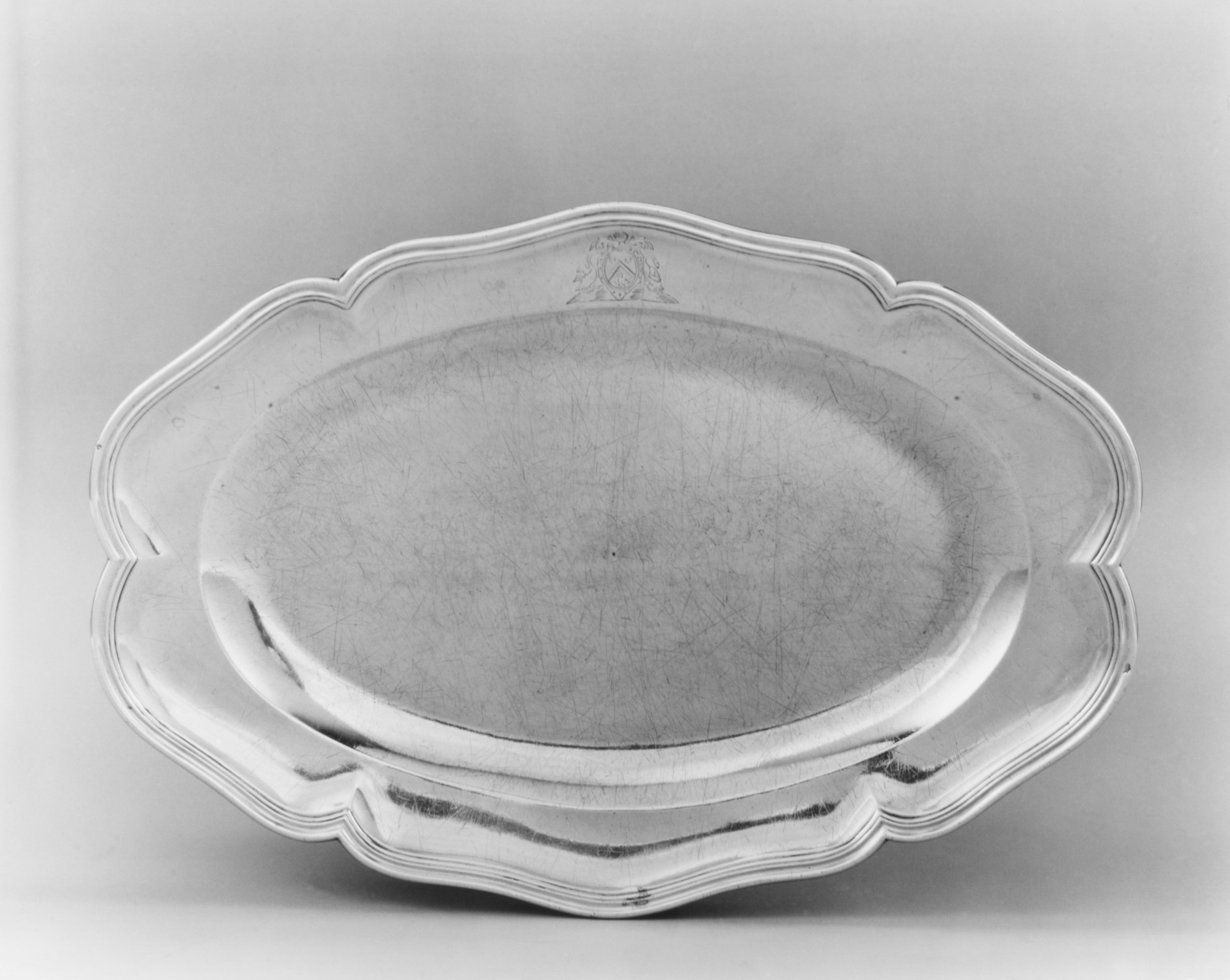
The Oval Dish: A Study in Silver, Lineage, and the Architecture of Light
In the rarefied world of couture, where fabric is the traditional medium, the Katherine Fashion Lab challenges the very definition of wearable art. Our latest standalone study dissects a singular object: an oval dish. Not as a utilitarian vessel, but as a masterclass in form, material, and heritage. This piece, forged from silver and drawing from a Global Heritage of craft, is a silent polemic on how objects can inform the structure, drape, and soul of high fashion. To analyze this dish is to decode a blueprint for a new kind of couture—one that finds its rhythm in the interplay of light, curve, and lineage.
I. The Materiality of Silver: From Metal to Movement
Silver, in the context of this dish, is not merely a precious metal. It is a strategic material that demands a rethinking of how texture and luminosity interact with form. The Katherine Fashion Lab observes that the dish’s surface is not uniformly polished. Instead, it exhibits a deliberate contrast between burnished and matte zones. This is a couture-level choice: the high-polish areas catch ambient light with a sharp, almost liquid brilliance, while the matte sections absorb it, creating a velvet-like depth. For a designer, this translates into a fabric philosophy. Imagine a gown where panels of liquid silk (the burnished) are juxtaposed against panels of raw, unprocessed cashmere or textured wool (the matte). The dish teaches us that light is a structural element, not an afterthought. The silver’s weight—substantial yet fluid in appearance—suggests a drape that is both heavy and ethereal, a paradox achievable only through meticulous tailoring and the use of dense, fluid materials like duchesse satin or metallic organza bonded with fine silver thread.
Furthermore, the dish’s silver composition speaks to longevity and heirloom status. In an era of fast fashion, this object is a testament to enduring value. The Lab posits that a couture piece inspired by this dish must embody the same principle: it is not a garment for a season, but a legacy artifact. The silver’s natural patina over time—a slow, graceful tarnish—is a narrative of aging. This suggests a design that evolves with its wearer, perhaps through reversible panels or modular elements that reveal different finishes as the piece ages, much like the dish’s surface will tell a story of use and care.
II. The Geometry of the Oval: Asymmetry and the Infinite Silhouette
The oval is a shape of profound significance in both couture and global design. Unlike the rigid circle or the sharp rectangle, the oval is a dynamic equilibrium. In this dish, the oval is not a perfect ellipse; it is slightly elongated, with a subtle taper at one end. The Katherine Fashion Lab identifies this as a deliberate asymmetry that disrupts expectation. This is not a static object—it suggests motion, a vessel that has been gently stretched by time or by the hands of an artisan. For a couture silhouette, this translates into a dress or jacket that avoids bilateral symmetry. One shoulder might be sculpted into a sweeping, oval-shaped cap that extends into a train, while the other remains clean and fitted. The hemline could follow a similar logic: a gentle, oval curve that dips lower at the back, creating a sense of forward momentum. This is the architecture of the oval—a form that feels both grounded and in flight.
The dish’s rim—thin, almost knife-edged—provides a critical detail. In couture, this is analogous to a precise neckline or cuff. The rim’s sharpness contrasts with the dish’s soft, concave interior. This interplay of hard and soft edges is a lesson in construction. A collar, for instance, could be cut with a razor-sharp, silver wire-reinforced edge, while the bodice below falls in soft, gathered folds. The oval’s continuous line also evokes the infinity of a Moebius strip. This inspires a garment where the front flows seamlessly into the back, with no visible seams—a feat achievable only through advanced pattern cutting and the use of silver-threaded mesh that can be shaped without distortion. The dish’s geometry, therefore, is not a decorative motif but a generative principle for an entire collection.
III. Global Heritage: The Dish as a Cultural Cartography
The dish’s origin, labeled Global Heritage, is a deliberate ambiguity. The Katherine Fashion Lab reads this as a palimpsest of influences. The oval form appears in Persian tureens, European silver service, and Japanese ceremonial bowls. The silver itself could have been mined in the Americas, refined in the Middle East, and shaped in Europe. This object is a cosmopolitan artifact, a silent traveler of trade routes and cultural exchanges. For a couture analysis, this demands a design that is syncretic, not appropriative. The garment must nod to multiple traditions without mimicking any single one. The dish’s surface might feature a faint, hammered pattern reminiscent of Islamic metalwork, a subtle filigree edge echoing Mughal jewelry, and a mirrored base that reflects the user—a nod to the vanity of European court culture.
This heritage also informs ritual and function. The dish was likely used for presenting precious foods or as a ceremonial object. In couture, this translates into a garment that is performative and interactive. Imagine a cape that, when opened, reveals an interior lined with silver leaf, mirroring the dish’s reflective interior. The act of wearing becomes a ritual of revelation. The global heritage of the dish also suggests a timelessness that transcends geography. The design must feel equally at home in a Marrakech riad, a Venetian palazzo, or a Tokyo gallery. This is achieved through a neutral, almost archetypal palette—silver, ivory, charcoal—that serves as a canvas for the object’s narrative.
IV. Contextualizing the Standalone Study: The Dish as a Micro-Cosmos
This analysis is a standalone study—a deliberate isolation of the dish from its functional context. The Katherine Fashion Lab treats the object as a pure aesthetic and conceptual entity. Without the distraction of food or display, the dish becomes a sculptural form in its own right. This methodological choice mirrors the couture process: a garment, before it is worn, is a three-dimensional sketch of potential. The dish’s emptiness is its strength. It invites the viewer to project meaning, much like a blank canvas or an unadorned mannequin. For the designer, this is a call to embrace negative space. A gown inspired by this dish might feature a large, oval cutout at the waist or back, framed by silver-embroidered edges. The void becomes a dynamic element, drawing the eye and creating a dialogue between the garment and the body.
Moreover, the standalone study emphasizes craft over context. The dish’s value lies in its execution—the precision of its curve, the quality of its silver, the balance of its proportions. In couture, this is the primacy of the atelier. Every stitch, every seam, every drape must meet the same exacting standard. The dish’s internal logic—its self-contained perfection—is a benchmark for the garment. It must not rely on accessories or setting to be compelling. It must be, in its own right, a wearable sculpture.
Conclusion: The Silver Code for Future Couture
The oval dish, in its silent silver dignity, offers a codex of couture principles. From its materiality, we learn the architecture of light; from its geometry, the dynamism of asymmetry; from its heritage, the ethics of global inspiration; and from its standalone nature, the power of self-contained beauty. The Katherine Fashion Lab concludes that this object is not merely an artifact of domestic history but a provocation for the future of fashion. It demands that we see the ordinary as extraordinary, that we treat metal as fabric, and that we recognize every object as a potential pattern. The next couture collection born from this study will not copy the dish—it will channel its essence: a silver whisper of light, a curve that holds the infinite, and a legacy forged in the quiet hands of heritage. This is the new couture: grounded in the past, but polished to a future brilliance.