Deconstructing the Annie Robe: A Couture Analysis of Identity and Performance
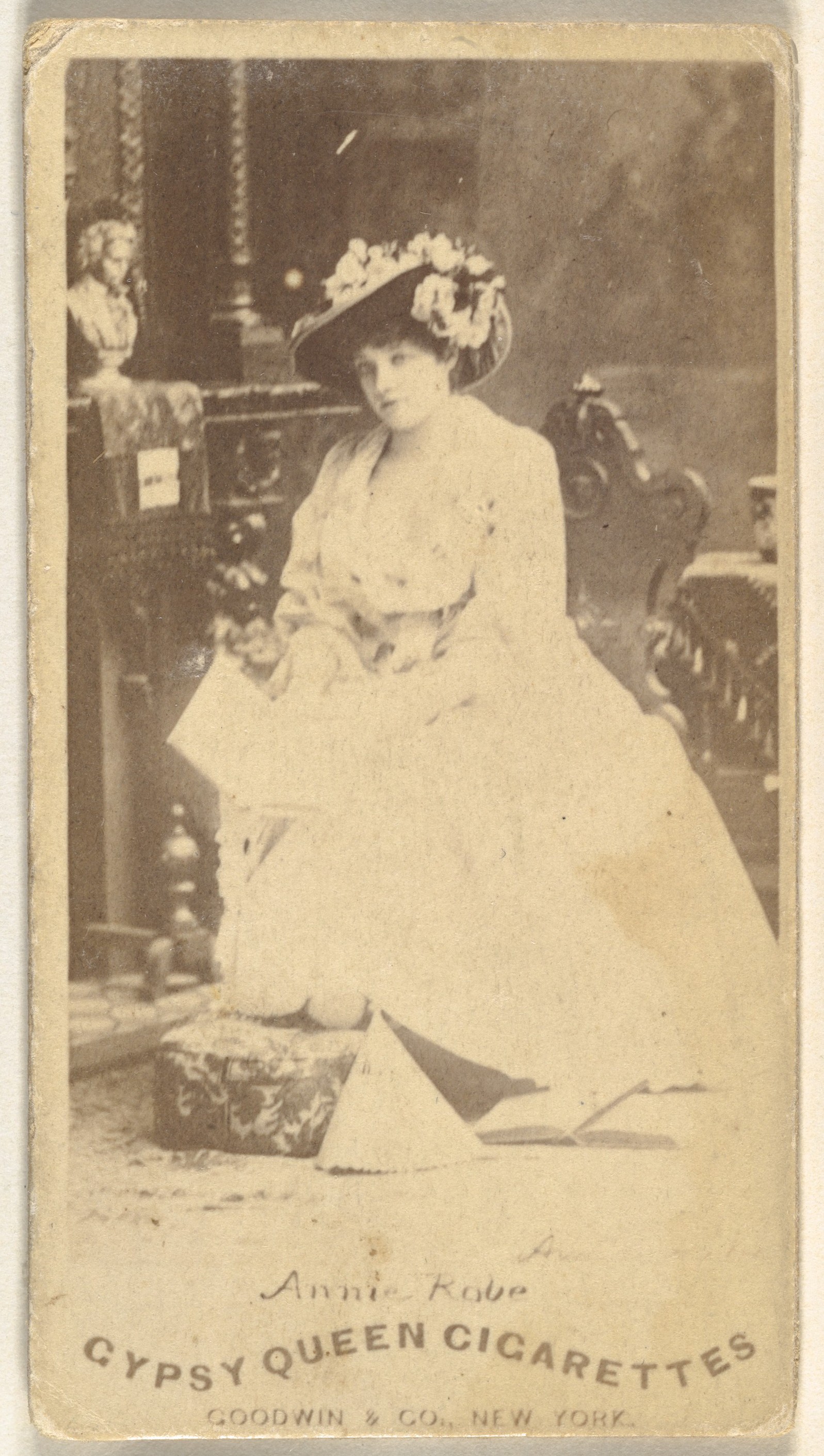
The Annie Robe, from the Actors and Actresses series (N171) for Gypsy Queen Cigarettes, presents a compelling case study in the intersection of late 19th-century commercial photography, theatrical identity, and the nascent language of haute couture. As a standalone study captured on an albumen photograph, this artifact transcends its ephemeral purpose as a trade card to become a rich document of sartorial storytelling. The subject, Annie Robe, is not merely a performer; she is a vessel for a constructed persona, one that leverages the visual codes of the stage to assert a specific form of glamour and exoticism. This analysis will dissect the garment, the pose, and the medium to understand how this image functions as a curated statement of global heritage and personal branding within the rigid confines of Victorian visual culture.
The Photographic Medium as a Couture Canvas
The choice of albumen print is not incidental but integral to the analysis. This process, dominant from the 1850s to the 1890s, offered a warm, sepia-toned palette that imbued the subject with a sense of timelessness and even nobility. The glossy surface, achieved by binding the light-sensitive silver to a paper coated with egg white, created a luminous effect that enhanced the texture of fabrics and the sheen of jewelry. For a subject like Annie Robe, this medium transforms a simple studio portrait into a stage. The light, likely from a northern window or early artificial source, is diffused, creating soft shadows that model her form and the folds of her costume. The photograph does not simply document; it elevates. The lack of a complex backdrop or props forces the viewer’s eye directly onto her attire and expression, making the garment itself the primary narrative device. This is a standalone study in the truest sense—the Annie Robe is the entire production.
Deconstructing the Garment: A Synthesis of Global Heritage
The costume worn by Annie Robe is a masterful synthesis of global heritage, a deliberate amalgamation of signifiers designed to evoke the exotic and the theatrical. The silhouette is distinctly late Victorian—a tightly corseted waist, a full, bell-shaped skirt, and a high neckline. Yet, the details subvert this Western foundation. The fabric appears to be a heavy, possibly silk or velvet, in a deep, dark hue, perhaps burgundy, navy, or black, which photographs as almost impenetrable shadow. This darkness serves as a canvas for the applied embellishments.
The most striking feature is the elaborate appliqué and embroidery. Intricate floral or geometric motifs, reminiscent of Ottoman or Mughal design, cascade from the shoulder to the hem. These are not subtle; they are bold, metallic threads—likely gold or silver—that catch the light, creating a shimmering effect against the dark ground. This is a direct reference to the Orientalism so popular in 19th-century theater and fashion. Designers like Paul Poiret would later champion this aesthetic, but here, in the 1880s or 1890s, Annie Robe is already embodying a fantasy of the East, a costume that signifies mystery, sensuality, and opulence. The sleeves are a hybrid: a fitted upper arm with a dramatic, pagoda-style cuff that flares out, possibly trimmed with fur or a deep fringe. This fusion of a Western tailored sleeve with an Eastern-inspired cuff underscores her character’s liminal identity—neither fully Victorian nor fully exotic, but a performed hybrid.
The Pose and the Performance of Power
Annie Robe’s posture is one of controlled authority. She stands three-quarter view, her body slightly angled away from the camera, but her gaze is direct, confronting the viewer. Her chin is lifted, a gesture of confidence that borders on defiance. One hand rests lightly on a prop—perhaps a chair back or a pedestal—while the other is placed on her hip, a classic pose of ownership and self-possession. This is not the demure, downward gaze typical of Victorian female portraiture. Instead, it is the stance of a leading lady, a star who commands attention.
The costume reinforces this power. The high collar, likely boned, forces her posture to be rigid, aristocratic. The weight of the fabric and the embellishment anchors her to the ground, making her appear formidable. There is no softness here; every line is deliberate. The Gypsy Queen Cigarettes branding is absent from the image itself, but the association is potent. The “Gypsy Queen” archetype—a free-spirited, passionate, and exotic figure—is directly channeled through Annie Robe’s attire. She is not a passive object of desire; she is the queen of her own narrative, using her costume as armor and as a declaration of her unique heritage.
The Context of the Standalone Study in Commercial Culture
To fully appreciate the Annie Robe, one must consider its commercial context. These albumen photographs were collectible trade cards, inserted into cigarette packages to encourage brand loyalty. They were the social media avatars of their day—bite-sized, visually arresting, and designed to be circulated. The Actors and Actresses series (N171) capitalized on the public’s fascination with the stage, offering a glimpse into a world of glamour and fantasy. For a woman to be featured in such a series was a mark of professional achievement, a sign that she had “made it.”
Yet, the standalone study format is key. Unlike group shots or scenes from a play, this portrait focuses entirely on Annie Robe as an individual brand. Her costume is not merely a theatrical outfit; it is her signature. The garment becomes a visual shorthand for her persona, a way to be instantly recognizable. In an era before mass media, this photograph served as her calling card, her portfolio, and her advertisement, all in one. The global heritage elements—the Eastern embroidery, the exotic silhouette—were carefully chosen to differentiate her from the hundreds of other actresses vying for attention. She is selling not just a product (cigarettes) but an image of cosmopolitan sophistication and artistic daring.
Conclusion: The Enduring Legacy of the Image
The Annie Robe from the Gypsy Queen Cigarettes series is far more than a historical curiosity. It is a sophisticated piece of visual branding that anticipates modern celebrity culture. By merging a Western photographic medium with a costume that draws on global heritage, the image creates a powerful, hybrid identity. The albumen print’s luminosity, the garment’s opulent details, and the subject’s commanding pose all work in concert to produce an icon of performed exoticism. For Katherine Fashion Lab, this analysis reveals that the language of couture has always been one of narrative construction. Annie Robe’s dress is not just fabric and thread; it is a statement of ambition, a claim to a place in the pantheon of stars. In the quiet, sepia-toned stillness of this photograph, we witness the birth of the modern fashion icon—a figure who understands that to be seen is to be remembered, and that the right garment can speak louder than any line of dialogue. This is the essence of couture: the art of transforming cloth into identity, and identity into legend.