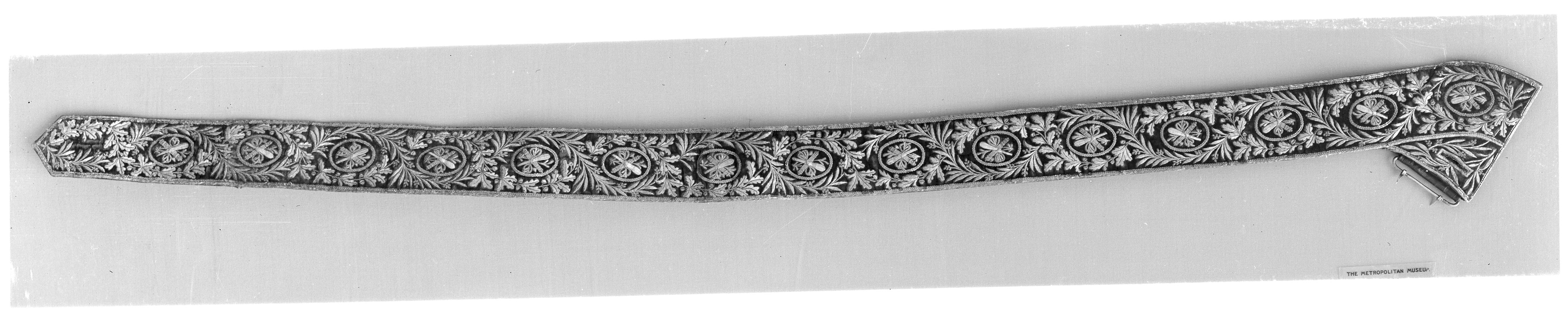
The Sword Belt: A Study in French Couture Artistry
In the rarefied world of haute couture, where every stitch is a statement and every material a manifesto, the sword belt emerges as a singular artifact of power, precision, and poetic restraint. At Katherine Fashion Lab, we approach this accessory not merely as a functional object but as a standalone study in the dialogue between tradition and modernity. Originating from French ateliers, this piece—crafted from rich leather, sumptuous velvet, and luminous silver thread—transcends its martial heritage to become a symbol of sartorial authority. This analysis dissects the sword belt’s material lexicon, structural elegance, and cultural resonance, offering a lens into how French couture elevates the utilitarian into the extraordinary.
The Material Trinity: Leather, Velvet, and Silver Thread
The foundation of any couture piece lies in its materiality, and the sword belt presents a triumvirate of textures that speak to both durability and decadence. Leather, sourced from the finest French tanneries, provides the belt’s core structure. Its grain is smooth yet resilient, suggesting a history of meticulous tanning processes that honor centuries of artisanal knowledge. The leather’s deep, almost black hue—achieved through natural dyes—offers a grounding anchor, evoking the strength of a cavalry officer’s regalia while remaining supple enough to contour to the wearer’s form. This duality is essential: the belt must bear weight without compromising comfort, a balance that only seasoned craftsmen can achieve.
Contrasting this robustness is velvet, applied as a subtle overlay along the belt’s inner edge or as a decorative panel. Velvet, with its plush nap and light-absorbing quality, introduces a tactile softness that tempers the leather’s austerity. In French couture, velvet has long been associated with regal opulence—think of the courts of Versailles—yet here it is used with restraint, as a whisper rather than a shout. The velvet’s deep burgundy or midnight blue, depending on the variant, creates a chiaroscuro effect against the leather, inviting the eye to linger on the belt’s contours. This interplay of hard and soft, matte and lustrous, is a hallmark of Katherine Fashion Lab’s design philosophy: to juxtapose opposites in pursuit of harmony.
The silver thread weaves through this composition like a narrative thread, embroidering motifs that range from geometric precision to floral flourishes. Silver, historically a metal of lunar symbolism and aristocratic distinction, is here rendered as thread—fine, malleable, yet unyielding in its brilliance. The embroidery, executed by hand in French ateliers, often features patterns inspired by medieval armorial bearings or Art Deco geometry. Each stitch is a deliberate act, with the silver catching light and casting micro-shadows that animate the belt’s surface. This is not mere decoration; it is a statement of intent. The silver thread transforms the belt from a utilitarian strap into a wearable artifact, one that commands attention without shouting.
Structural Integrity: The Architecture of the Sword Belt
A sword belt is, at its core, an engineering marvel. It must support the weight of a blade—historically a weapon of status and defense—while allowing freedom of movement. In this couture interpretation, the belt’s architecture is reimagined for the modern wearer, yet it retains the structural logic of its forebears. The belt is typically wide, ranging from three to five inches, ensuring even weight distribution across the hips or waist. The leather is reinforced with a hidden layer of stiffened canvas or horsehair, a technique borrowed from corsetry, to prevent sagging without sacrificing flexibility.
The buckle, often crafted from brass or silver-plated metal, is a focal point of design. Here, the silver thread embroidery extends to the buckle’s frame, where it intertwines with the leather to create a seamless transition between hardware and textile. The buckle’s mechanism—a prong-and-hole system or a more contemporary magnetic clasp—is engineered for ease of use, yet its aesthetic is deliberately archaic, evoking the chivalric codes of the past. This tension between function and form is resolved through precision: every rivet, every seam, every fold is executed with the exactitude of a Swiss watchmaker.
The belt’s length is adjustable, with multiple eyelets that allow for a customized fit. This adaptability is crucial, as the sword belt is designed to be worn over a variety of garments—from a tailored blazer to a flowing gown. The interior of the belt is lined with a soft suede or silk, preventing chafing and adding a layer of luxury that only the wearer can feel. This hidden detail underscores a key tenet of French couture: that true elegance lies in the unseen.
Cultural Resonance: From the Battlefield to the Runway
To understand the sword belt’s place in contemporary fashion, one must trace its lineage through French history. The sword belt, or ceinturon, was a staple of military dress from the Renaissance through the Napoleonic era, signifying rank and readiness. In the 19th century, it was adopted by civilian aristocrats as a marker of leisure and authority, often paired with frock coats and top hats. By the 20th century, the sword belt had been largely relegated to ceremonial use, its martial connotations softened by time.
Katherine Fashion Lab’s reinterpretation reclaims this accessory for the modern wardrobe, infusing it with a sense of empowerment that transcends gender and occasion. The belt is no longer a tool of war but a symbol of self-possession. When worn, it cinches the waist, creating an hourglass silhouette that flatters without constricting. It can be paired with a crisp white shirt and tailored trousers for a look of understated power, or layered over a velvet gown for a touch of dramatic flair. The silver thread embroidery, with its subtle sheen, catches the eye in low light, making the belt as suitable for evening galas as for daytime presentations.
This versatility is a testament to French couture’s ability to evolve while honoring its roots. The sword belt is, in essence, a conversation between past and present—a dialogue that Katherine Fashion Lab facilitates through meticulous craftsmanship and forward-thinking design. It is a piece that invites the wearer to consider their own relationship with authority, elegance, and identity.
Conclusion: The Sword Belt as a Standalone Study
In isolating the sword belt as a subject of analysis, we uncover the layers of artistry that define French couture. The leather, velvet, and silver thread are not mere materials but conduits of meaning, each contributing to a narrative of strength, softness, and luminosity. The structural integrity ensures that the belt is not just beautiful but functional, a testament to the atelier’s commitment to excellence. And the cultural resonance, from military origins to contemporary runway, speaks to the belt’s enduring relevance as a symbol of personal power.
At Katherine Fashion Lab, we believe that true couture is not about excess but about intentionality. The sword belt, in its refined form, embodies this philosophy. It is a standalone study in how a single accessory can encapsulate a world of history, technique, and emotion. For the discerning wearer, it is more than a belt—it is a declaration. And in that declaration, we find the essence of French artistry: timeless, deliberate, and utterly captivating.