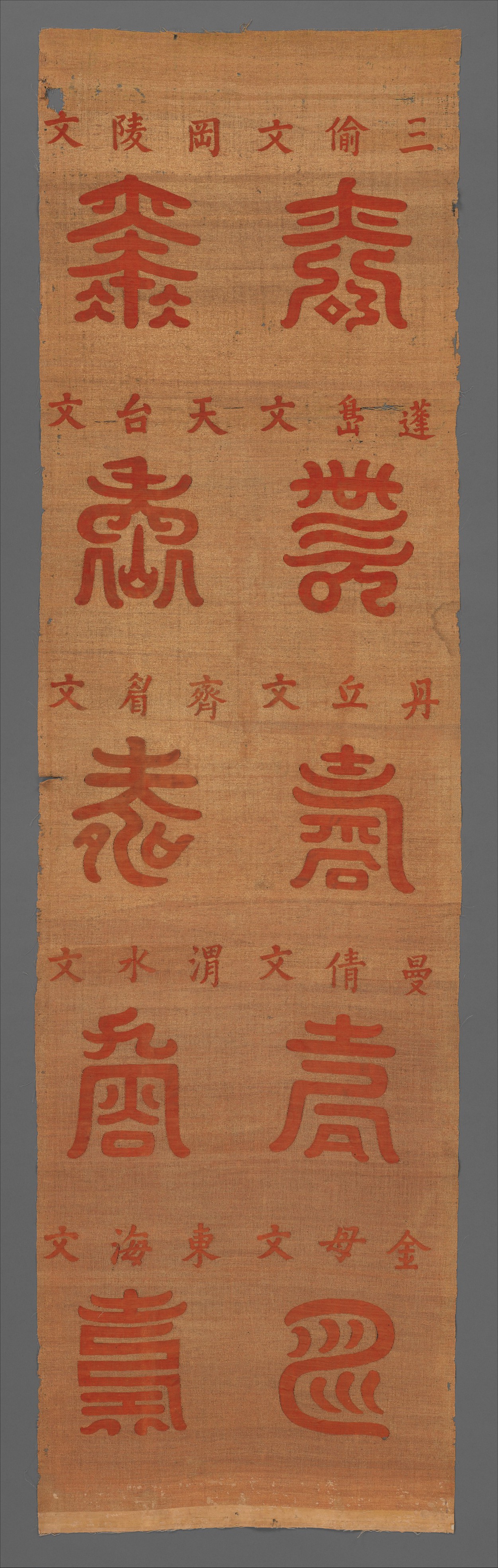
Decoding Eternity: The “Panel with Longevity (Shou) Characters” as a Masterpiece of Kesi Couture
In the rarefied domain of haute couture, where fabric is not merely a medium but a manifesto, the Panel with Longevity (Shou) Characters emerges as a transcendent artifact. Hailing from late imperial China, this standalone study—rendered in the exacting technique of kesi (silk and metal thread tapestry)—is far more than a decorative textile. It is a strategic convergence of material opulence, semiotic depth, and artisanal virtuosity. For the connoisseur of luxury, this panel represents a pinnacle of narrative textile design, where every thread weaves a philosophy of endurance, status, and cosmic harmony.
The Strategic Lexicon of Longevity
Deciphering the Shou Motif as Brand Identity
At the heart of this panel lies the Shou (壽) character, a Chinese logograph symbolizing longevity, immortality, and perpetual vitality. In the context of couture analysis, this symbol functions as a visual brand signature—a recurring motif that anchors the entire composition. Unlike Western heraldic symbols that often denote lineage or conquest, the Shou character embodies a universal aspiration: the desire for a life extended in grace and prosperity. For the elite patron of Qing-dynasty China, commissioning such a panel was an act of self-canonization, an assertion of one’s place within a continuum of ancestral legacy and future legacy.
The strategic deployment of the Shou character across the panel’s surface is not random. It is a calculated rhythmic repetition that creates a visual mantra. Variations in calligraphic style—from seal script to cursive forms—add a layer of intellectual sophistication. This is not mere decoration; it is a semiotic architecture designed to reinforce the message of durability. In luxury branding, such repetition builds recognition and emotional resonance. Here, it builds a universe of meaning around the concept of timelessness.
Kesi: The Engineering of Exclusivity
Material Alchemy: Silk and Metal Threads
The kesi technique, often translated as “cut silk” or “woven tapestry,” is a labor-intensive process that demands extraordinary precision. Unlike conventional weaving where the weft thread runs continuously across the warp, kesi employs a small shuttle technique that allows each color area to be woven independently. This creates distinct, unbroken color blocks with razor-sharp edges—a hallmark of the highest-quality kesi. The panel’s foundation is mulberry silk, prized for its luster, tensile strength, and ability to absorb natural dyes with unparalleled depth. The result is a fabric that feels weightless yet structurally resilient, akin to a haute couture gown’s internal architecture.
The inclusion of gilt metal threads elevates the panel from textile to treasure. These threads, typically made by wrapping silk filaments in gold or silver leaf, are woven into the background and the Shou characters themselves. The effect is a controlled luminosity—a shimmer that shifts with the angle of light, creating a dynamic interplay between opacity and brilliance. In a dimly lit chamber, the panel would have emitted a soft, regal glow, signaling the owner’s access to rare materials and master artisans. This is the couture equivalent of exclusive sourcing: a material story that cannot be replicated by mass production.
Technical Mastery as Status Marker
Every centimeter of this panel reflects an investment in human capital. A single kesi panel could take months or even years to complete, requiring a team of weavers with specialized knowledge of dye chemistry, thread tension, and pattern mapping. The precision of the Shou characters—their clean curves and uniform stroke widths—indicates the work of a master weaver who could translate a calligrapher’s brushstroke into a woven grid without loss of fluidity. This fusion of calligraphic art and textile engineering is a hallmark of imperial-grade couture, where the artisan’s hand is both invisible and omnipresent.
Contextualizing the Standalone Study
From Functional Object to Pure Art
The designation of this piece as a “standalone study” is critical. Unlike panels intended for robes, screens, or altar cloths, this object was likely created as an autonomous work of art—a textile painting meant for contemplation. In the context of a scholar’s studio or a private reception hall, it would have been displayed on a wall or mounted as a hanging scroll. This shift from functional to contemplative aligns with the modern couture practice of creating wearable art that transcends utility. The panel is not a garment, but it shares the same DNA: it is a statement piece that communicates identity without being worn.
This standalone status also implies a curatorial intention. The owner was not merely acquiring a decorative item; they were commissioning a philosophical object. The repeated Shou characters serve as a mnemonic device, prompting meditation on the nature of time, mortality, and legacy. In luxury terms, this is the ultimate experiential value: the panel does not just look beautiful; it enacts a worldview. It is a textile talisman, a woven prayer for continuity in a world of flux.
Couture Implications: Lessons for Modern Luxury
Narrative Density and Material Integrity
For the contemporary fashion house, the Panel with Longevity Characters offers a masterclass in narrative density. Every element—from the choice of motif to the weave structure—is laden with meaning. There is no empty ornamentation. This principle is increasingly vital in an era of conscious consumption, where clients demand that luxury goods carry stories of provenance, craftsmanship, and cultural resonance. The panel’s material integrity—its use of silk and metal without synthetic shortcuts—is a precursor to today’s emphasis on sustainable luxury. It reminds us that true opulence is not about excess but about precision and permanence.
The Art of Repetition as Branding
The strategic repetition of the Shou character anticipates modern branding strategies. Just as a luxury logo is repeated across a collection to reinforce identity, the Shou motif creates a visual echo that embeds the concept of longevity into the viewer’s subconscious. For a modern couturier, this suggests that motif-driven design—when executed with variation and depth—can elevate a garment from fashion to icon. The panel teaches us that repetition is not monotony; it is a ritual of meaning.
Conclusion: A Textile Testament to Timelessness
The Panel with Longevity (Shou) Characters is more than a historical artifact; it is a couture archetype. It embodies the ideals that define the highest echelons of fashion: artisanal mastery, material rarity, symbolic depth, and narrative cohesion. In its woven threads, we find a dialogue between the ephemeral and the eternal—a tension that lies at the core of all great design. For the Lead Curator of Katherine Fashion Lab, this panel stands as a benchmark for how textile art can communicate values that transcend time. It is not merely a study of longevity; it is longevity itself, rendered in silk and gold.