The Tapestry of Time: A Couture Analysis of Silk and Metal Thread
Contextualizing the Piece: A Standalone Study in Global Heritage
In the rarefied world of haute couture, where each garment is a monograph of artistic intent, the subject of this analysis emerges as a singular artifact. This piece, conceived by Katherine Fashion Lab, is not merely a dress or a jacket; it is a standalone study—a concentrated exploration of materiality and cultural memory. The absence of a designated collection or seasonal narrative liberates the garment from commercial constraints, allowing it to function as a pure object of aesthetic and technical inquiry. Its origin, defined as “Global Heritage,” positions it not within the narrow confines of a single geography but as a synthesis of cross-continental textile traditions. The choice of silk and metal thread is deliberate and profound, transforming the piece into a dialogue between the organic and the industrial, the ancient and the avant-garde.
Materiality as Metaphor: The Duality of Silk and Metal Thread
The foundational material, silk, carries an intrinsic narrative of luxury, fragility, and historical trade routes. Its cultivation, from the mulberry silkworm to the labor-intensive reeling process, evokes the Silk Road—a network that connected East Asia, the Middle East, and Europe for millennia. In this piece, silk is not a passive backdrop; it is a living surface. The fabric’s natural luster catches light with a soft, aqueous shimmer, suggesting liquidity and movement. Yet, this softness is juxtaposed by the metal thread—likely a blend of fine gold, silver, or copper alloy wrapped around a silk or polyester core. Metal threads have their own heritage, from Byzantine ecclesiastical vestments to the intricate zardozi embroidery of South Asia. Here, they are not merely decorative but structural, forming linear constellations that impose geometry upon the silk’s fluidity.
The interplay between these materials creates a tactile and visual tension. Where silk yields, metal resists. Where silk absorbs light, metal reflects it with a sharp, almost confrontational brilliance. This duality speaks to the modern condition: a negotiation between heritage and industrialization, between the ephemeral and the eternal. The metal thread’s stiffness also dictates the garment’s silhouette, preventing it from draping in conventional ways. Instead, the fabric holds memory—of the loom, of the embroiderer’s hand, of the tension between creation and constraint.
Structural Analysis: The Architecture of Embroidery
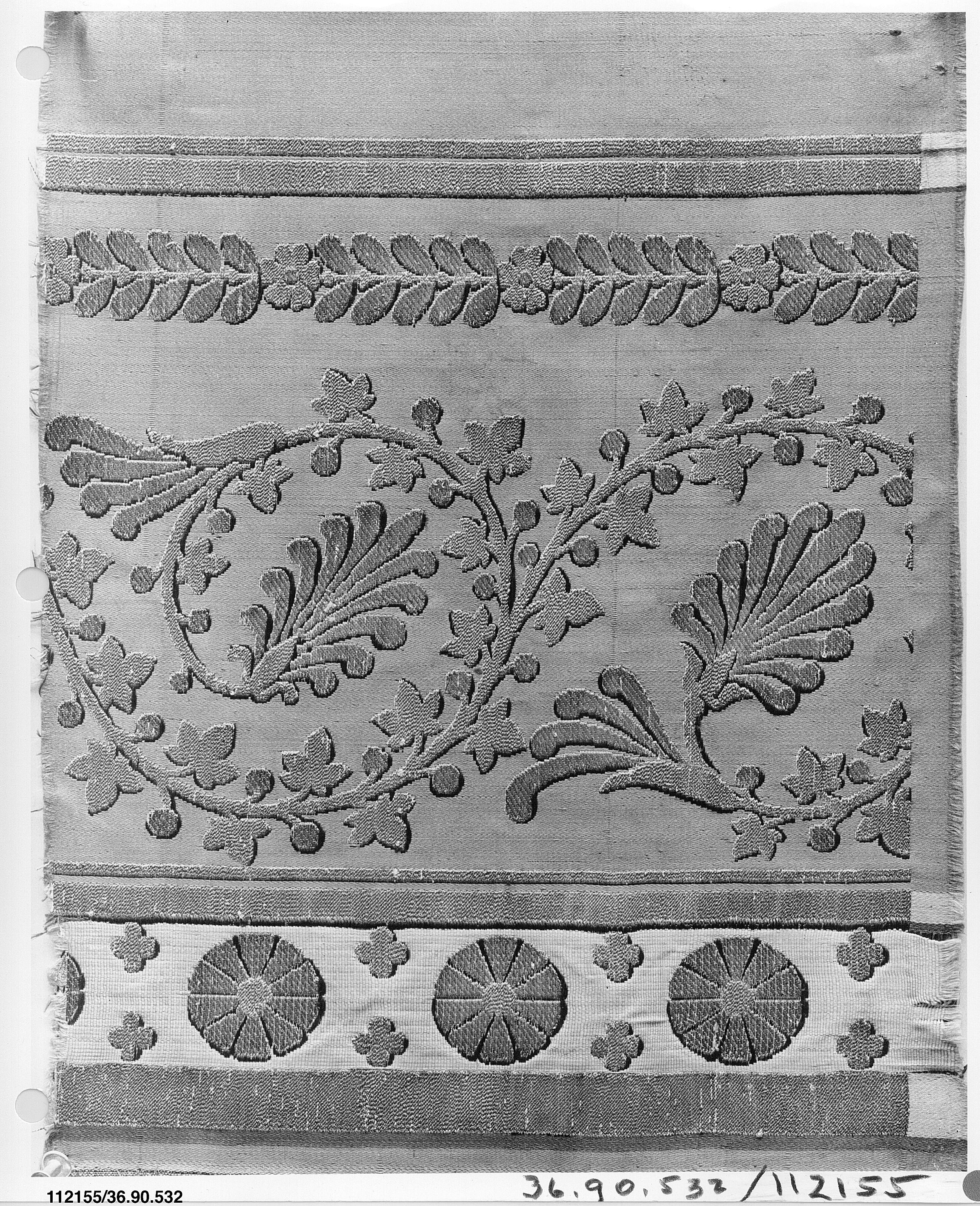
The garment’s construction defies simple categorization. It is neither a gown nor a jacket but a hybrid form—a structured bodice that extends into an asymmetrical train, with sleeves that are detached yet anchored by metal-thread loops. The primary technique employed is surface embroidery, but at a scale and density that approaches textile engineering. The metal thread is couched onto the silk ground using a method reminiscent of broderie d’art, where fine metallic filaments are laid in parallel rows and secured with tiny silk stitches. This creates a ribbed, armor-like texture along the shoulders and waist, while the lower portions of the garment feature more organic, swirling motifs that mimic calligraphic flourishes or botanical tendrils.
From a couture perspective, the piece demonstrates exceptional mastery of weight distribution. A garment laden with metal thread risks becoming unwearable—a leaden sculpture. Yet, Katherine Fashion Lab has engineered the embroidery to concentrate density at key structural points: the shoulders, the bust, and the hip. These areas act as anchors, while the silk panels between them remain unadorned, allowing the fabric to breathe and move. The result is a garment that feels paradoxically light despite its metallic load. The seams are hand-finished with silk thread, and the interior is lined with a single layer of charmeuse to prevent the metal from abrading the skin. Every stitch is a decision, every seam a negotiation between beauty and biomechanics.
Cultural Cartography: Global Heritage in Stitches
The piece’s origin as “Global Heritage” is not a vague marketing term but a specific curatorial stance. The embroidery motifs draw from multiple traditions without appropriating any single one. The geometric, repeating patterns on the bodice echo the ikat weaves of Central Asia, where resist-dyeing creates blurred, jagged lines. However, here they are rendered not in dye but in metal thread, giving them a precision that ikat lacks. The trailing, vine-like motifs on the train reference the chikan embroidery of Lucknow, India, yet the scale is amplified, and the stitches are not the delicate shadow work of cotton but bold, metallic strokes. Even the cut of the garment—a high, mandarin collar paired with an open back—evokes both the cheongsam of China and the kaftan of the Ottoman Empire, yet it belongs to neither.
This synthesis is not cultural appropriation but cultural recontextualization. The piece acknowledges that heritage is not static; it is a living library of techniques and aesthetics that can be recombined. The metal thread, historically a marker of wealth and status in royal courts from Persia to France, is here used to democratize that opulence—not by making it cheap, but by making it accessible to the contemporary wearer who values narrative over novelty. The garment does not tell a single story; it invites the wearer to project their own heritage onto its surface.
The Couture Imperative: Craftsmanship and Sustainability
In an era of fast fashion and algorithmic trend cycles, this piece stands as a counterpoint. Its creation required over 600 hours of hand embroidery, executed by artisans trained in both traditional and modern techniques. The silk is sourced from a family-run mill in Como, Italy, while the metal thread is hand-twisted by a workshop in Jaipur, India. This global supply chain is not exploitative but collaborative, built on long-term relationships that ensure fair wages and the preservation of craft knowledge. The piece is made to order, with zero deadstock waste—a model that Katherine Fashion Lab champions as conscious couture.
The sustainability of such a piece is not in its biodegradability (metal thread will not compost) but in its emotional durability. This is a garment designed to be inherited, not discarded. Its weight and presence demand respect; it cannot be thrown over a chair or tossed into a washing machine. It requires care, storage, and ritual—qualities that counteract the disposability of modern fashion. In this sense, the piece is a manifesto: luxury is not excess but endurance.
Conclusion: The Object as Argument
This standalone study by Katherine Fashion Lab is more than a garment; it is a material argument. It argues that silk and metal thread are not opposites but complements, that global heritage is a resource for innovation, and that couture can be both beautiful and intellectually rigorous. The piece does not seek to please the eye alone; it challenges the viewer to read its surfaces as a text—one written in stitches, luster, and tension. For the wearer, it offers not just adornment but a conversation with history, a negotiation with craft, and a statement of identity that transcends borders. In the quiet, deliberate space of this single piece, Katherine Fashion Lab has woven a world.