Heritage Analysis: Courtiers in a Rose Garden – A Strategic Lens for Katherine Fashion Lab
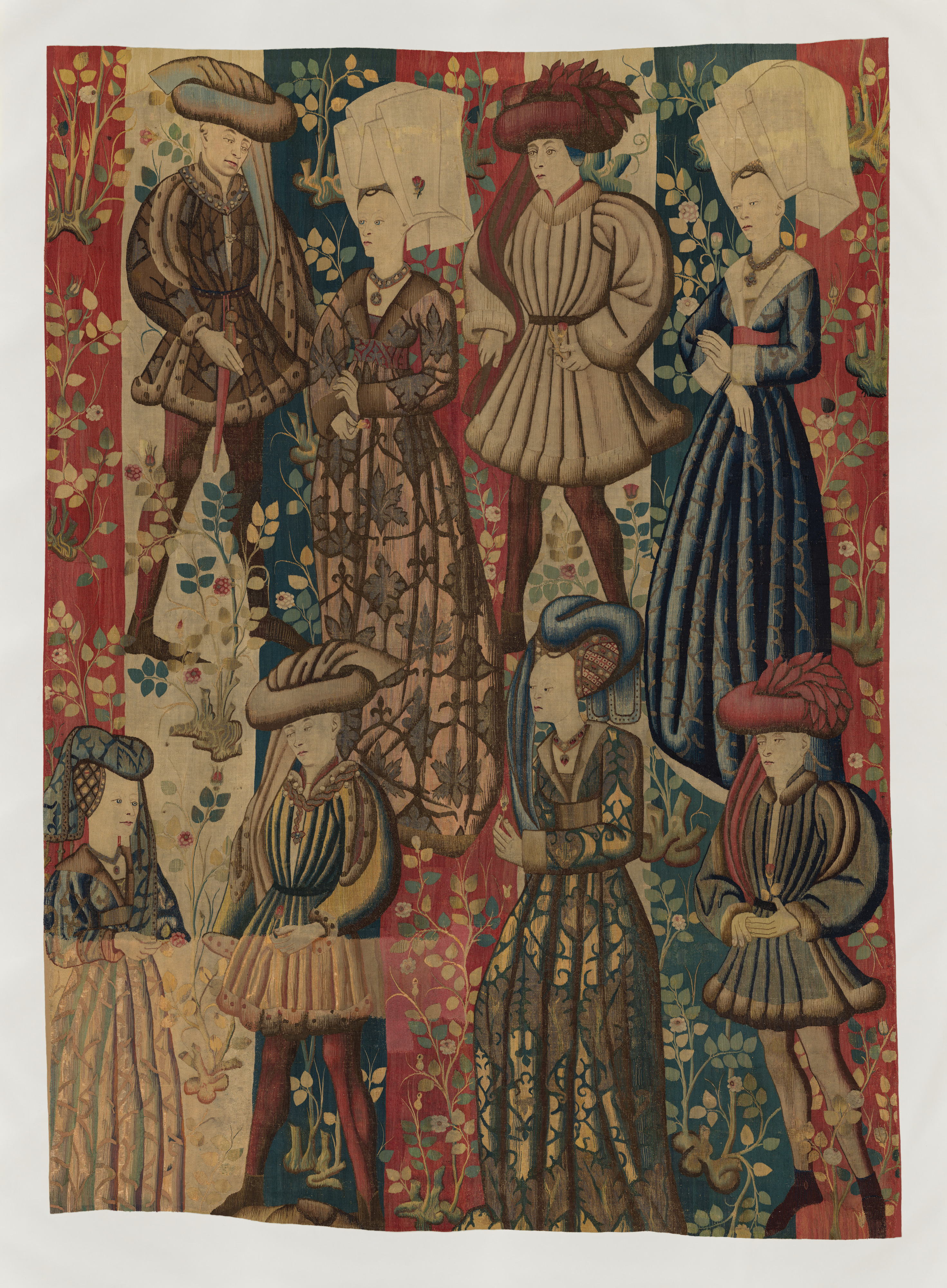
This paper presents a standalone heritage analysis of the South Netherlandish tapestry, Courtiers in a Rose Garden: Four Gentlemen and Four Ladies, executed in wool warp, wool, silk, and metallic weft yarns. Commissioned as a strategic research asset for Katherine Fashion Lab, the analysis decodes the work’s symbolic power, historical adornment, and spiritual meaning, culminating in a forward-looking 2026 high-end luxury strategy. The tapestry, a relic of late medieval courtly culture, offers a rich lexicon of visual codes that can inform contemporary brand narratives, material storytelling, and experiential luxury.
Symbolic Power: The Rose Garden as a Microcosm of Courtly Authority
The rose garden in this tapestry is not a mere backdrop but a deliberate spatial construct of power. The enclosed garden, or hortus conclusus, was a potent symbol in both secular and sacred contexts. In the courtly sphere, it represented a controlled, exclusive environment where social hierarchies were performed and reinforced. The presence of four gentlemen and four ladies, arranged in symmetrical, dignified postures, suggests a ritualized display of aristocratic harmony and mutual obligation. The rose itself—a flower of the Virgin Mary, of love, and of dynastic bloodlines—serves as a dual signifier: divine favor and earthly lineage.
For Katherine Fashion Lab, this symbolic architecture translates directly into luxury brand strategy. The garden functions as an exclusive ecosystem—a metaphor for the brand’s curated clientele, where each garment or accessory is a sign of belonging. The symmetry of the courtiers implies a balance of power and grace, a quality that high-end consumers seek in their personal presentation. The metallic weft yarns, catching light, underscore the interplay of visibility and opulence, reinforcing that true luxury is both seen and felt as a form of social currency.
Historical Adornment: Weaving Status and Identity
The tapestry’s medium—wool warp with wool, silk, and metallic weft yarns—is itself a statement of technological and economic prowess. Silk, imported from the East, was a luxury fiber reserved for the elite; metallic threads, often silver-gilt, signified wealth and access to global trade routes. The courtiers’ garments are rendered with meticulous detail: fur-lined hems, jeweled collars, and elaborate headdresses. The gentlemen wear houppelandes (long, full-bodied gowns) with dagged sleeves, while the ladies sport hennins (conical headdresses) and brocaded kirtles. These elements are not decorative but functional markers of rank, occupation, and marital status.
From a strategic standpoint, Katherine Fashion Lab can draw on this historical adornment to inform a 2026 collection that prioritizes material integrity and narrative depth. The use of silk and metallic threads in the tapestry suggests a return to artisanal, labor-intensive techniques. A luxury strategy could involve partnering with heritage weaving mills in Flanders or France to produce limited-edition fabrics that echo the tapestry’s texture and luminosity. The headdresses and collars, reimagined as sculptural accessories, offer a bridge between historical silhouette and modern minimalism. This approach aligns with the growing demand for “slow luxury”—pieces that carry a story of provenance and craftsmanship.
Spiritual Meaning: The Rose as a Portal to Transcendence
Beyond its social function, the rose garden carries profound spiritual meaning. In late medieval Christianity, the rose was a symbol of the Virgin Mary’s purity and the Passion of Christ. The red rose signified martyrdom and divine love; the white rose, virginity and grace. The garden itself evoked the Paradise Garden, a liminal space between earth and heaven where courtly love and divine love intertwined. The courtiers’ serene expressions and restrained gestures suggest a state of spiritual contemplation, a reminder that earthly beauty is a reflection of heavenly order.
For Katherine Fashion Lab, this spiritual dimension offers a differentiation point in a saturated luxury market. The 2026 strategy can incorporate ritual and mindfulness into the brand experience. For example, a flagship store could be designed as a “rose garden” sanctuary, with scent diffusers using rose absolute, ambient soundscapes of medieval choral music, and interactive displays that explain the symbolic language of flowers. The garments themselves could be infused with subtle rose motifs—embroidered, woven, or printed in metallic inks—as talismans of protection and grace. This approach appeals to the modern consumer’s desire for emotional resonance and spiritual well-being, moving beyond pure aesthetics to a deeper sense of belonging.
2026 High-End Luxury Strategy: From Tapestry to Totem
The tapestry’s strategic value for Katherine Fashion Lab lies in its ability to serve as a totemic artifact—a single, powerful image that encapsulates the brand’s ethos. The 2026 strategy should be anchored in three pillars: Exclusivity, Artisanship, and Transcendence.
Exclusivity
Just as the rose garden was accessible only to courtiers, Katherine Fashion Lab must cultivate a sense of guarded intimacy. This can be achieved through invitation-only trunk shows, private viewings of the tapestry as a brand artifact, and a membership program that offers early access to collections. The tapestry’s four couples suggest a model of curated relationships—limit the number of VIP clients to create a true inner circle.
Artisanship
The tapestry’s medium—wool, silk, and metallic yarns—should inspire a material manifesto. For 2026, launch a “Weaving Heritage” capsule collection that uses only natural fibers and hand-finishing techniques. Collaborate with a master weaver to reproduce a section of the tapestry as a wearable scarf or shawl, priced at a premium that reflects its labor. This positions the brand as a guardian of dying crafts, appealing to connoisseurs who value authenticity over novelty.
Transcendence
The spiritual meaning of the rose garden offers a pathway to experiential luxury. In 2026, host a series of “Garden Meditations” in partnership with a wellness retreat, where clients can engage with the tapestry’s symbolism through guided visualization and floral design workshops. The brand’s visual identity can incorporate the tapestry’s color palette—deep crimson, verdant green, and burnished gold—as a signature code. This creates a holistic brand universe where every touchpoint, from packaging to pop-up events, echoes the tapestry’s serene authority.
Conclusion
The Courtiers in a Rose Garden tapestry is more than a historical artifact; it is a strategic template for Katherine Fashion Lab’s 2026 high-end luxury positioning. By decoding its symbolic power, historical adornment, and spiritual meaning, the brand can craft a narrative of exclusive belonging, artisanal integrity, and transcendent experience. In a market driven by fleeting trends, the tapestry’s enduring elegance offers a timeless foundation for a luxury house that seeks not just to dress its clients, but to ennoble them.