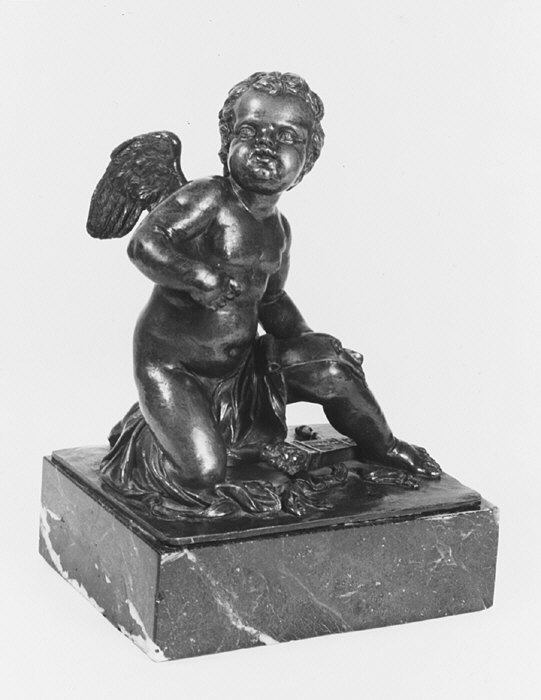
Executive Summary: Cupid as a Foundational Archetype for Luxury Strategy
This heritage analysis deconstructs the archetype of Cupid, tracing its evolution from a primordial force in ancient civilization to a potent vector for contemporary luxury strategy at Katherine Fashion Lab. Moving beyond the trivialized Renaissance cherub, we excavate the deity's origins in the Bronze Age, where he was known as Eros in Greece, a cosmogonic power of creation and union. Cast in bronze—the medium of gods, heroes, and sacred contracts—this figure embodies a complex duality: destructive desire and generative love, chaotic impulse and binding order. This analysis positions Cupid not as a mere motif, but as a systemic symbol whose historical resonance directly informs a 2026 high-end strategy centered on emotional alchemy, symbolic weight, and the curation of profound personal narratives.
I. Archaeological Excavation: Cupid in Bronze – The Medium is the Covenant
The specification of Bronze as the medium is not incidental; it is the core of the archetype's initial authority. In ancient civilizations, bronze was more than an alloy; it was a technological and spiritual pinnacle. Reserved for deities, rulers, and the most sacred ceremonial objects, its casting process—involving earth, fire, and skilled artifice—was itself an alchemical act. A bronze Eros/Cupid was not a decoration but a manifestation of a fundamental, untamable cosmic principle. The material conveys permanence, value, and solemnity. Unlike fleeting gold or fragile clay, bronze acquires a patina, a narrative of its own journey through time, mirroring how love itself is tempered and transformed by experience. This inherent historical adornment speaks to luxury that is earned, layered, and authentically aged by narrative, not artificially distressed.
Symbolic Power & Spiritual Meaning: The Duality of the Archetype
The ancient Eros, as depicted in early poetry and fragments, was a formidable, often terrifying force. He was a primeval deity who orchestrated the union of opposing elements to generate life and cosmos. His power was twofold: an irresistible, chaotic urge that could destabilize the mind and society (the "bitter-sweet" anguish of desire), and a profoundly ordering, creative principle that forged unbreakable bonds (the foundation of family, community, and philosophical harmony). This duality is the archetype's true symbolic power. He represents the transformative moment where raw impulse is alchemized into lasting connection, where vulnerability becomes strength. Spiritually, he mediates between the human and the divine, the physical and the transcendent, making the experience of love a sacred, world-shaping event.
II. Historical Resonance & DNA Correlation: The Connective Tissue of Form and Function
The research context references a DNA correlation with studies on Rock in the form of a fantastic mountain and Jar in the shape of a bronze container (hu). This methodological parallel is critical. It reveals that disparate objects—a natural rock sculpted into a symbolic landscape and a ceramic vessel mimicking a prestigious bronze form—share a deeper logic: the embodiment of aspiration and containment. The mountain rock represents reaching for the sublime, the transcendent peak. The hu jar is a vessel for precious contents, a container of ritual substance. Cupid in bronze perfectly synthesizes this duality. He is the aspiration (the upward flight, the reach for the unattainable beloved, the sublime ideal of love) and the container (the binding covenant, the tangible bond, the "vessel" of a shared emotional world). This correlation instructs us to look beyond superficial aesthetic and identify the underlying psychic functions that objects serve: connection, transcendence, and the sacred holding of value.
From Ancient Adornment to Modern Talisman
Historically, adornment featuring Eros/Cupid was never merely pretty; it was talismanic. A fibula (brooch) depicting the god secured a garment but also invoked his power to secure bonds. A signet ring with his image sealed contracts in both a legal and a spiritual sense. This transforms the concept of jewelry and wearable objects from accessory to instrument—a personal artifact charged with intentionality. For the contemporary luxury client, this translates to pieces that are active participants in the wearer's narrative, designed not just to be seen, but to do something: to commemorate, to protect, to vow, to empower a specific intention.
III. Strategic Integration: The 2026 High-End Luxury Strategy
For Katherine Fashion Lab's 2026 trajectory, the Cupid archetype provides a robust framework to transcend seasonal trends and engage with the growing consumer demand for meaning, depth, and emotional intelligence in luxury. The strategy is built on three pillars derived from the analysis:
Pillar 1: Emotional Alchemy & The Duality Collection
Develop collections that explicitly reference the dual nature of the archetype. This is not about literal representation, but material and conceptual storytelling. Utilize the patina of bronze alongside polished platinum or gold, symbolizing the raw and the refined aspects of connection. Designs should balance sharp, arrow-like lines (piercing desire, decisive choice) with encircling, embracing forms (secure bonds). Narrative marketing will frame pieces as for "The Commitment and The Craving," appealing to the full spectrum of human connection.
Pillar 2: The Modern Talisman & Bespoke Narratives
Launch a high-jewelry and object-based program, "The Covenants," focused on limited-edition and bespoke pieces that function as contemporary talismans. Each piece is co-created with the client around a specific intention—a union, a personal conquest, a creative genesis. The process mirrors the sacred casting of bronze, involving client storytelling, symbolic material integration (e.g., incorporating a personal metal fragment), and ritualistic presentation. This transforms the client from buyer to patron and participant in a mythic process.
Pillar 3: Patina of Experience & Legacy Branding
Shift the value proposition from "new" to "profound." Leverage the archetype's ancient roots to position the brand as a curator of timeless human stories, not a manufacturer of products. Marketing and client experiences should evoke the historical resonance of the objects studied: the aspirational mountain and the containing vessel. VIP experiences could involve private archaeological viewings or philosophical salons on the nature of desire and creation. The brand itself becomes the "bronze container," holding and giving form to the most precious contemporary narratives, acquiring its own patina of cultural credibility.
Conclusion: The Archetype Cast Anew
The Bronze Cupid, analyzed through the lens of symbolic power and historical resonance, offers Katherine Fashion Lab a profound strategic resource. He is a metaphor for the brand's own mission: to be the force that connects raw creative impulse to lasting cultural form, to transform fleeting desire into legacious objects of meaning. By channeling this archetype's primordial duality, spiritual gravity, and talismanic history, the 2026 strategy can position the Lab not merely as a fashion house, but as a modern atelier of emotional archaeology, crafting the sacred instruments for the human narrative. The goal is to create pieces that, like the ancient bronze, are cast not just in metal, but in time and significance.