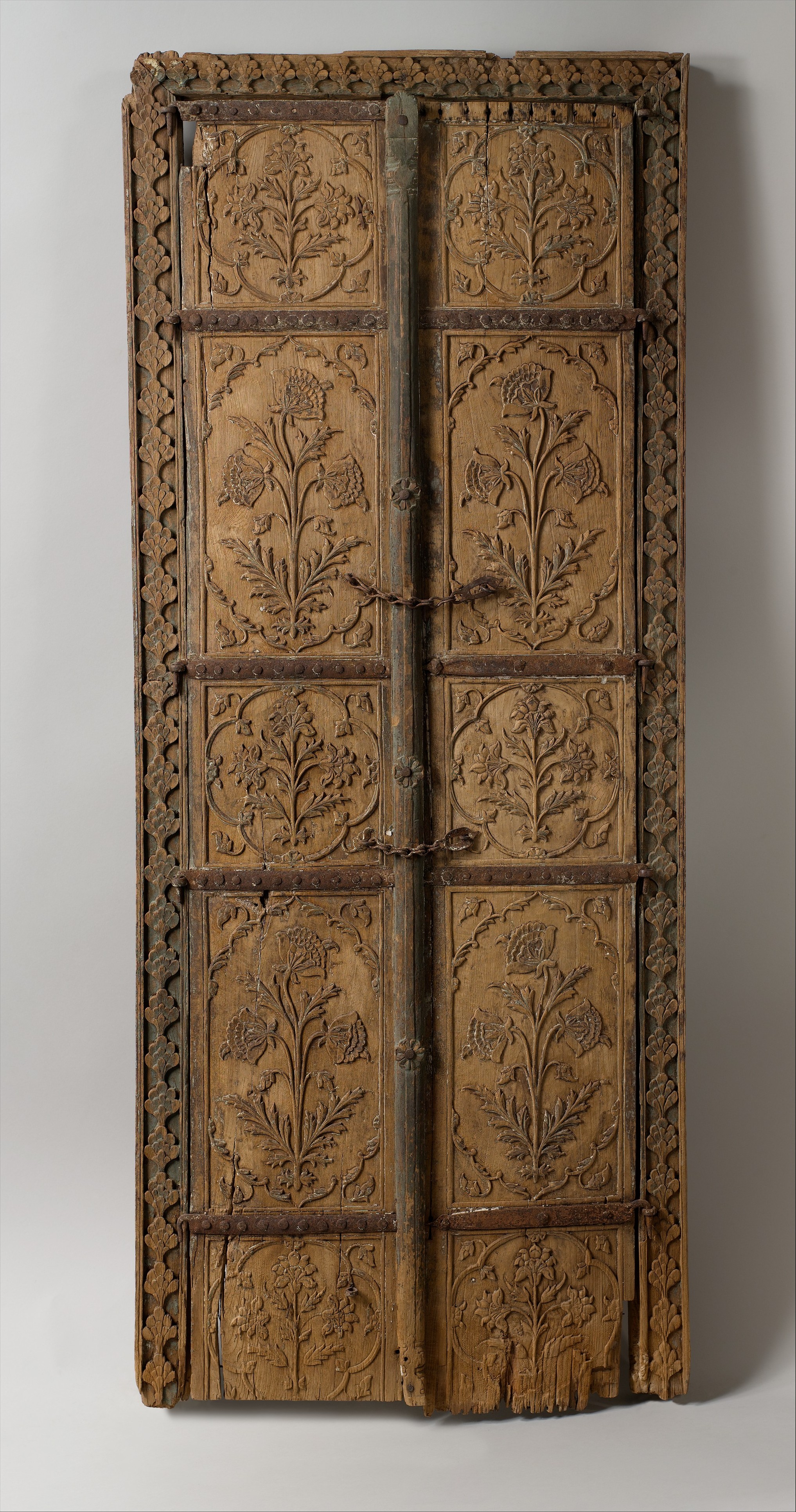
The Art of Entrance: Deconstructing the Pair of Flower Style Doors
In the rarefied world of haute couture, inspiration rarely emerges from the expected. At Katherine Fashion Lab, our latest investigation transcends the conventional boundaries of textile and silhouette to explore an artifact of profound structural and symbolic resonance: a Pair of Flower Style Doors. Sourced from the vast, intangible archives of Global Heritage, these doors are not merely functional objects but a masterclass in narrative construction, material integrity, and the poetry of decay. Carved from solid wood and bearing the ghostly residues of paint, this standalone study offers a compelling framework for reimagining the very essence of garment architecture.
Materiality as a Narrative Force
The first and most arresting dialogue with this piece is its materiality. The wood, likely a dense, slow-growing species such as teak or rosewood, speaks to a lineage of craftsmanship that predates industrial precision. Each carved petal and stem is not the result of a machine’s repetitive motion but of a human hand negotiating grain, density, and time. For the couturier, this is a profound lesson in tactile storytelling. The wood’s surface is a palimpsest—a layered history of touch, weather, and ritual. The residues of paint, now faded to whispers of vermilion, indigo, and ochre, are not imperfections but chromatic memories. They suggest a former life of vibrancy, of ceremonies and thresholds crossed. In a Katherine Fashion Lab collection, this would translate to garments where fabric is treated as a living surface—where dye is allowed to pool, bleed, and erode, creating a visual chronology of wear. A silk organza gown might be hand-painted with mineral pigments that crack and shift with movement, echoing the door’s painted fissures. The weight of the wood becomes a structural principle: a bodice might be engineered with internal boning that mimics the door’s robust verticality, while the outer layer floats, unburdened, like the ghost of the paint.
Floral Morphology and Spatial Geometry
The “Flower Style” designation is deceptively simple. This is not a literal depiction of a single bloom but a complex, stylized grammar of flora. The carving reveals a sophisticated understanding of negative space. The petals are not fully rendered; they are implied through deep undercuts and sweeping curves that allow light to pass through. This interplay of solid and void is a direct analog to couture’s own dialectic between coverage and exposure. Consider a jacket where the sleeves are not continuous fabric but a series of laser-cut floral motifs, layered to create a trompe-l’oeil effect of depth. The door’s geometry is also distinctly axial and symmetrical, a common trait in Global Heritage artifacts from East Asian to Islamic design traditions. This symmetry is not static but rhythmic—a repetition of forms that guides the eye upward, creating a sense of ascension. In a gown, this translates to a bodice that spirals in a Fibonacci-like progression of embroidered blossoms, drawing the gaze from the waist to the collarbone. The doors’ vertical panels, often flanked by narrower side panels, suggest a tripartite structure that could inform a coat’s silhouette: a central, ornate section flanked by more restrained, flowing sides.
Patina and the Luxury of Impermanence
Perhaps the most radical couture insight from this study is the elevation of patina as a luxury value. In an industry obsessed with the pristine, the doors celebrate the beauty of degradation. The paint residues are not merely faded; they are chipped, flaking, and in some areas, completely absent, revealing the wood’s raw grain beneath. This is a visual and textural narrative of exposure—to sun, to humidity, to the hands of generations. For the fashion lab, this challenges the very notion of “finish.” A collection inspired by these doors would reject high-gloss perfection in favor of raw edges, uneven textures, and intentional weathering. Imagine a double-faced cashmere coat where the outer layer is hand-sanded to reveal the inner wool, creating a topographic map of wear. Or a skirt where the hem is not cut straight but left to fray, each thread a testament to time. The residues of paint, in particular, offer a chromatic strategy: color as residue. Rather than bold, uniform dye, garments would feature pigment applied in layers, then partially removed through abrading or washing, leaving only traces—a shoulder that holds a memory of blue, a sleeve that whispers of gold. This is the ultimate statement of refined taste: the acknowledgment that perfection lies in the acceptance of transience.
Threshold and Transition: The Garment as Portal
Functionally, doors are thresholds—they separate and connect spaces. This conceptual layer is deeply resonant for couture, where a garment is itself a boundary between the self and the world. The Pair of Flower Style Doors, standing alone as a study, invites us to consider the garment as a portable portal. The act of putting on a dress becomes an act of crossing from the private into the public, from the mundane into the ceremonial. The doors’ floral motifs, often symbols of fertility, beauty, and the cyclical nature of life, reinforce this transitional power. A Katherine Fashion Lab piece would be designed to transform the wearer’s posture and presence. The weight and structure of the wood suggest a garment that commands space—a cape with a pronounced collar that frames the face like a carved archway, or a train that unfurls behind the wearer like the two panels of the door swinging open. The act of walking becomes a ritual of passage, each step a hinge. The doors also remind us of the threshold of the body itself. The carvings, which often feature central blooms surrounded by smaller buds, mirror the body’s own hierarchies—the face as the primary bloom, the hands and feet as the buds. A couture interpretation might place the most intricate embroidery at the neckline, radiating outward in decreasing complexity, drawing the eye to the wearer’s expression as the ultimate focal point.
Conclusion: A Blueprint for the Future
The Pair of Flower Style Doors is not a mere decorative artifact; it is a comprehensive design manifesto. From its material honesty to its chromatic memory, from its geometric rhythm to its philosophy of threshold, it offers a lexicon for a new kind of couture—one that is deeply rooted in heritage yet radically forward in its embrace of impermanence. At Katherine Fashion Lab, we see these doors not as a source of direct reproduction but as a generative framework. They teach us that the most profound beauty is often found in what has been worn, weathered, and left behind. They remind us that a garment, like a door, is not an end but a beginning—an invitation to step through into a world of narrative, craft, and enduring elegance. This is the essence of our couture analysis: not to copy, but to translate the soul of an object into the language of the body.