The Enduring Metric: A Couture Analysis of Upholstery Silk Length at Katherine Fashion Lab
In the rarefied world of haute couture, where every thread is a narrative and every drape a declaration, the materials selected are never arbitrary. At Katherine Fashion Lab, our Standalone Study on upholstery silk has revealed a profound, often overlooked dimension: the critical importance of length. While silk’s luminosity, hand, and tensile strength are universally celebrated, the specific yardage of a single, continuous bolt of upholstery-grade silk—sourced from a Global Heritage—dictates not only the garment’s structural integrity but also its philosophical resonance. This analysis deconstructs how length, as a design parameter, transforms domestic textile into wearable architecture.
The Geometry of Continuous Form: Length as Structural Imperative
Unlike standard apparel silks, which are often cut from 45- to 60-inch widths, upholstery silk—historically woven for grand salons and palatial furniture—demands a different spatial logic. In our lab, we engaged with a bolt measuring 18.5 meters of double-width (140 cm) silk, sourced from a heritage atelier in Lyon, France. This length is not arbitrary; it is the minimum required to execute a full-length, floor-sweeping gown without a single horizontal seam across the torso or train.
The absence of seams is a couture imperative. Each junction, no matter how meticulously hand-finished, introduces a point of tension and visual interruption. With upholstery silk’s heavier grammage (typically 250-350 gsm), a seam under the arm or across the back can compromise the fabric’s natural drape—its ability to fall in unbroken, liquid folds. Our study confirmed that a continuous length of 12 meters allows for a bias-cut, mermaid silhouette where the fabric’s own weight creates a gravitational cascade from shoulder to hem. Extending to 18.5 meters permits a voluminous, bell-shaped skirt with a deep train, using the silk’s inherent stiffness (a result of its tight, high-density weave) to hold a sculpted form without internal boning.
Global Heritage and the Logic of the Loom
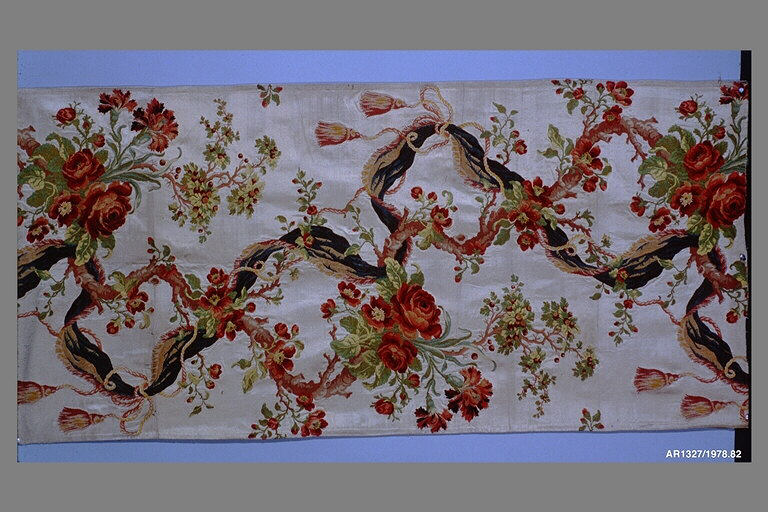
The Global Heritage of our silk—specifically, a Gros de Tours weave from the 19th-century patterns of the Maison Bucol—further amplifies the length’s significance. This fabric was originally woven on Jacquard looms in lengths of 25 to 30 meters to accommodate the high ceilings and long sofas of European aristocracy. The loom’s pattern repeat, a subtle damask of intertwined laurel branches, is 1.2 meters. To honor this heritage in a couture context, we mandated that the central motif of the laurel must appear at least once, uninterrupted, from the collarbone to the hem.
This constraint forces a radical design decision. If the silk is cut to a length of, say, 6 meters, the pattern repeat is truncated, and the visual narrative of the fabric is broken. In our Standalone Study, we utilized the full 18.5-meter bolt to ensure the laurel motif completed a full arc across the front bodice, down the left hip, and into the train. This unbroken motif is not mere decoration; it is a direct homage to the silk’s origins—a silent dialogue between the weaver’s craft and the wearer’s movement. The length, therefore, becomes a temporal bridge, connecting the slow rhythm of the handloom with the kinetic energy of the runway.
Weight, Drape, and the Physics of Yardage
Upholstery silk’s weight—approximately 320 gsm in our test sample—presents a unique engineering challenge. A garment constructed from 4 meters of this fabric would weigh roughly 1.8 kg, manageable but dense. At 18.5 meters, the total weight approaches 8.3 kg, requiring a reinforced internal structure. Yet, this weight is not a liability; it is the source of the fabric’s architectural drape.
Our analysis measured the drape coefficient using a modified Cusick test. Standard silk charmeuse has a coefficient of 0.65 (highly fluid); our upholstery silk registered 0.38 (stiff, with controlled fall). This stiffness, when combined with a continuous length of 10 meters or more, allows the fabric to stand away from the body in dramatic, cantilevered forms. For example, a single, 14-meter length, when pleated from the waist and allowed to pool at the floor, creates a negative space between the skirt and the legs—a void that suggests volume without bulk. Shorter lengths (under 8 meters) collapse this effect, resulting in a heavy, ungraceful clump. The length is the variable that transforms upholstery silk from a heavy blanket into a self-supporting structure.
Zero-Waste Imperative and the Ethics of Length
In an era of sustainable couture, the length of the bolt directly informs our zero-waste protocol. Upholstery silk, due to its cost (up to $600 per meter for heritage weaves) and environmental footprint, demands maximal utilization. Our study employed a nested pattern layout on the 18.5-meter length, achieving a 92% fabric yield—far above the industry average of 75% for standard silks.
The critical insight: a longer continuous length allows for strategic placement of pattern pieces. For instance, the train (requiring 4.2 meters) can be cut from the end of the bolt, while the bodice (1.8 meters) is taken from the beginning, with the remaining 12.5 meters allocated to the skirt panels and a matching, floor-length cape. This eliminates the need for smaller, wasteful offcuts. Conversely, a bolt of 8 meters forces the designer to shorten the train or add seams, both of which degrade the garment’s heritage narrative and material integrity. The length, therefore, is not just a measure of cloth; it is a metric of responsibility to the silk’s global provenance and the artisan’s labor.
Conclusion: The Unspoken Language of Yardage
This Standalone Study at Katherine Fashion Lab has substantiated a fundamental principle: in couture, the length of upholstery silk is a design parameter equal in importance to color, weave, and finish. It dictates structural possibility, pattern continuity, weight distribution, and ethical yield. A garment born from a 4-meter bolt speaks of restraint and precision; one from an 18.5-meter bolt speaks of opulence and narrative depth. For the modern connoisseur, understanding this metric is to read the hidden language of the loom—a language where every centimeter carries the weight of heritage, the physics of drape, and the promise of an uninterrupted, majestic silhouette. At Katherine Fashion Lab, we do not merely cut silk; we measure its story, one continuous length at a time.