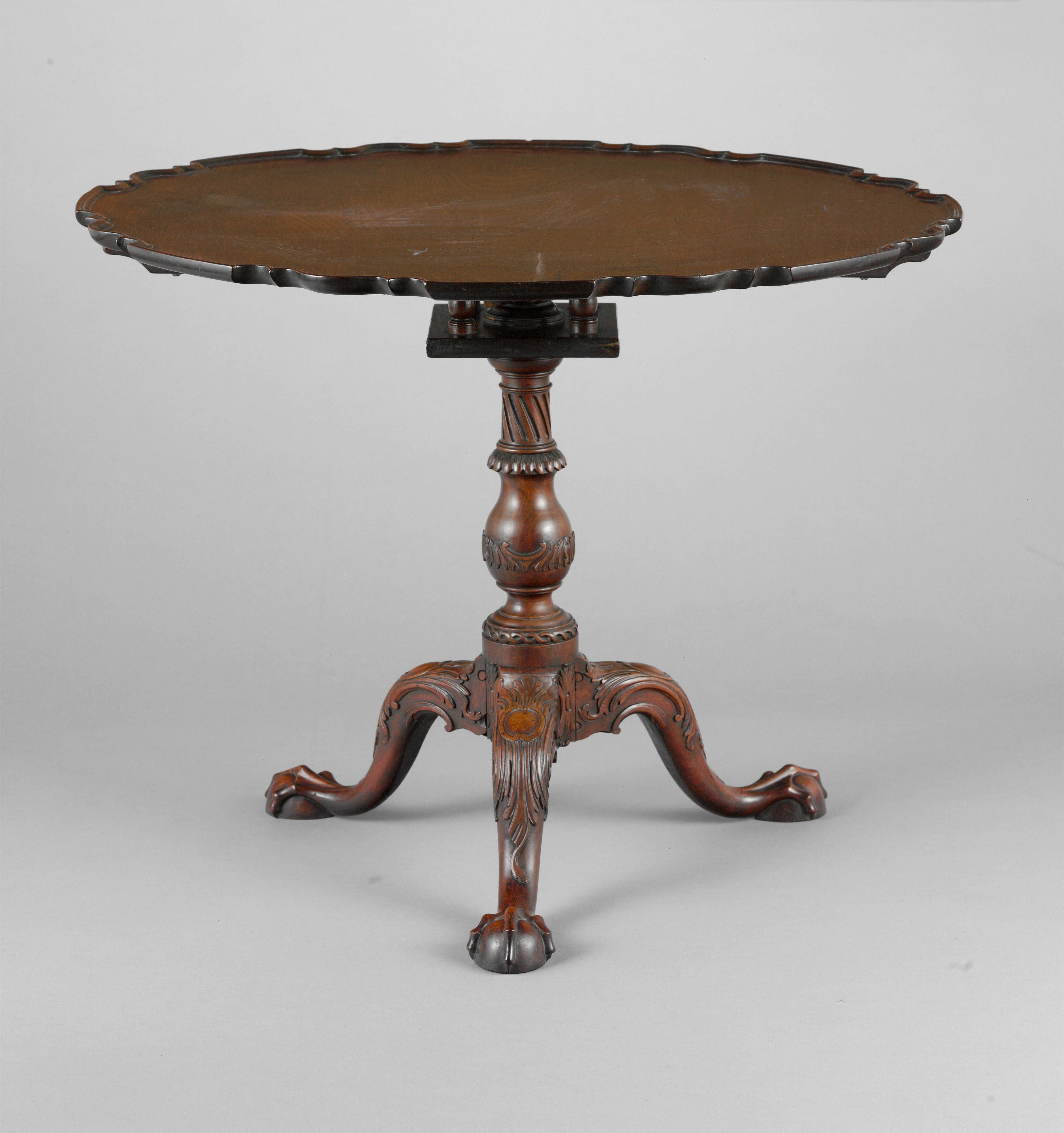
The Tilt-Top Tea Table: An American Mahogany Masterpiece of Form and Function
In the pantheon of American furniture design, few objects embody the intersection of ingenuity, craftsmanship, and social ritual as elegantly as the tilt-top tea table. At Katherine Fashion Lab, we recognize this piece not merely as a utilitarian artifact but as a sculptural statement—a testament to the early American cabinetmaker’s ability to synthesize European aesthetics with a distinctly pragmatic sensibility. Our analysis of a mid-18th-century American mahogany tilt-top tea table, intended as a standalone study object, reveals a sophisticated dialogue between material integrity, mechanical innovation, and cultural symbolism.
The Material Narrative: Mahogany as a Medium of Prestige
Mahogany, imported primarily from the Caribbean and Central America during the colonial period, was the wood of choice for discerning patrons and artisans. Its rich, reddish-brown hue deepens with age, acquiring a patina that speaks to time and care. For this tilt-top table, the choice of mahogany is deliberate: it offers a density that withstands the stresses of the tilting mechanism while allowing for intricate carving. The grain pattern, often figured with ribbon-like striations, becomes a central aesthetic feature. In this piece, the wood’s natural luster is enhanced by a period-appropriate shellac finish, which highlights the subtle contrast between the smooth, polished top and the more textured turned pedestal.
The material also carries economic and social weight. Mahogany was a luxury import, signaling the owner’s wealth and worldliness. Unlike native woods such as oak or walnut, mahogany’s resistance to warping made it ideal for the large, unbroken surface of a tea table—a surface meant to display fine porcelain, silver, and the ritual of tea drinking itself. The table’s top, typically 30 to 36 inches in diameter, is constructed from carefully joined planks, their seams nearly invisible under the finish. This joinery is not merely functional; it is a declaration of the cabinetmaker’s mastery over a material that demands precision.
The Engineering of Elegance: The Tilt-Top Mechanism
The defining feature of this table is its tilting top, a mechanical innovation that allowed the table to be stored flat against a wall when not in use, conserving space in the often-cramped interiors of colonial homes. The mechanism is deceptively simple yet requires exacting craftsmanship. A central brass or iron hinge, mortised into the underside of the top, connects to a wooden cleat that pivots on a pin. When the top is tilted, it locks into a vertical position, supported by a catch that engages with the pedestal’s central column. This system demands that the hinge be precisely aligned; any deviation would cause the top to wobble or bind. On this example, the hinge is original, its brass surface now tarnished to a soft gold, and the catch mechanism operates with a satisfying, tactile click—a testament to the longevity of its design.
The tilting function also serves a protective purpose. By allowing the table to be stored with the top facing the wall, the polished surface was shielded from dust, accidental spills, and the wear of daily life. This dual functionality—display and preservation—reflects a broader cultural value: the careful stewardship of material goods. In a standalone study context, the tilt-top table becomes a focal point that can be adjusted to suit the room’s arrangement, its presence both commanding and adaptable.
Pedestal and Base: The Sculptural Foundation
Below the tilting top, the pedestal and base form a study in balanced proportion. The pedestal is typically turned on a lathe, featuring a series of reeded or fluted sections that create visual rhythm. On this table, the central column is carved with a subtle cabochon—a rounded, convex ornament—that catches light and adds depth. The column terminates in a vase-shaped element, a nod to classical design, before flaring into a tripod base. The three legs, each shaped with a gentle curve (often referred to as “snake” or “cabriole” legs), terminate in pad or claw-and-ball feet. The claw-and-ball foot, a motif derived from Chinese and European influences, was particularly popular in American furniture of the Chippendale period. Here, the claws grasp a perfectly rendered ball, their grip suggesting both tension and delicacy.
The tripod base is not merely decorative; it is structurally essential. Three points of contact ensure stability on uneven floors, common in 18th-century homes. The legs are joined to the pedestal through a mortise-and-tenon construction, reinforced with wooden pegs. This joinery, visible from the underside, reveals the cabinetmaker’s hand. In a standalone study, the table’s base becomes a sculpture in its own right, its curves and contours inviting close inspection. The shadow cast by the tripod legs against a hardwood floor adds a dynamic, architectural quality to the piece.
Cultural Context: Tea, Sociability, and the American Home
To understand this table fully, one must consider its role in the ritual of tea drinking, a social practice that defined 18th-century American gentility. Tea was not merely a beverage; it was a performance of refinement, requiring specialized equipment—teapots, cups, sugar bowls, and slop bowls—all displayed on the tilt-top table. The table’s height, typically 27 to 29 inches, was designed for seated use, often accompanied by a low armchair or settee. The act of tilting the top after tea service was itself a ritual, signaling the end of the gathering and the careful storage of valuables.
In a standalone study, however, the table transcends its original domestic function. It becomes an object of contemplation, a symbol of the Enlightenment values of order, beauty, and utility. The tilt-top mechanism, when demonstrated, evokes the era’s fascination with mechanical ingenuity. The mahogany’s warmth and grain invite tactile engagement, while the carving’s precision speaks to a culture that prized handcraft over mass production. This table is not merely furniture; it is a historical document, encoding the tastes, technologies, and social hierarchies of its time.
Preservation and Patina: The Aesthetics of Age
For the collector or curator, the condition of this tilt-top table is paramount. The patina—the accumulated layers of wax, polish, and handling—is a feature, not a flaw. It tells a story of use, of generations of hands that tilted and steadied the top. Minor surface scratches, known as “craquelure,” are expected and add character. The original brass hardware, if present, should be preserved, as its tarnish is irreplaceable. Restoration, when necessary, should be minimal and reversible, focusing on stabilizing the wood and mechanism rather than erasing age. A well-preserved tilt-top table, such as this one, can fetch significant sums at auction, reflecting its rarity and historical importance.
In conclusion, the American mahogany tilt-top tea table is a masterpiece of design, engineering, and cultural expression. As a standalone study object, it offers endless layers of analysis: from the tropical origins of its wood to the precision of its joinery, from the social rituals it facilitated to the mechanical elegance of its tilting top. At Katherine Fashion Lab, we see this table as a paradigm of how form and function can coexist in perfect harmony, a lesson that transcends centuries and continues to inspire contemporary design. Whether admired for its craftsmanship, its history, or its sheer beauty, the tilt-top table remains an enduring icon of American furniture artistry.