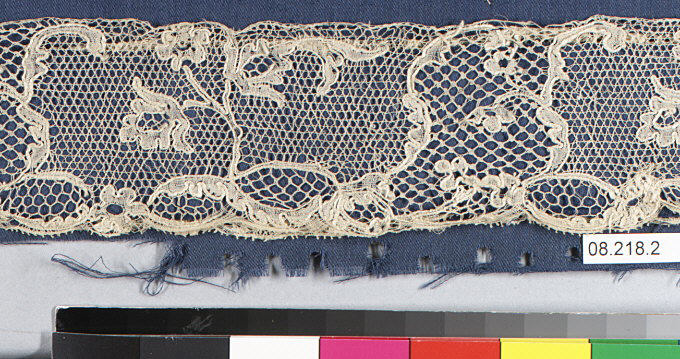
Fragment: A Deconstruction of Continuity in Global Lace Heritage
In the rarefied ateliers of haute couture, the concept of the "fragment" is often treated as a preliminary state, a broken piece awaiting repair or integration into a grander whole. Katherine Fashion Lab’s standalone study, Fragment, challenges this hierarchical assumption, proposing instead that the fragment is a complete ontological unit—a vessel of concentrated history, technique, and narrative. By isolating the intricate, time-intensive art of bobbin lace from its traditional applications and contextual moorings, the Lab does not merely present a textile; it stages a profound philosophical inquiry. This analysis posits that Fragment operates on three interconnected planes: as a deconstruction of temporal linearity in fashion heritage, as a strategic material innovation that redefines value creation, and as a contemplation on beauty in imperfection and incompleteness.
Deconstructing Linearity: The Fragment as a Non-Chronological Archive
The "Global Heritage" origin point is crucial, yet it is deliberately non-specific. Bobbin lace itself is a fragment of a larger, dispersed history—its origins debated among Flanders, Italy, and beyond, its techniques carried and adapted across continents through trade, migration, and colonialism. By refusing to anchor the piece to a single geographic or cultural narrative, Katherine Fashion Lab rejects a linear, proprietary view of heritage. Instead, the lace fragment becomes a palimpsest of global exchange. Each twist of the thread, each "pin and bobbin" movement, echoes centuries of transmitted knowledge, a code passed through generations of artisans whose individual contributions are often lost to history.
This standalone study liberates the lace from its typical role as an accent—a collar, an insert, a trim—that supports a larger garment’s silhouette. Here, the fragment is the silhouette. This act of isolation forces the viewer to engage with the lace not as decorative subtext, but as primary text. The complex patterns—perhaps a sliver of Venetian gros point, a hint of Maltese floral motifs, or a geometric fragment of Russian Vologda lace—are no longer contextualized by a dress’s form or function. They become autonomous architectural statements, their voids and densities, their rhythms and pauses, speaking a self-sufficient visual language. The heritage is not worn; it is contemplated in its raw, unassimilated state.
Material as Strategy: Bobbin Lace and the Economics of Rarity
In a fashion landscape dominated by the economics of scale and speed, the choice of bobbin lace is a radical strategic declaration. The material’s value is intrinsically linked to the non-scalable investment of human time and precision. A single fragment, as presented in this study, can represent dozens, if not hundreds, of hours of labor. By presenting this labor as the core product, Katherine Fashion Lab makes a critical statement on value perception in luxury. The value is not derived from brand logo density or seasonal novelty, but from the undeniable, tangible evidence of expertise and time—the ultimate scarce resources.
This study treats the lace fragment not as a relic, but as a platform for innovation. Freed from its supporting role, the lace can be re-examined in terms of its structural properties, its interaction with light and shadow, its potential for hybridization. The Lab likely explores its integration with unexpected mediums—perhaps stabilizing it within resin to explore fossilization, fusing it with metallic filaments for conductive properties, or laser-cutting its patterns into complementary materials. This transforms the heritage technique from a closed archive into an open-source code for future creation. The fragment becomes a seed, demonstrating that true luxury innovation lies not in discarding the past, but in deepening its dialogue with the present through technological and conceptual cross-pollination.
The Aesthetics of Imperfection: Completeness in the Fragment
The most compelling conceptual pivot in Fragment is its subversion of the finished object. In traditional couture, a garment is presented as a resolved, perfect totality. A fragment, by definition, suggests something is missing. Katherine Fashion Lab inverts this logic, arguing that the fragment’s very incompleteness is its source of power and completeness. The raw, unbound edges of the lace are not flaws; they are narrative portals. They invite the viewer to imagine what was before and what could be after, engaging them as a co-creator in the story. This aligns with a broader cultural shift towards aesthetic values that embrace wabi-sabi, the beauty of the imperfect and transient.
This standalone piece asks: where does the art truly reside? In the final, symmetrical, worn garment, or in the painstaking, iterative process of its most complex component? By exhibiting the lace fragment as a finished artwork, the Lab shifts the locus of artistic genius from the designer’s sketch to the artisan’s hands, and to the material’s own behavior under tension. The "fragment" is thus revealed to be the whole—it contains the entire story of its making. Its delicate, seemingly vulnerable structure becomes a metaphor for resilience; it has survived the deconstruction of the whole to stand alone, asserting that heritage is not a static backdrop but a living, breathing, and beautifully incomplete conversation.
In conclusion, Katherine Fashion Lab’s Fragment is a masterful couture analysis conducted not with words, but with thread. It deconstructs linear heritage narratives to reveal a global, interconnected craft continuum. It strategically leverages the unparalleled time-value of bobbin lace to comment on modern luxury economics. Finally, it champions a new aesthetic completeness found in intentional imperfection. This standalone study proves that the most powerful statements are often not those that shout in totality, but those that whisper in fragments, leaving space for history, imagination, and profound respect for the hand to fill the voids. The fragment, therefore, is not a remnant of the past; it is a blueprint for a more thoughtful, sustainable, and intellectually rich future for couture.