The Art of Emptiness: Deconstructing the Freestanding Screen with Dancer
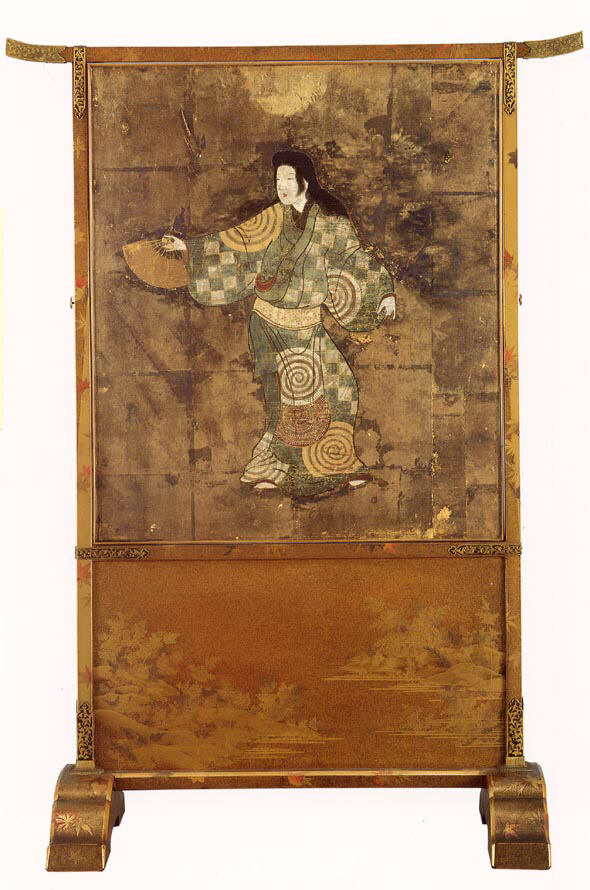
In the rarefied echelons of haute couture, where fabric meets philosophy, Katherine Fashion Lab presents a singular artifact of inspiration: a freestanding screen depicting a dancer, executed in ink, color, and gold on gilt paper, mounted on a lacquered screen. This piece, originating from Japan and intended as a standalone study, transcends mere decorative function to become a masterclass in spatial economy, kinetic stillness, and the power of negative space. For the discerning fashion executive, this screen offers a profound lexicon for reimagining silhouette, texture, and the very architecture of clothing.
The Material Alchemy: Ink, Gold, and the Lacquered Frame
The screen’s materiality is its first lesson. Ink, color, and gold on gilt paper—a triumvirate of restraint and opulence. The ink, likely sumi-e derived, delivers a monochromatic foundation that captures the dancer’s essence through fluid, calligraphic strokes. This is not a literal representation but a distillation of movement, where a single brushstroke can imply a limb’s arc or a fabric’s drape. For the couturier, this suggests a radical departure from over-embellishment. Instead, consider garments where the primary narrative is carried by a single, masterful line—a seam that curves like a brushstroke, a hem that floats like an ink wash on silk.
The gold, applied as pigment or leaf to the gilt paper, introduces a counterpoint of luminosity. It does not overwhelm but punctuates, catching light in a way that mimics the dancer’s ephemeral presence. In fashion, this translates to strategic placement of metallic threads, gilded embroidery, or even liquid-gold finishes on a single panel of a gown. The gold is not decoration; it is a tool for directing the viewer’s gaze, much like a spotlight on a stage. The lacquered screen, with its deep, reflective finish, frames the composition with a tactile depth. Lacquer’s glossiness invites touch while denying it—a paradox that high fashion often exploits through fabrics like patent leather, organza, or coated tulle that play with transparency and reflection.
Kinetic Stillness: The Dancer as a Study in Motion
The subject—a dancer—is frozen in a moment of potential energy. This is not the climax of a leap but the breath before it. The screen’s composition likely employs ma, the Japanese concept of negative space as an active, breathing void. The dancer’s posture, perhaps with one arm extended and a foot poised, creates tension between the figure and the surrounding emptiness. For fashion design, this principle challenges the conventional focus on the garment’s positive form. Instead, consider the void as a design element: cutouts that reveal skin, asymmetrical hemlines that create negative shapes, or draped fabric that pools like a shadow. The garment becomes a frame for the body’s own kinetic narrative.
This study also echoes the Noh theater tradition, where movement is minimal yet charged with meaning. A dancer’s slow, deliberate turn or the slight tilt of a masked head conveys volumes. In couture, this translates to garments that prioritize gesture over volume. A cape that falls in a single, unbroken line; a sleeve that flares only at the wrist; a train that trails without weight. The screen teaches that power lies in what is left unsaid—or, in fashion, unsewn.
Standalone Study: The Screen as a Fashion Blueprint
Described as a standalone study, this screen is not part of a narrative series. It exists as a complete statement, inviting the viewer to project their own interpretation. This autonomy is crucial for the fashion creative. A collection piece, like this screen, must function as a singular artifact while contributing to a broader aesthetic language. For Katherine Fashion Lab, this suggests a collection where each garment is a discrete study in composition, material, and movement—a series of independent poems rather than a linear story.
Lessons in Silhouette: The Screen’s Architectural Influence
The screen itself is an architectural object—a freestanding partition that defines space without enclosing it. Its panels create a rhythm of vertical lines, much like the pleats of a Fortuny dress or the seams of a tailored jacket. For the fashion executive, this evokes the potential of structural draping. Imagine a gown that mimics the screen’s folding logic: a bodice with hinged panels that open and close with movement, or a skirt that fans out like a screen’s accordion folds. The lacquered finish suggests a glossy, almost armor-like surface, inspiring jackets with patent finishes or skirts with resin-coated overlays that catch light and shadow.
The dancer’s silhouette, rendered with economy, also critiques the Western obsession with corsetry and padding. Japanese aesthetics celebrate the natural line of the body, enhanced rather than reshaped by clothing. This screen advocates for garments that follow the body’s own geometry—a bias-cut slip dress, a kimono-sleeved coat, or a wide-legged trouser that moves with the gait. The gold accents can be strategically placed at the waist, shoulder, or hip to guide the eye without distorting form.
Color Palette: The Discipline of Restraint
The screen’s palette—black ink, gold, and the natural tone of gilt paper—is a masterclass in chromatic discipline. Black, in Japanese aesthetics, is not the absence of color but the presence of depth. It absorbs and reflects, creating a visual anchor. The gold adds warmth without competing, while the paper’s ivory or beige base provides a breathing space. For a couture collection, this palette translates into a monochromatic foundation punctuated by gold or silver accents. Consider a black silk crepe gown with gold-thread embroidery at the neckline, or a charcoal wool coat with a single gold button. The lesson is that luxury lies in restraint—a principle often lost in the race for maximalist trends.
Contextualizing for the Contemporary Runway
In the context of modern fashion, where digital overload and fast cycles dominate, this screen offers a counter-narrative. It demands slow looking, deliberate crafting, and respect for materials. For Katherine Fashion Lab, the screen is a manifesto for sustainable luxury—not as a marketing term but as a design philosophy. Each garment becomes a study in longevity, where every stitch and seam serves a purpose, much like every brushstroke on the screen. The gold leaf, for instance, can be mirrored in hand-applied metallic foils on recycled fabrics, creating pieces that are both precious and responsible.
Ultimately, the Freestanding Screen with Dancer is not just an artwork but a strategic blueprint for the fashion executive. It teaches that emptiness can be a design tool, that movement can be captured in stillness, and that opulence is most powerful when it is sparingly applied. As Katherine Fashion Lab continues to push the boundaries of couture, this screen stands as a silent, gilded mentor—reminding us that the most profound statements are often made with the lightest touch.