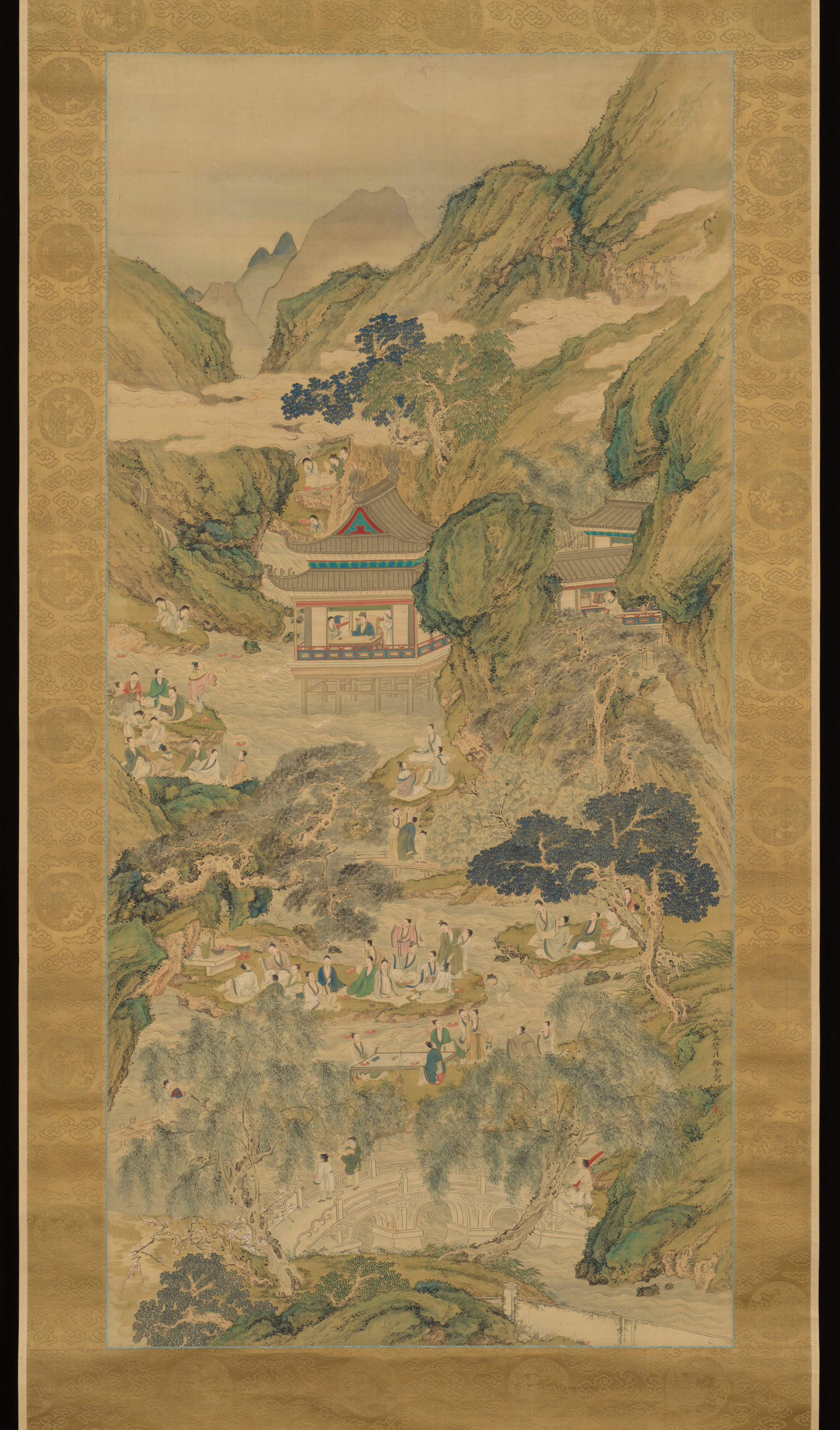
The Orchid Pavilion Gathering in Blue and Green: A Couture Analysis of Silk, Ink, and Ephemeral Elegance
Introduction: The Confluence of Tradition and Textile
In the rarefied domain of haute couture, where the ephemeral meets the eternal, few artifacts command as profound a reverence as the Japanese hanging scroll (kakemono). At Katherine Fashion Lab, we approach such works not merely as historical documents but as living repositories of design philosophy—textiles that whisper narratives of pigment, weave, and cultural memory. The subject of this analysis, “Orchid Pavilion Gathering in Blue and Green,” a late Edo-period scroll executed in ink and color on silk, offers an unparalleled case study in the intersection of pictorial composition and garment construction. Originating in Japan, this standalone study—unmoored from a larger narrative cycle—demands a couture lens to decode its chromatic architecture, material logic, and spatial poetics.
Materiality as Couture Foundation
The scroll’s substrate—silk—is the first and most intimate couture element. In Japanese textile tradition, silk is not a passive ground but an active participant in the visual dialogue. The warp and weft of this particular hanging scroll exhibit a tabby weave of exceptional fineness, with a thread count that suggests a fabric destined for ceremonial rather than quotidian use. The silk’s natural luster, now mellowed by centuries, creates a subtle iridescence that modulates the mineral pigments applied atop it. For the couture atelier, this is a critical lesson: the foundation must not only bear the design but enhance it through its own inherent qualities. The silk here acts as a base fabric whose translucency and drape would influence any garment inspired by its surface—a gown, for instance, might employ a silk charmeuse or chiffon to replicate the scroll’s interplay of opacity and light.
Chromatic Palette: The Blue-Green Synthesis
The titular “blue and green” palette is not arbitrary but deeply symbolic. In East Asian art, these hues derive from mineral sources: azurite (gunjō) for the blues and malachite (rokushō) for the greens. Their application in this scroll is meticulous, with layers built up in gradated washes that evoke both landscape and garment drapery. The blue, concentrated in the sky and distant mountains, conveys depth and transcendence, while the green—used for foliage and the celebrated Orchid Pavilion itself—suggests renewal and scholarly retreat. For a couture collection, this chromatic strategy translates into a color-blocking technique that defines silhouette: a structured bodice in deep azurite, flowing into a skirt of malachite pleats, mimicking the scroll’s vertical progression. The absence of red or yellow is deliberate, creating a cool-toned monochrome that compels the eye toward the narrative center—the gathering of poets and calligraphers under the pavilion’s eaves.
Compositional Structure: The Garment as Narrative Scroll
The scroll’s composition is a masterclass in asymmetrical balance, a principle that resonates profoundly with modern couture draping. The pavilion, rendered in fine ink outlines, occupies the lower-middle register, while figures—each no larger than a thumbnail—are scattered along a winding path. This diagonal axis creates a visual rhythm that a designer might replicate in a gown’s seam lines or embroidery placement. The empty spaces, or yohaku, are not voids but active negative spaces that allow the eye to rest—a concept directly applicable to garment construction. A couture piece inspired by this scroll would feature strategic cutouts or sheer panels that echo the unpainted silk, creating a dialogue between density and transparency. The figures themselves, though minuscule, are rendered with precise ink strokes that suggest embroidery—perhaps a sashiko technique in metallic thread to capture their gestural energy.
Ink as Structural Line
Beyond color, the ink (sumi) provides the scroll’s architectural skeleton. The calligraphic lines that define the pavilion’s roof, the willow branches, and the scholars’ robes are not merely outlines but dynamic strokes that convey motion and weight. In couture, this translates to structural seams and darts that shape the garment’s form without overwhelming the fabric. A tailored jacket, for instance, might feature ink-black piping along its lapels and hem, echoing the scroll’s linear precision. The ink’s fluidity also suggests draping techniques—folds of silk that fall as naturally as the brushstrokes that describe them. The scroll’s artists understood that line is not secondary to color but coequal; a couture interpretation must honor this parity by using graphic elements (beading, appliqué, or laser-cut lace) to anchor the chromatic expanse.
Cultural Context: The Gathering as Social Fabric
The “Orchid Pavilion Gathering” references the historical 353 CE event where Wang Xizhi and 41 literati composed poetry along a winding stream. In Japan, this motif was adapted during the Edo period to celebrate intellectual camaraderie and aesthetic refinement. For a modern fashion house, this context imbues the scroll with narrative weight—it is not merely a decorative pattern but a cultural code that speaks to community, creativity, and the passage of time. A couture collection inspired by this scroll might incorporate hidden details: embroidered verses from the poems, or interlocking seams that symbolize the gathering’s unity. The scroll’s vertical format also suggests a kimono-inspired silhouette—a long, flowing gown with a train that mimics the scroll’s unfurling, inviting the wearer to become part of the narrative, a living figure within the painted landscape.
Technical Execution: Pigment and Preservation
The application of mineral pigments on silk requires exceptional skill. The azurite and malachite were ground, mixed with animal glue (nikawa), and applied in thin, successive layers to achieve opacity without cracking. This layering technique parallels the construction of haute couture garments, where multiple fabrics—silk organza, tulle, charmeuse—are assembled to create depth. The scroll’s preservation, with minimal fading, indicates the use of high-quality binders and careful storage—a lesson in material stewardship for any atelier. For a contemporary interpretation, a fashion lab might experiment with natural dyes derived from indigo and chlorophyll to replicate the blue-green palette, ensuring the garment ages with grace rather than degradation.
Conclusion: From Scroll to Silhouette
The “Orchid Pavilion Gathering in Blue and Green” is not an artifact confined to a museum wall; it is a blueprint for couture innovation. Its silk ground, mineral palette, asymmetrical composition, and calligraphic energy offer a lexicon of design principles that transcend medium. At Katherine Fashion Lab, we see in this hanging scroll a garment in waiting—a gown that drapes like a painted landscape, a jacket structured like a pavilion’s roof, a train that flows like a winding stream. The scholar-poets of the Orchid Pavilion gathered to celebrate the ephemeral beauty of a spring day; in couture, we gather to immortalize that beauty in silk, thread, and form. This scroll reminds us that the finest fashion is not worn but inhabited—a second skin that carries the weight of history and the lightness of artistic vision.