Deconstructing La Bisi: A Couture Analysis of Material Memory and Modernity
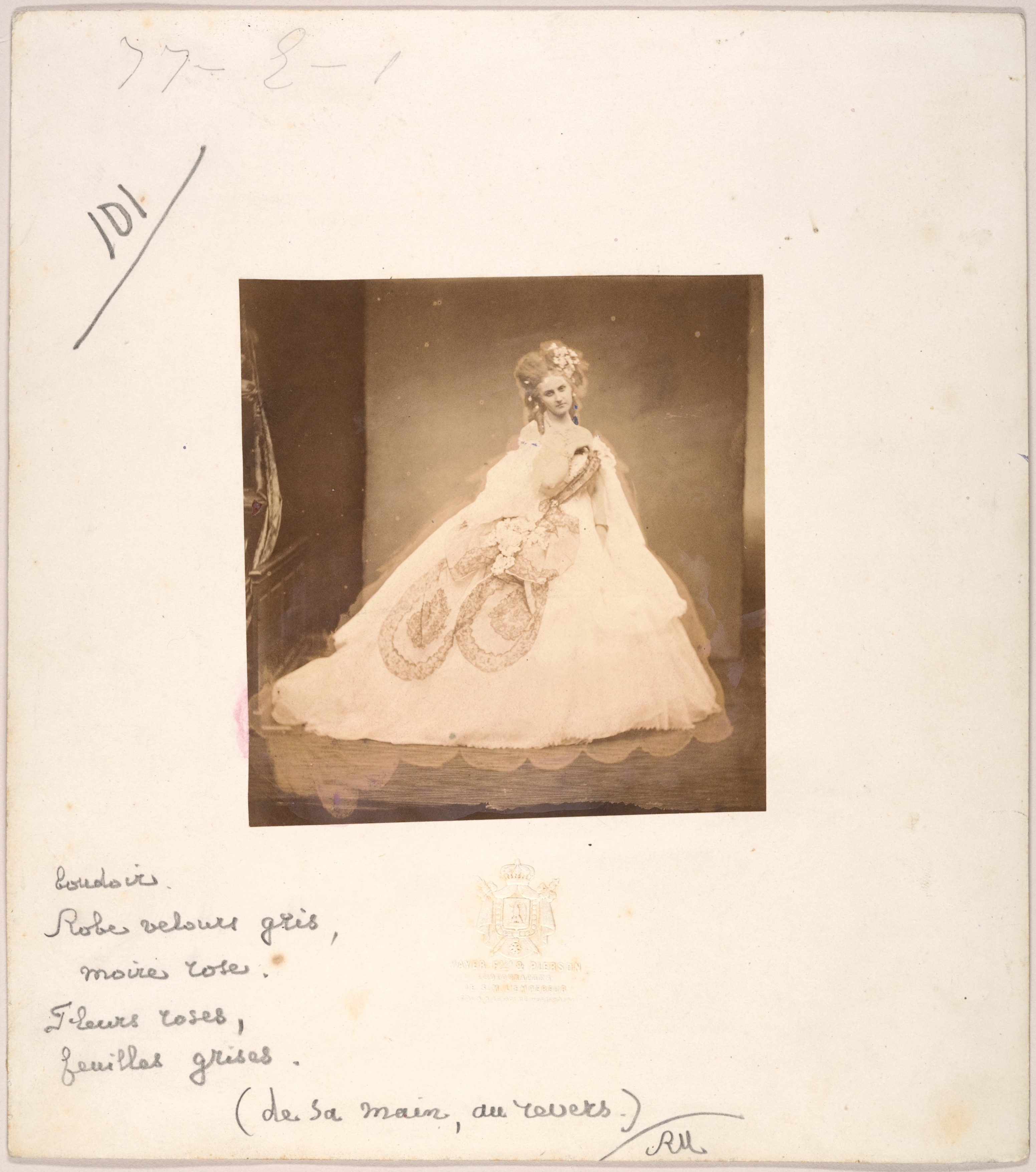
In the annals of fashion history, few artifacts possess the layered resonance of La Bisi, a singular study preserved as an albumen silver print from a glass negative. Housed within the Katherine Fashion Lab’s Global Heritage collection, this image transcends mere documentation to become a profound meditation on couture as both art and artifact. The subject—a boudoir scene featuring a robe velour gris, moire rose, fleurs roses, and feuilles grises (de sa mai, au revers)—offers a rich tapestry of textures, colors, and symbolic gestures that demand rigorous analysis. This essay deconstructs La Bisi through the lens of materiality, cultural heritage, and the interplay of intimacy and artifice, revealing how a 19th-century photographic process can illuminate contemporary fashion’s deepest preoccupations.
The Alchemy of Material: Albumen Silver and the Language of Luxury
The choice of albumen silver print from glass negative as the medium for La Bisi is neither incidental nor purely archival. This 19th-century photographic technique, which binds egg whites to paper to create a lustrous, sepia-toned surface, mirrors the very essence of couture: the transformation of base materials into objects of enduring beauty. The glass negative, with its capacity for infinite detail, captures the robe velour gris (gray velvet robe) with a tactile precision that borders on the synesthetic. One can almost feel the nap of the velvet, its plush density contrasting with the moire rose (pink moiré) that ripples like water under light. Moiré, a fabric with a watered silk finish, is itself a testament to industrial artistry—its patterns emerge from pressure and heat, echoing the alchemical processes of photography. Together, these materials speak to a luxury that is not merely visual but haptic, demanding to be touched, worn, and remembered.
The photograph’s sepia tonality further enhances this material dialogue. The gray of the velvet reads as a spectrum of silvers and charcoals, while the pink moiré acquires a muted, almost melancholic warmth. This is not the garish pink of contemporary fast fashion but a rose fleuri (floral pink) that suggests petals dried between pages of a book. The fleurs roses (pink flowers) and feuilles grises (gray leaves) embroidered or appliquéd onto the robe—presumably from a spring collection (“de sa mai, au revers” suggesting “from May, on the reverse”)—introduce a botanical lexicon that bridges nature and artifice. These motifs are not mere decoration; they are semiotic markers of temporality, referencing the fleeting bloom of spring and the enduring gray of stone or shadow. The reverse placement (“au revers”) hints at a hidden narrative, a secret garden folded into the garment’s interior, accessible only to the wearer or the intimate viewer.
Boudoir as Stage: Intimacy, Performance, and the Female Gaze
The setting—a boudoir—is central to La Bisi’s meaning. Historically, the boudoir was a private space for women to dress, undress, and engage in acts of self-presentation away from the public eye. Yet the photograph transforms this private chamber into a stage. The robe velour gris, with its luxurious weight, becomes a costume for a performance of femininity that oscillates between vulnerability and power. The moire rose, with its shifting patterns, suggests a body in motion, a woman who is both subject and object of her own gaze. This duality is crucial: La Bisi is not a passive portrait but an active construction of identity through dress.
The inclusion of fleurs roses and feuilles grises further complicates the boudoir’s symbolism. Flowers have long been associated with female sexuality and transience, but here they are rendered in fabric—permanent yet fragile. The gray leaves introduce a note of decay or restraint, tempering the rose’s romanticism. This tension mirrors the broader cultural anxieties of the late 19th century, when the rise of photography and mass production threatened the handmade authenticity of couture. La Bisi, as a standalone study, resists this commodification by emphasizing the unique, the tactile, and the ephemeral. It is a relic of a moment when fashion was still primarily a haptic experience, before the digital age reduced garments to pixels and hashtags.
Global Heritage: The Cultural Crossroads of La Bisi
Labeled as part of the Global Heritage collection, La Bisi invites analysis beyond its European origins. The albumen silver process, though invented in France, was quickly adopted worldwide, becoming a tool for documenting colonial encounters and exoticized “others.” Yet La Bisi subverts this trajectory. Its subject is not an exoticized body but a European woman in a boudoir, framed by materials that speak to global trade: velvet from Italy or France, moiré from China or Japan, and photographic chemicals from Germany or England. The “fleurs roses” and “feuilles grises” evoke the chinoiserie and japonisme that swept through 19th-century European fashion, a fascination with asymmetry, natural motifs, and muted palettes. La Bisi thus becomes a microcosm of cultural exchange, where local and global influences coalesce into a singular aesthetic statement.
This global heritage is also a commentary on labor. The albumen print required skilled artisans—photographers, chemists, and printers—just as the robe required weavers, dyers, and embroiderers. The garment’s “de sa mai, au revers” inscription hints at a specific seasonal collection, tying the object to a network of production and consumption that spanned continents. In this sense, La Bisi is not just a fashion study but a document of globalization’s early stages, where luxury goods circulated as markers of status and taste.
Standalone Study: The Power of Singularity
The designation standalone study is perhaps the most provocative element of La Bisi’s description. Unlike a series or a fashion plate, this image exists in isolation, demanding undivided attention. It rejects the narrative flow of a collection or the didacticism of a catalog, instead offering a single, intense moment of contemplation. This singularity aligns with the couture ethos: each garment is a unique creation, not a mass-produced copy. The photograph, too, is unique—a direct positive from a glass negative, with no negative for reproduction. In an age of digital infinite reproducibility, La Bisi’s standalone status is a radical act of preservation, a refusal to let the image be diluted or decontextualized.
Analyzing La Bisi through the lens of Katherine Fashion Lab’s curatorial mission reveals a deep commitment to materiality, history, and the enduring power of the handmade. The robe velour gris, moire rose, and floral motifs are not merely decorative; they are conduits for exploring themes of time, identity, and cultural memory. The albumen silver print, with its fragile beauty, reminds us that fashion is always an act of translation—from fiber to fabric, from sketch to garment, from body to image. La Bisi stands as a testament to this process, a ghostly yet vivid echo of a moment when couture was both intimate and monumental.