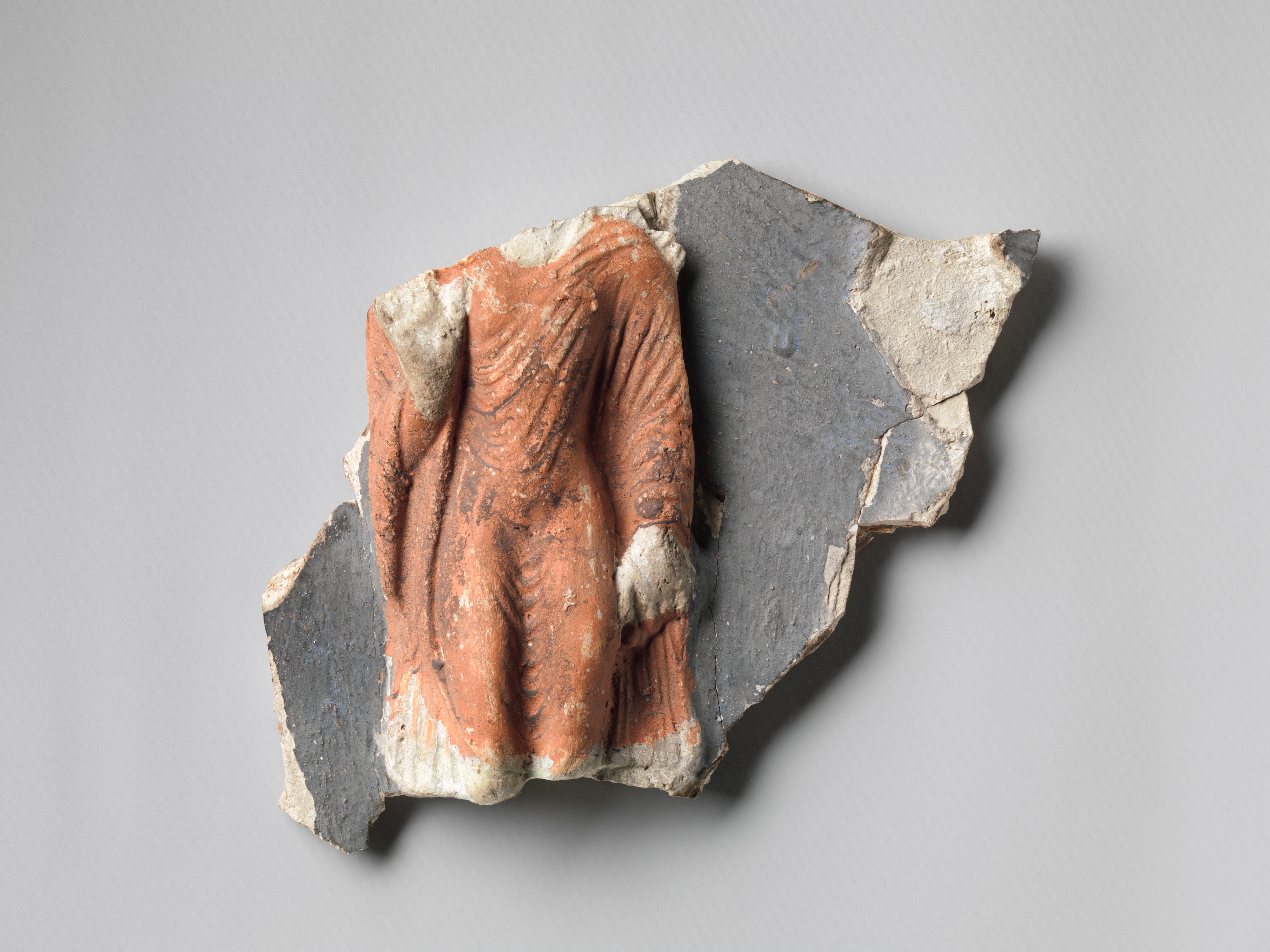
Deconstructing the Divine: An Art Historical and Couture Analysis of the Fragment of a Halo with Buddha Figure
In the rarefied intersection of haute couture and ancient art, the Fragment of a Halo with Buddha Figure from China’s Xinjiang Autonomous Region emerges as a profound case study in material transcendence. This piece, a standalone relic of stucco with polychrome traces, is not merely a broken artifact; it is a masterclass in the interplay between ephemeral materiality and eternal symbolism. For the discerning eye of a fashion curator, this fragment offers a lexicon of texture, color, and form that speaks directly to the core tenets of luxury: rarity, craftsmanship, and narrative depth. The halo, or mandorla, traditionally signifies divine radiance, yet here, its fragmentation becomes a metaphor for the incomplete, the suggestive, and the powerfully evocative—a principle that high fashion has long exploited to create allure.
The Material Lexicon: Stucco as a Couture Substrate
Stucco, a humble composite of lime, sand, and water, is rarely celebrated in the lexicon of luxury textiles. Yet, in this fragment, its application elevates the mundane to the sacred. The artisan’s hand is visible in every undulation, every subtle ridge that once formed the Buddha’s silhouette. This tactile quality mirrors the haute couture process, where fabric is not merely cut but sculpted. The stucco’s porous surface, now weathered by centuries in the arid Tarim Basin, absorbs light unevenly, creating a chiaroscuro effect that a silk faille or matte crepe might emulate. The color remnants—faded ochres, vermilions, and azurites—are not vibrant but whispered, like the ghost of a pigment. In contemporary couture, this palette is echoed in the work of designers who favor “aged” or “weathered” finishes, such as Gucci’s distressed leathers or Maison Margiela’s patinated silks. The fragment teaches us that luxury need not be pristine; it can be resonant with the passage of time.
Form and Silhouette: The Halo as a Structural Device
The halo, typically rendered as a perfect circle or almond shape, is here a broken arc—a crescent of divinity. This fragmented geometry is a powerful design motif. In fashion, the circle symbolizes unity and eternity, but its rupture introduces tension and modernity. Consider a Balenciaga gown with a single, sweeping asymmetrical sleeve that mimics the curve of a halo, or a Rick Owens cape that drapes like a shattered mandorla. The Buddha figure itself, though only partially preserved, suggests a seated or standing posture of serene composure. The drapery of monastic robes, rendered in stucco’s subtle folds, anticipates the pleating techniques of Issey Miyake or the bias cuts of Madame Grès. The fragment’s incomplete nature invites the couturier to complete the story through silhouette, to let the missing parts speak through absence—a concept akin to the Japanese wabi-sabi aesthetic, which finds beauty in imperfection.
Color Theory: The Alchemy of Faded Pigments
The polychrome remnants on this stucco fragment are a study in color archaeology. The original palette would have been vibrant: gold leaf for the halo, deep lapis for the Buddha’s hair, cinnabar for the robes. What remains is a muted symphony of earth tones, where red has oxidized to burnt sienna, blue to a dusty slate, and white to a soft ivory. This chromatic decay is not a loss but a transformation. In haute couture, this effect is replicated through techniques like ombre dyeing, hand-painting, or surface decay treatments. A Valentino evening gown might feature a gradient from deep burgundy to pale blush, mimicking the fade of ancient frescoes. The fragment’s color story also aligns with the current trend of “desert minimalism” in luxury fashion—a palette of sand, rust, and faded indigo that evokes the Silk Road’s trade routes. The Buddha’s halo, once a blaze of gold, now glows with a subtle, diffused luminance, suggesting that true luxury is not about brightness but about depth of hue.
Narrative and Context: The Xinjiang Connection
Originating from the Xinjiang Autonomous Region, this fragment is a product of the Silk Road’s cultural confluence. Buddhist art from this region—particularly the cave temples of Kizil and Dunhuang—blends Indian, Persian, and Chinese influences. This syncretism is a blueprint for global luxury today. A fragment of a halo is not just a religious symbol; it is a node in a network of exchange. In fashion, this translates to collections that borrow from multiple cultures, but with reverence and intellectual rigor, not appropriation. The fragment’s standalone status—removed from its original architectural context—makes it a portable luxury object, akin to a couture accessory. It invites the wearer or viewer to imagine the whole from the part, to engage in an act of creative reconstruction. This is the essence of a narrative-driven garment: a coat that tells the story of a journey, a dress that whispers of a forgotten ritual.
Implications for Katherine Fashion Lab
For Katherine Fashion Lab, this fragment offers a curatorial manifesto. The studio’s design philosophy should embrace the archaeological gaze—treating each garment as a fragment of a larger, lost whole. The use of stucco-like textures could be explored through bonded fabrics, resin finishes, or 3D-printed elements that mimic the material’s porosity. The color palette should be drawn from the fragment’s faded pigments, with an emphasis on tonal variation rather than flat saturation. The halo’s broken arc could inspire a series of asymmetrical collars, capes, or headpieces that frame the face with a sense of divine incompleteness. Most importantly, the fragment teaches that luxury is not about opulence but about intentionality—every mark of age, every crack, every faded hue is a testament to time, place, and the hand that made it. This is the ultimate lesson for a couture house: to create objects that feel as though they have always existed, yet are entirely new.
In conclusion, the Fragment of a Halo with Buddha Figure is not a relic to be preserved behind glass; it is a living design reference. Its stucco body, faded colors, and incomplete form challenge the fashion industry to rethink luxury as a process of excavation and revelation. For Katherine Fashion Lab, this piece is a call to fragment the expected, to celebrate the broken, and to find the divine in the material. The halo may be shattered, but its light still guides.