The Architectural Edge: A Couture Analysis of Edging in Global Heritage Lace
In the rarefied world of haute couture, where every stitch is a statement and every millimeter of fabric is a canvas, the concept of edging transcends mere finishing. It is the threshold where a garment meets the void, the final negotiation between structure and air. At Katherine Fashion Lab, our standalone study of edging, rooted in the global heritage of needlework, redefines this boundary as an architectural feat. By harnessing the ancient techniques of cutwork, reticello, and punto in aria—executed on the purest linen—we elevate edging from a functional trim to a narrative of cultural lineage and sculptural precision. This analysis dissects the material, technical, and conceptual dimensions of our approach, revealing how these historical methods inform a contemporary couture vocabulary that is both fragile and formidable.
The Global Heritage of Openwork: A Foundation of Mastery
To understand our edging, one must first appreciate the geographic and temporal roots of its constituent techniques. Cutwork, or punto tagliato, emerged in Renaissance Italy as a method of cutting away sections of linen and embroidering the remaining edges to create intricate patterns. It is a technique of subtraction and reinforcement, where the void is as deliberate as the thread. Reticello, a precursor to true needlelace, evolved from cutwork by introducing geometric grids of pulled threads, often stitched with buttonhole bars to form star-like motifs. This technique, perfected in 16th-century Venice, represents a dialogue between order and delicacy. Finally, punto in aria—literally “stitch in the air”—is the apotheosis of lace: a free-form needlelace worked without a ground fabric, relying solely on the framework of thread. Originating in the same Venetian workshops, it embodies the ultimate liberation of thread from cloth. Our study honors these origins, sourcing linen from heritage mills in Belgium and Ireland, where flax cultivation and weaving traditions date back centuries. The result is a substrate that is both strong and supple, capable of supporting the tension required for these intricate edge treatments.
Material Dialogues: Linen as the Canvas of Precision
The choice of linen is not arbitrary; it is a material that demands respect and rewards patience. Unlike cotton or silk, linen fibers are long, inelastic, and inherently crisp, making them ideal for cutwork and reticello, where clean edges and structural integrity are paramount. In our lab, we use a 100% European linen with a thread count of 180 per inch, ensuring a tight weave that can withstand the removal of threads without fraying. The natural off-white hue of unbleached linen serves as a neutral ground, allowing the shadows cast by openwork to become part of the design. For the edging itself, we employ a 40/2 linen thread, spun from the same flax, to maintain material homogeneity. This consistency is critical: when a cutwork edge transitions into a punto in aria scallop, the thread must behave identically under tension, ensuring that the transition between fabric and air is seamless. The tactile quality of linen—cool to the touch, with a slight stiffness—also imparts a architectural rigidity to the edging, preventing it from collapsing into limpness. It is a material that speaks of durability and history, yet its transparency in openwork creates an illusion of weightlessness.
Technical Execution: The Lattice and the Void
Cutwork Edging: Subtraction as Addition
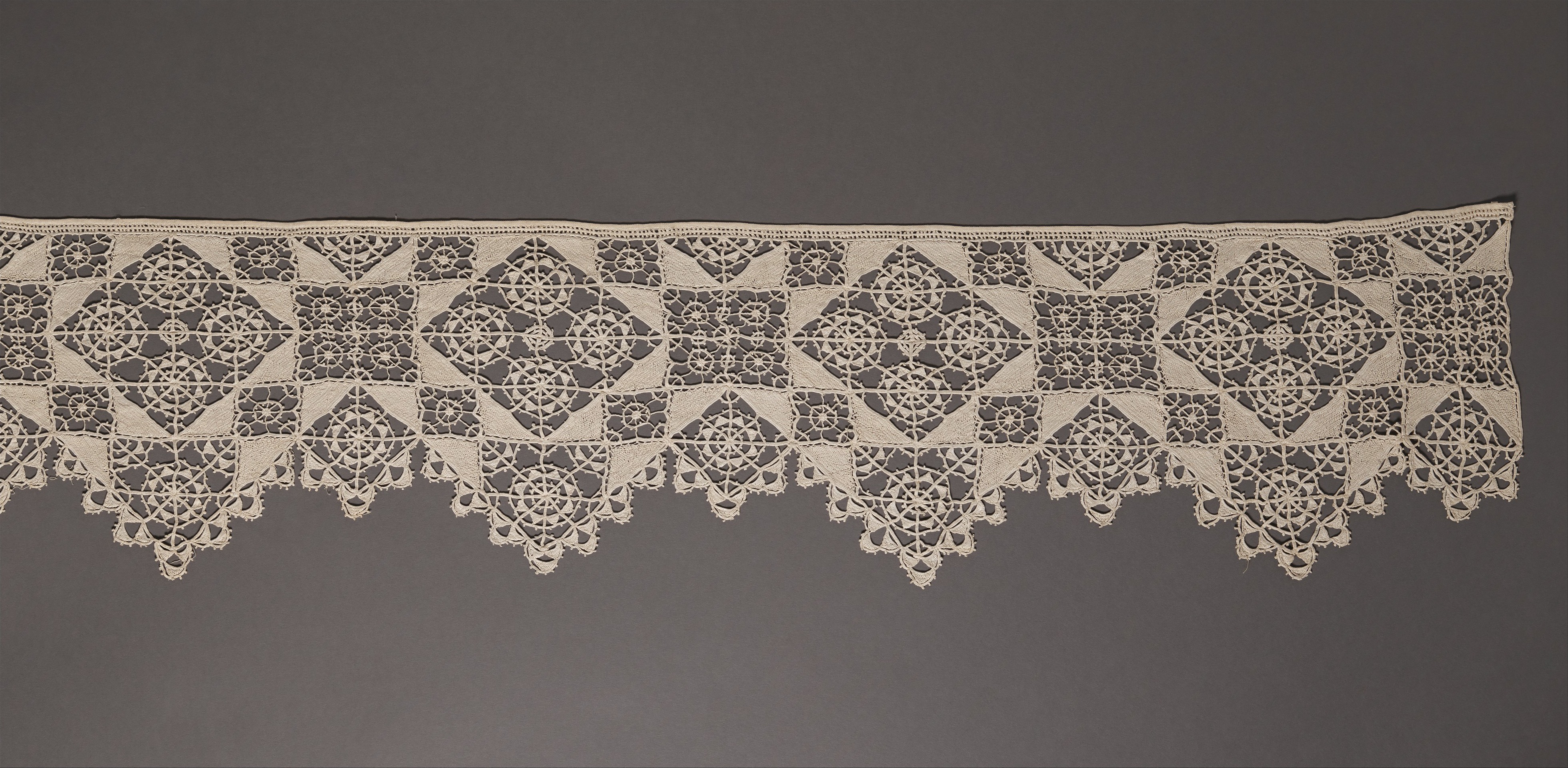
Our cutwork edging begins with a meticulously drawn pattern on the linen, typically a repeating floral or geometric motif inspired by 17th-century Venetian manuscripts. Using a sharp stiletto, we cut small windows within the fabric, leaving a margin of 1.5 millimeters. The raw edges are then overcast with a buttonhole stitch using the linen thread, creating a reinforced border that prevents fraying. This stitch is worked at a density of 20 stitches per centimeter, ensuring that the edge is both flexible and durable. The voids are then filled with needlelace bars—single threads wrapped with buttonhole stitches—that form a lattice. The result is an edging that is both transparent and structured, where the negative space becomes a pattern in itself. This technique is particularly effective for hemlines and cuffs, where the cutwork creates a lacy border that catches light and movement.
Reticello Edging: Geometry in Suspension
Reticello edging takes the cutwork concept further by removing entire warp and weft threads from the linen, leaving a grid of holes. In our lab, we extract three threads per centimeter, creating a network of square apertures. The edges of this grid are stabilized with a running stitch, and then we weave needlelace patterns—such as stars, wheels, and zigzags—across the open spaces. The edging itself is defined by a scalloped outer line, where the needlelace extends beyond the fabric’s edge, forming a series of pointed arches. This technique requires extraordinary precision: each stitch must be tensioned identically to maintain the geometry. The result is an edging that resembles a delicate spiderweb, yet its structural integrity is such that it can support the weight of a full linen gown. The global heritage of this method is evident in its symmetry, echoing the Islamic geometric patterns that influenced Renaissance Italy through trade routes.
Punto in Aria Edging: The Stitch That Flies
The pinnacle of our study is the punto in aria edging, which dispenses with the linen ground entirely at the edge. Using a parchment pattern as a guide, we build a framework of couched threads, which are then covered with buttonhole stitches to form shapes—leaves, petals, or abstract scrolls. The edging is worked from the fabric outward, with the needlelace gradually detaching from the linen to float in space. This technique is the most labor-intensive, requiring up to 40 hours per linear foot. The thread tension must be perfectly calibrated: too loose, and the edging sags; too tight, and it distorts the fabric. The result is an edge that appears to be drawn in the air, with a three-dimensional quality that cutwork cannot achieve. In our standalone study, we have used punto in aria to create a 12-inch scalloped border for a collar, where the lace extends beyond the neckline like a frozen breath. This technique is the ultimate expression of edging as a standalone element, where the boundary between garment and space is dissolved.
Conceptual Implications: Edging as Identity
Beyond technique, our study of edging at Katherine Fashion Lab carries profound conceptual weight. In the context of global heritage, these methods are not merely decorative; they are markers of cultural identity. Cutwork, reticello, and punto in aria were historically symbols of status and artistry, often reserved for ecclesiastical vestments and aristocratic attire. By reviving them on linen, we reclaim a narrative of craftsmanship in an era of mass production. The edging becomes a statement of resistance against the ephemeral, a commitment to the slow, deliberate act of making. Furthermore, the transparency of these edges challenges traditional notions of modesty and exposure. A cutwork hemline reveals the skin beneath, while a punto in aria collar frames the face as if in a delicate cage. This interplay of concealment and revelation is central to couture’s power: the edge is where the garment yields to the body, where structure meets sensuality.
Conclusion: The Edge as Threshold
In this standalone study, Katherine Fashion Lab has demonstrated that edging is far more than a finishing touch. It is a philosophical boundary, a technical challenge, and a repository of global heritage. By combining cutwork, reticello, and punto in aria on linen, we have created edgings that are both historically informed and radically contemporary. They are architectural in their precision, sculptural in their form, and narrative in their origins. For the couturier, the edge is not where the garment ends, but where it begins to speak. In every buttonhole stitch and every floating thread, we honor the hands that came before us—Venetian nuns, Irish lacemakers, Flemish weavers—while pushing the boundaries of what edging can be. The result is a collection of edges that are not merely seen, but felt: as texture, as light, as the very threshold between craft and art.