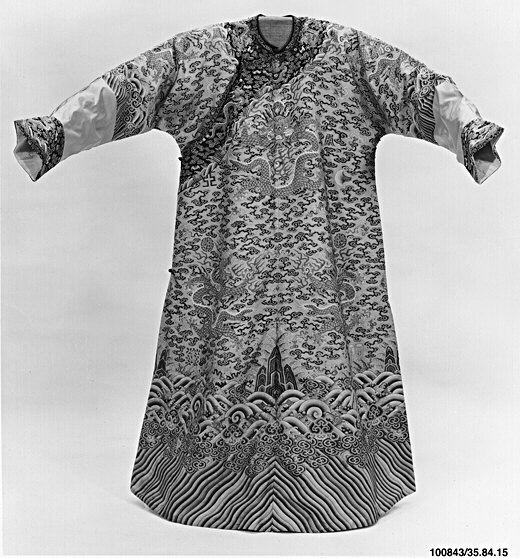
Deconstructing Imperial Majesty: The Emperor’s Twelve-Symbol Robe
In the annals of global couture, few garments rival the Emperor’s Twelve-Symbol Robe for its synthesis of political authority, cosmological order, and artisanal mastery. This Qing dynasty masterpiece—crafted from lustrous silk and intricate metallic thread—transcends mere clothing to become a wearable constitution of the Chinese universe. For Katherine Fashion Lab, analyzing this robe is not an exercise in antiquarian nostalgia; it is a study in how materiality, symbolism, and hierarchical design can inform contemporary luxury’s quest for meaning. The robe stands as a testament to the power of deliberate, encoded aesthetics—a lesson in how every stitch can communicate sovereignty.
Materiality as Sovereignty: Silk and Metallic Thread
The foundation of the robe’s authority lies in its materials. Silk, cultivated for millennia in China, was not merely a textile but a state-monopolized resource, synonymous with refinement and imperial reach. Its natural luster and fluid drape created a surface that caught and reflected light, making the emperor a living, moving source of illumination—a metaphor for the sun’s life-giving force. The metallic thread, woven from flattened gold or silver, added a dimension of permanence and value. Gold, incorruptible and radiant, signified the emperor’s role as the “Son of Heaven,” whose mandate was as enduring as precious metal.
From a couture perspective, the interplay of silk and metal produces a paradoxical tactile experience: the softness of the fabric juxtaposed with the rigidity of the thread. This tension mirrors the emperor’s dual nature—human yet divine, gentle yet absolute. The metallic thread also introduces a structural element, stiffening the silk enough to maintain the robe’s voluminous silhouette, a visual proclamation of power. In modern terms, this is akin to using custom-woven brocade with integrated metallic fibers to create a garment that stands apart, both physically and symbolically.
The Twelve Symbols: A Visual Lexicon of Cosmic Governance
The robe’s most defining feature is its twelve symbols, each meticulously embroidered onto the silk. These are not decorative motifs but a codified language of rulership. The symbols include the sun, moon, stars, mountains, dragon, pheasant, temple cups, aquatic grasses, flames, grains of millet, an axe, and the fu symbol (a pair of animals representing discernment). Each carries a specific mandate: the sun, moon, and stars represent the emperor’s alignment with celestial cycles; mountains evoke stability and earth’s bounty; the dragon embodies imperial power and transformation; the pheasant symbolizes literary refinement; temple cups denote ritual piety; aquatic grasses suggest purity; flames signify brightness and judgment; grains represent agricultural prosperity; the axe stands for decisiveness; and the fu symbol indicates the ability to distinguish good from evil.
This system creates a hierarchical visual narrative. The symbols are arranged in three registers on the robe: the upper section features celestial and atmospheric symbols (sun, moon, stars, mountains), the middle section contains creatures and objects (dragon, pheasant, temple cups, grasses), and the lower section holds terrestrial and moral symbols (flames, grains, axe, fu). This vertical ordering mirrors the Chinese cosmological hierarchy—heaven above, earth below, and humanity in between. The emperor, by wearing the robe, literally embodies this structure, becoming the axis mundi.
For Katherine Fashion Lab, this offers a blueprint for narrative-driven design. Each symbol could be reinterpreted in a contemporary collection: a minimalist dragon rendered in metallic thread against a matte silk ground, or a stylized sun motif repeated asymmetrically across a gown. The key is to retain the symbolic weight without falling into literal reproduction. The robe teaches that luxury is not about excess but about intentional iconography—every element must serve the story of power, identity, or aspiration.
Color and Cut: The Language of Imperial Hierarchy
The robe’s color palette is equally codified. The primary hue is a deep, saturated yellow—specifically, the shade of imperial yellow reserved exclusively for the emperor. In Chinese color theory, yellow corresponds to the center, the earth element, and the emperor’s mediating role between heaven and earth. The metallic thread, often gold, reinforces this chromatic authority. Contrast accents in blue (for the sky), red (for fire and vitality), and black (for water and wisdom) appear in the symbols, creating a restrained but potent color harmony.
The cut of the robe is a full-length, wide-sleeved, cross-collared gown with a side closure. This silhouette, known as a longpao, is deliberately non-body-conforming. It drapes loosely, allowing the robe to move with the emperor’s gestures, creating a visual effect of fluidity and omnipresence. The wide sleeves, often extending past the hands, emphasize the emperor’s role as a figure who is not bound by mundane labor. The cross-collar, closing from left to right, follows Manchu tradition and distinguishes the Qing court from earlier Han Chinese dynasties.
This design philosophy challenges contemporary fashion’s obsession with fit and body contour. Instead, the robe prioritizes symbolic form over physical form. For a modern couturier, this suggests that a garment can communicate authority through volume, drape, and color rather than through revealing the body. A power suit, for example, might adopt an exaggerated shoulder line or a trailing cape to evoke similar gravitas.
Technique: The Invisible Hand of Mastery
The robe’s creation required thousands of hours of labor by artisans in imperial workshops. The silk was handwoven, often in a satin weave to maximize luster. The metallic thread was produced by wrapping gold leaf around a silk core, then painstakingly embroidered using techniques such as couching (laying the thread on the fabric surface and securing it with small stitches) and satin stitch for flat, dense coverage. The symbols were often worked in kesi (slit tapestry) or su xiu (Su embroidery), known for its even stitches and ability to create subtle shading.
This level of craftsmanship is the antithesis of fast fashion. It demands a master-apprentice lineage and a tolerance for imperceptible perfection. For Katherine Fashion Lab, this underscores the value of artisanal partnerships. A modern couture house can commission embroiderers who specialize in metallic thread work, or develop new techniques using laser-cut metal appliqués that echo the historical method while embracing contemporary technology. The lesson: true luxury is not just in the material but in the invisible labor that transforms material into meaning.
Contextualizing the Robe for Modern Couture
In a standalone study, the Emperor’s Twelve-Symbol Robe offers a masterclass in branding through symbolism. Just as the robe communicated the emperor’s cosmic mandate, a luxury house today must communicate its values through every garment. The robe’s symbols are not random; each is a deliberate choice that reinforces the wearer’s identity. Similarly, a designer can create a “symbol system” for a collection—a recurring motif (a geometric pattern, a specific flora, a mythological creature) that becomes the collection’s signature.
Moreover, the robe’s hierarchical composition can inspire runway presentation. Imagine a show where garments ascend from earth tones to celestial blues and golds, mirroring the robe’s vertical cosmology. The finale piece could be a gown with embroidered symbols that tell a story of creation, governance, or transcendence. This is not costume but couture with a thesis.
Finally, the robe’s material dialogue between silk and metal invites innovation. Katherine Fashion Lab could explore hybrid fabrics—silk blended with conductive metallic threads for interactive garments, or silk woven with recycled gold fibers as a statement on sustainability and value. The emperor’s robe was a static object of reverence; a modern interpretation could be dynamic, responsive, and personal.
Conclusion: The Robe as Eternal Prototype
The Emperor’s Twelve-Symbol Robe is far more than a historical artifact. It is a prototype for how clothing can encode power, cosmology, and identity. Its silk and metallic thread are not just materials but metaphors—for permanence, for light, for the intersection of human craft and cosmic order. For Katherine Fashion Lab, this robe is a reminder that the most enduring couture is that which carries a narrative, demands mastery, and respects the weight of every symbol. In a world of fleeting trends, this imperial garment stands as an immutable standard: a garment that is not worn, but inhabited.