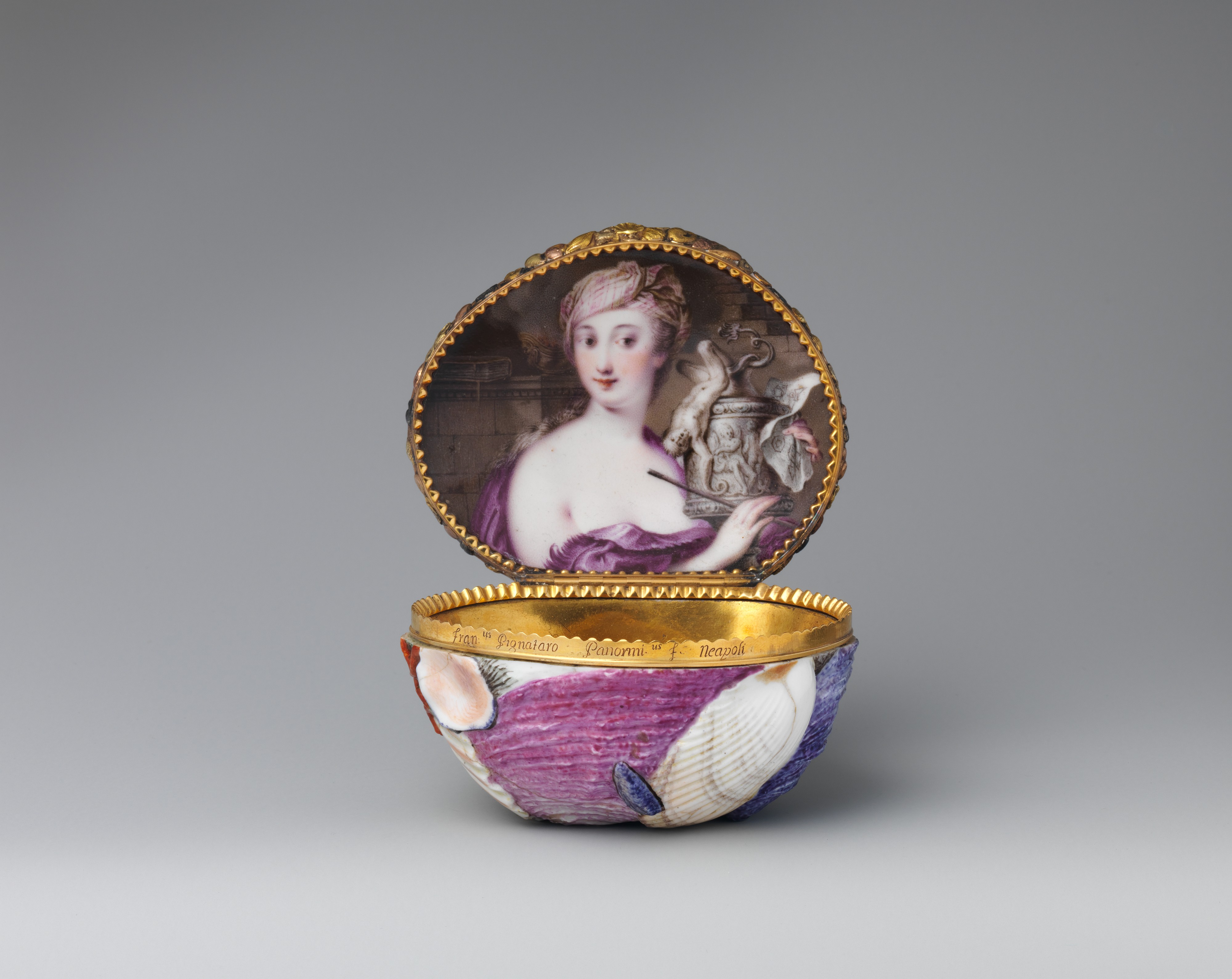
The Snuffbox: A Microcosm of Global Heritage in Porcelain and Gold
In the rarefied domain of couture analysis, the snuffbox—a diminutive object of personal luxury—transcends its utilitarian origins to become a profound artifact of cultural synthesis. At Katherine Fashion Lab, we examine this piece not merely as a container for powdered tobacco, but as a masterclass in the confluence of material science, artistic tradition, and global trade networks. Crafted from soft-paste porcelain and adorned with polychrome enamels, then set in sumptuous gold mounts, this snuffbox embodies a heritage that spans continents and centuries. Its analysis reveals the intricate dialogue between Eastern ceramic innovation and Western decorative ambition, a narrative that resonates deeply with contemporary luxury’s emphasis on provenance and cross-cultural storytelling.
Material Alchemy: Soft-Paste Porcelain as a Testament to Innovation
The Quest for Translucency and Whiteness
Soft-paste porcelain, the substrate of this snuffbox, represents a pivotal chapter in the history of ceramic technology. Unlike hard-paste porcelain, which required kaolin clay and petuntse stone—materials native to China—European artisans in the 18th century labored to replicate its luminosity through experimental recipes. This snuffbox’s body is a composite of white clay, ground glass, and lime, fired at lower temperatures to achieve a creamy, vitreous surface. The result is a canvas of remarkable delicacy, one that absorbs enamel pigments with a softness that hard-paste cannot emulate. For the couture analyst, this material choice signals a deliberate pursuit of artistic authenticity over industrial precision. The slight imperfections—a subtle warping, a minute crackle in the glaze—are not flaws but signatures of human craftsmanship, echoing the hand of the artisan who shaped it.
Polychrome Enamels: The Language of Color and Narrative
The decoration of this snuffbox employs polychrome enamels, a technique that demands exceptional skill. Each hue—whether the deep cobalt of a distant landscape, the rose-pink of a floral garland, or the gilded accents that catch candlelight—is applied in successive firings. The palette is not arbitrary; it reflects the global exchange of pigments. The blue derives from cobalt oxide, sourced from mines in Saxony or Persia; the reds and yellows from iron and antimony, traded along maritime routes. The enamels depict a pastoral scene, likely inspired by French or German rococo motifs, yet the composition bears traces of Chinoiserie—a willow tree, a pagoda-like structure—indicating the artist’s engagement with Eastern iconography. This hybridization is deliberate: the snuffbox becomes a narrative vessel, telling a story of cultural curiosity and commercial ambition.
Gold Mounts: The Architecture of Prestige
Structural and Symbolic Functions
The gold mounts—the hinged lid, the rim, and the base—are not mere embellishments but integral to the object’s identity. In the 18th century, gold served as both a status marker and a practical safeguard, protecting the fragile porcelain from chipping. The mounts are crafted with precision: the hinges operate with a silken resistance, the clasp clicks with authority. The gold’s alloy, likely 18-karat, exhibits a warm patina that speaks to age and careful handling. From a couture perspective, the mounts function as the snuffbox’s tailoring, defining its silhouette and ensuring its portability. They transform a ceramic plaque into a wearable accessory, one that could be slipped into a waistcoat pocket or displayed on a mantelpiece.
Engraving and Chasing: The Hand of the Goldsmith
Closer inspection reveals intricate chasing and engraving on the gold—scrollwork, acanthus leaves, and a monogram, perhaps of the original owner. These details are executed with a burin, each stroke a testament to the goldsmith’s mastery. The monogram, likely belonging to a European aristocrat or merchant, personalizes the object, linking it to a specific lineage. In the context of global heritage, this personalization underscores the snuffbox’s role as a cultural intermediary. It was an object that facilitated social rituals—the offering of snuff, the exchange of pleasantries—while simultaneously embodying the wealth derived from colonial trade. The gold itself may have originated from mines in the Americas, refined in Europe, and set by a craftsman in Paris or London. Thus, the snuffbox is a microcosm of the global economy, its materials drawn from three continents.
Contextualizing the Snuffbox: A Standalone Study in Luxury and Legacy
The Ritual of Snuff-Taking as a Social Canvas
To understand this snuffbox fully, one must consider its original context: the ritual of snuff-taking in the 18th and 19th centuries. Snuff was not merely a stimulant but a social lubricant, a gesture of refinement. The snuffbox was an extension of the self, displayed during conversations, negotiations, and courtships. Its materiality—the coolness of porcelain, the weight of gold—enhanced the sensory experience. For Katherine Fashion Lab, this ritual mirrors the modern luxury experience: the unboxing of a couture piece, the tactile pleasure of fabric, the weight of a bespoke accessory. The snuffbox is a precursor to the personalized luxury object, a standalone study in how material culture encodes status, taste, and identity.
Global Heritage as a Design Philosophy
Labeling this snuffbox as “Global Heritage” is not an academic abstraction but a design philosophy. The object’s creation required knowledge systems from China (porcelain technology), the Islamic world (enamel techniques), and Europe (goldworking). It traveled through trade networks—the East India Companies, the Silk Road’s maritime offshoots—and was adapted to local tastes. The soft-paste porcelain, for instance, was Europe’s attempt to emulate Chinese hard-paste, a process that involved industrial espionage and technological leapfrogging. The polychrome enamels, meanwhile, drew on Persian and Venetian traditions. This snuffbox is thus a synthesis of global artisanal intelligence, a object that could not exist without the cross-pollination of cultures.
Implications for Contemporary Couture
For the modern designer, this snuffbox offers a lesson in narrative-driven craftsmanship. Its value lies not in the sum of its materials but in the stories they tell. The porcelain’s fragility speaks to the risk of innovation; the gold’s permanence, to the desire for legacy. In an era of fast fashion and digital saturation, the snuffbox reminds us that luxury is a slow, deliberate process—a dialogue between maker, material, and history. Katherine Fashion Lab advocates for a return to this ethos, where each piece is a standalone study, a repository of global heritage. The snuffbox, in its quiet elegance, challenges us to see couture not as a product but as a cultural artifact, one that bridges past and present, East and West, utility and art.
In conclusion, this soft-paste porcelain snuffbox, with its polychrome enamels and gold mounts, is far more than a relic. It is a testament to human ingenuity, a node in the network of global exchange, and a benchmark for the kind of thoughtful, heritage-infused design that defines true luxury. As we analyze its contours and colors, we are reminded that the most profound statements in fashion are often found in the smallest details.