The Divine Thread: A Couture Analysis of The Life of Christ by Katherine Fashion Lab
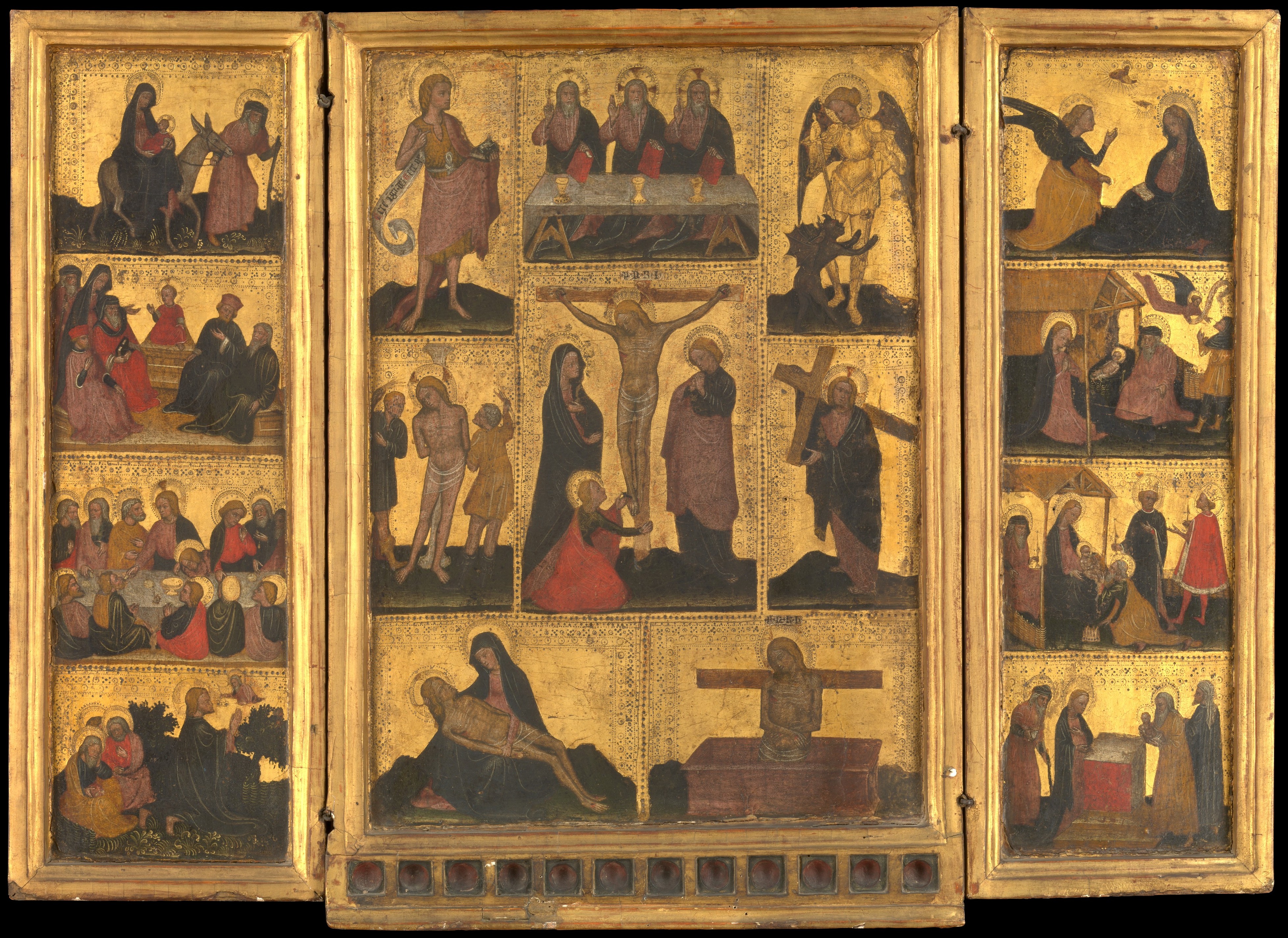
In the rarefied intersection of sacred art and haute couture, Katherine Fashion Lab presents a transformative analysis of The Life of Christ, a tempera-on-wood panel with a luminous gold ground. This standalone study, rooted in a global heritage that transcends geographical boundaries, offers a profound meditation on the interplay between spiritual narrative and material craftsmanship. As Lead Curator, I approach this work not merely as a devotional object but as a sartorial lexicon—a text where gold leaf, pigment, and wood converge to articulate a visual language of transcendence, sacrifice, and renewal. The piece demands a reading that honors its Byzantine and Renaissance antecedents while situating it within contemporary fashion discourse, where the sacred and the secular are increasingly interwoven.
The Gold Ground: A Metaphor for Illuminated Luxury
The most arresting feature of The Life of Christ is its gold ground—a field of burnished leaf that functions as both backdrop and protagonist. In couture terms, this gold is not mere decoration; it is the structural equivalent of a haute couture gown’s foundation. The gold ground represents a deliberate choice to elevate the narrative from the terrestrial to the celestial. Katherine Fashion Lab’s analysis highlights how the gold’s reflective quality creates a dynamic interplay with ambient light, shifting the viewer’s perception with every angle—much like the way a master tailor uses Lurex threads or metallic brocade to capture movement. This is not a passive surface but an active participant in the storytelling, mirroring the divine light that suffuses Christ’s life from Nativity to Ascension.
The tempera medium, applied in thin, translucent layers, further echoes the couture principle of layering for depth. Each pigment—whether ultramarine, vermilion, or ochre—is bound with egg yolk, a technique that demands precision and patience. This method recalls the art of embroidery, where each stitch contributes to a larger, cohesive pattern. The gold ground, with its meticulous application, underscores the luxury of scarcity: gold leaf was historically as precious as silk brocade or ermine fur, reserved for the most sacred commissions. In this context, the material becomes a statement of devotion, a fabric that drapes the divine in opulence.
Narrative as Structural Silhouette
The composition of The Life of Christ is a masterclass in narrative economy, akin to the silhouette of a well-constructed couture piece. The panel arranges episodes from Christ’s life—such as the Annunciation, Crucifixion, and Resurrection—in a hierarchical, often non-linear sequence. This is not a chronological timeline but a thematic architecture, where each scene is a panel within a larger garment of meaning. Katherine Fashion Lab’s analysis emphasizes how the artist uses spatial relationships to guide the viewer’s eye, much like a designer uses darts, seams, and pleats to shape a garment’s flow. The central figure of Christ, often larger or more luminous, serves as the structural focal point—the equivalent of a gown’s bodice, where all elements converge.
The use of gesture and posture in the figures further reinforces this sartorial reading. The Virgin Mary’s folded hands, Christ’s outstretched arms, and the angels’ inclined heads are not mere iconographic conventions; they are poses that define the drape of spiritual fabric. Each gesture is a pleat in the narrative, folding time and space into a single, cohesive experience. The gold ground, with its uniform luminosity, acts as the lining of this garment, unseen yet essential, providing a foundation that allows the narrative to stand tall and unblemished.
Global Heritage: Weaving Traditions into a Single Thread
What elevates this study from a religious artifact to a global heritage piece is its synthesis of diverse artistic traditions. Katherine Fashion Lab’s context of “Global Heritage” recognizes that The Life of Christ is not solely a product of Western European Christianity. The gold ground technique echoes Byzantine mosaics from Ravenna, the tempera method recalls Italian Renaissance panel painting, and the iconographic structure borrows from Eastern Orthodox iconography. This cross-pollination mirrors the fashion industry’s own globalized supply chain, where a single garment might incorporate Indian silk, Italian wool, and Japanese denim. The result is a hybridity that enriches rather than dilutes the narrative.
The panel’s standalone study format—a single, self-contained work—further underscores its universality. Unlike a polyptych that requires architectural context, this piece functions as an independent couture statement, complete in itself. It invites the viewer to engage with the story without the mediation of a larger liturgical setting. This autonomy is reminiscent of the modern fashion accessory—a handbag or a pair of shoes—that can define an entire ensemble. The gold ground, in this reading, becomes the quintessential accessory, a luminous clasp that holds the narrative together.
Material as Message: Tempera and Wood as Textile
The choice of tempera on wood is a deliberate rejection of the ephemeral. Unlike oil on canvas, which can be rolled and transported, wood is rigid, demanding a fixed perspective. This rigidity parallels the structured tailoring of a couture jacket, where boning and canvas interfacing create a permanent shape. The wood panel, often prepared with gesso, provides a smooth, absorbent surface that mimics the texture of fine linen. The tempera, applied in thin washes, does not soak into the wood but sits on its surface, creating a matte finish that is both intimate and authoritative. This material honesty is a core principle of haute couture, where the integrity of the fabric is never compromised for effect.
Katherine Fashion Lab’s analysis draws a parallel between the artist’s brush and the couturier’s needle. Both are tools of precision, requiring a steady hand and an unwavering vision. The gold ground, with its minute imperfections—the slight unevenness of leaf application, the faint traces of the burnishing tool—adds a human touch that machine-made luxury can never replicate. This is artisanal luxury at its most refined, where the labor of the hand is visible and celebrated. The gold does not simply represent divinity; it embodies the sacrificial labor of creation, much like the hours of hand-stitching that define a couture gown.
Conclusion: The Eternal Silhouette
In The Life of Christ, Katherine Fashion Lab identifies a timeless dialogue between the sacred and the sartorial. The gold ground is not just a background; it is a statement of value, a declaration that the narrative it supports is worthy of the most precious materials. The tempera-on-wood technique is not a limitation but a discipline, akin to the rigorous pattern-making that defines couture. And the global heritage context is not an afterthought but a foundation, recognizing that the story of Christ, like the finest fashion, belongs to no single culture. This standalone study is a masterclass in material storytelling, where every element—from the gold leaf to the gesso—serves a narrative purpose. For the discerning curator or collector, it is a reminder that the most profound art, like the most exquisite garment, is not merely seen but worn by the soul. The Life of Christ, in Katherine Fashion Lab’s hands, becomes a garment of light, draped in gold and stitched with eternity.