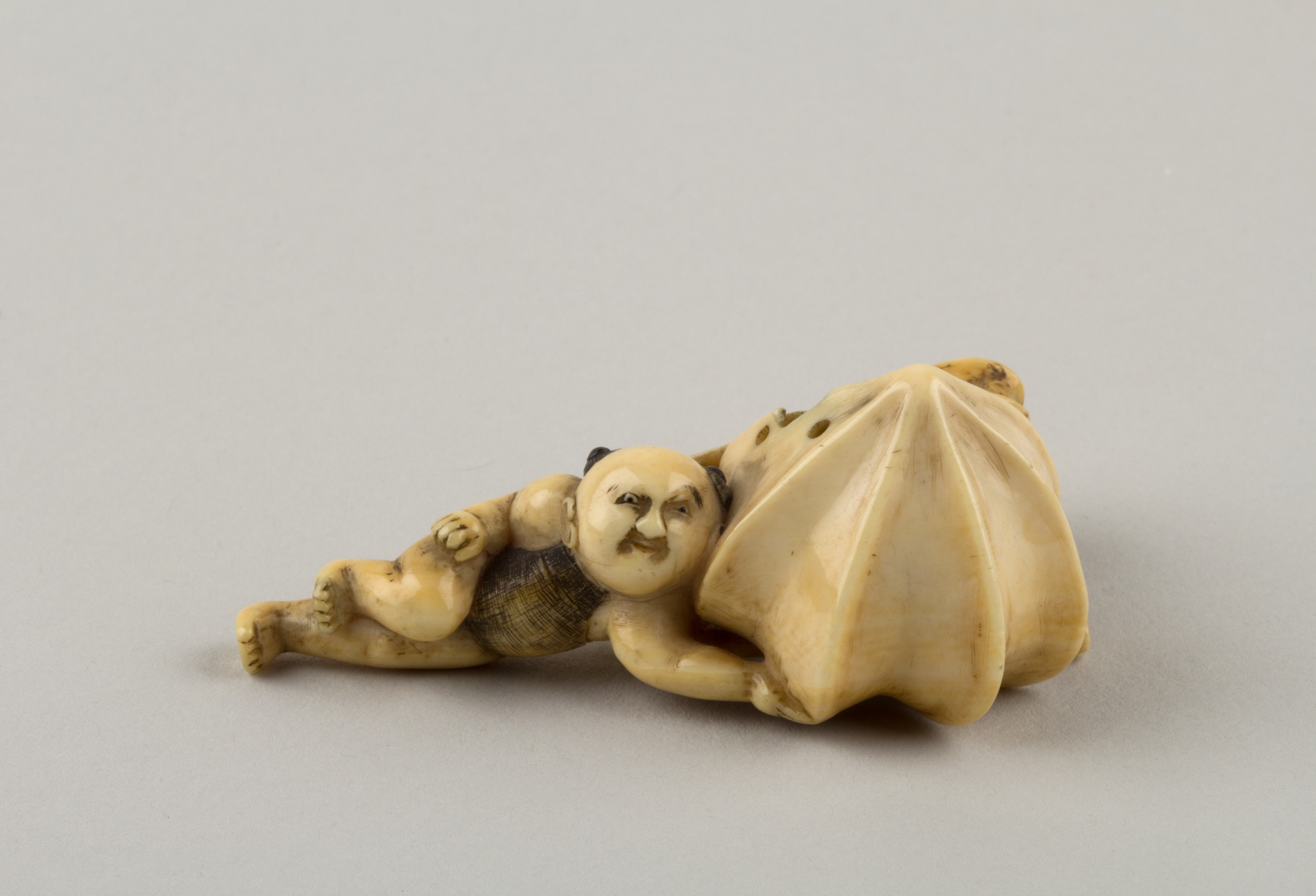
Heritage Analysis: Netsuke of Boy Carrying a Branch of Fruit
Introduction: The Object as Cultural Artifact
The Netsuke of a Boy Carrying a Branch of Fruit, carved from ivory in Edo-period Japan (circa 17th–19th century), represents a pinnacle of miniature sculptural artistry and symbolic communication. As a lead heritage curator for Katherine Fashion Lab, this analysis positions the netsuke not merely as a historical accessory but as a strategic repository of symbolic power, historical adornment, and spiritual meaning. For a 2026 high-end luxury strategy, this object offers a blueprint for embedding layered cultural narratives into modern design, leveraging scarcity, craftsmanship, and metaphysical resonance to elevate brand equity.
Symbolic Power: The Boy, the Branch, and the Fruit
The netsuke’s iconography—a youthful male figure bearing a branch laden with fruit—encodes multiple layers of meaning within Japanese and broader East Asian cosmology. The boy (often interpreted as a child or adolescent) symbolizes continuity, vitality, and the promise of lineage. In Shinto and Buddhist traditions, youth represents the untainted potential of life, a vessel for spiritual growth. The branch of fruit, frequently identified as persimmon, peach, or pomegranate, carries distinct connotations: abundance, longevity, and fertility. The peach, in particular, is a Daoist symbol of immortality, while the pomegranate’s many seeds evoke prosperity and familial expansion.
In the context of Japan’s hierarchical Edo society, netsuke served as status markers for merchant and samurai classes. A boy carrying fruit thus signified not only personal wealth but also the bearer’s hope for a flourishing household and successful progeny. For Katherine Fashion Lab, this duality—public status and private aspiration—offers a rich template for luxury storytelling. A 2026 collection could embed similar double-coded symbolism: an exterior of opulence paired with an interior narrative of growth, legacy, or spiritual fulfillment. This aligns with the rising demand for conscious luxury, where consumers seek objects that resonate with personal values rather than mere display.
Historical Adornment: Netsuke as Functional Art
The netsuke’s physical form—a compact, durable toggle—was integral to traditional Japanese dress. Men’s kimono, lacking pockets, required a sagemono (hanging pouch) suspended from the obi (sash) via a cord, with the netsuke acting as a counterweight. This functional necessity elevated the netsuke to an object of intimate daily use, handled, admired, and passed down through generations. The Boy Carrying a Branch of Fruit exemplifies the carver’s mastery of negative space, with the branch wrapping around the figure to create a natural cord hole, ensuring both aesthetic harmony and utility.
From a heritage perspective, this fusion of form and function is critical. In high-end luxury, adornment must serve a purpose beyond decoration. The netsuke teaches that the most enduring designs are those that integrate utility with artistry—a principle now echoed in the slow fashion movement. For Katherine Fashion Lab, this suggests a 2026 strategy that prioritizes multifunctional accessories: a brooch that doubles as a pendant, a belt buckle with a hidden compartment, or a bag charm that carries personal talismans. Such pieces honor the netsuke’s legacy while meeting contemporary desires for versatility and sustainability.
Spiritual Meaning: The Ivory Medium and Transience
The choice of ivory as the medium is fraught with spiritual and ethical significance. In Japanese culture, ivory (from elephant or walrus tusks) was prized for its warmth, durability, and capacity for fine detail. It was also imbued with protective qualities, believed to ward off evil spirits and bring good fortune. The natural grain of ivory, with its subtle variations, was seen as a reflection of impermanence (mujo), a core Buddhist concept. The netsuke’s small scale—often no larger than a few centimeters—intensified this sense of preciousness, as the carver worked within the material’s organic limits.
However, the contemporary luxury landscape must confront the ethical implications of ivory use. The 2026 strategy for Katherine Fashion Lab cannot replicate the medium; instead, it must translate its spiritual essence into sustainable alternatives. Consider recycled precious metals, ethically sourced bone, or bio-resin composites that mimic ivory’s translucency. The spiritual meaning of protection and transience can be reimagined through engraved mantras, hidden gemstones, or modular designs that evolve with the wearer. By honoring the netsuke’s metaphysical role without its ecological cost, the brand aligns with regenerative luxury—a key trend for discerning clientele.
2026 High-End Luxury Strategy: From Heritage to Hyper-Relevance
To translate the Netsuke of Boy Carrying a Branch of Fruit into a 2026 luxury strategy, Katherine Fashion Lab must adopt a three-pillar framework: narrative depth, material innovation, and experiential resonance.
Pillar 1: Narrative Depth as Brand Equity
The netsuke’s power lies in its storytelling density. A single object conveys family, prosperity, protection, and artistry. For 2026, Katherine Fashion Lab should launch a “Heritage Icons” collection where each piece is accompanied by a curatorial dossier—digital or physical—detailing its symbolic origins. The Boy Carrying Fruit motif could be reimagined as a limited-edition brooch, with the fruit cast in 18-karat gold and the boy’s form in matte black titanium, referencing Edo-era contrasts. Each purchase includes a QR code linking to a virtual exhibition on Japanese netsuke history, deepening the consumer’s emotional investment. This approach leverages cultural capital as a differentiator in a saturated market.
Pillar 2: Material Innovation with Ethical Imperative
Replace ivory with lab-grown diamond dust composite or recycled porcelain, materials that echo ivory’s smoothness and luminosity while championing sustainability. The branch could be rendered in reclaimed wood from Japanese temples, adding a layer of provenance and spiritual authenticity. For the fruit, consider enamel inlay using natural pigments—indigo for abundance, vermilion for longevity. This material palette not only avoids ethical pitfalls but also appeals to the eco-luxury consumer who demands transparency and traceability. The 2026 strategy should publish a “Material Ethics Report” alongside the collection, reinforcing trust.
Pillar 3: Experiential Resonance through Ritual
Netsuke were handled daily, their textures and meanings absorbed through touch. Katherine Fashion Lab can resurrect this ritualistic intimacy by designing “daily talisman” accessories—a ring with a rotating bezel revealing a hidden fruit motif, or a cuff that clicks into place like a netsuke toggle. Host private workshops where clients learn the history of Japanese toggles and co-create their own symbolic charms, guided by master artisans. This transforms the purchase into a transformative experience, aligning with the 2026 trend of “experiential luxury” where memory outweighs material possession.
Conclusion: The Netsuke as a Strategic North Star
The Netsuke of Boy Carrying a Branch of Fruit is far more than a historical curiosity; it is a strategic artifact that distills centuries of symbolic, spiritual, and functional wisdom into a single, portable form. For Katherine Fashion Lab, this object illuminates a path toward meaning-driven luxury in 2026—one that honors tradition while embracing ethical innovation, and that elevates the consumer from a buyer to a custodian of heritage. By weaving the netsuke’s narrative into every facet of design, materiality, and client engagement, the brand can achieve not just market relevance but cultural permanence. The boy carrying fruit carries not just a branch, but a legacy—and it is this legacy that will define the future of high-end luxury.