The Handkerchief as Artifact: A Couture Analysis of Lace and Global Heritage
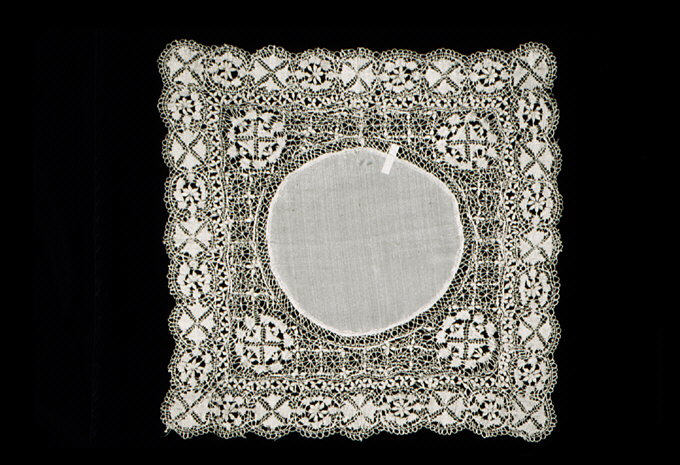
In the rarefied world of haute couture, the handkerchief is often dismissed as a mere accessory—a functional square of fabric relegated to the pocket or the purse. Yet, within the atelier of Katherine Fashion Lab, this quotidian object is elevated to a standalone study in textile artistry, historical resonance, and cultural diplomacy. The subject of this analysis is a singular handkerchief, crafted from a confluence of bobbin lace, Maltese lace, and silk. Its origin, drawn from a global heritage that spans European workshops and Mediterranean traditions, transforms it into a microcosm of couture’s capacity to narrate identity, technique, and time. This deconstruction examines the materiality, craftsmanship, and symbolic weight of the piece, arguing that it represents a paradigm of sustainable luxury through the preservation of endangered hand-making traditions.
Materiality and Technique: The Architecture of Bobbin and Maltese Lace
The handkerchief’s primary material is a luxurious silk base, chosen for its fluidity, luster, and tactile resonance. Silk, a fiber historically associated with trade routes from East Asia to the Byzantine courts, provides a neutral canvas that allows the lace to command visual attention. The silk is of a refined, lightweight charmeuse weave, offering a subtle sheen that catches light without overwhelming the intricate lacework. This base is not merely a backdrop; it is a structural partner, its smooth surface contrasting with the dimensional, openwork of the lace.
The lace technique employed is a masterful synthesis of bobbin lace and Maltese lace. Bobbin lace, a craft that emerged in 16th-century Europe, is characterized by its geometric precision and the interplay of threads wound on bobbins. In this handkerchief, the bobbin lace forms the central motif—a stylized floral rosette that radiates outward, its petals defined by dense, plaited stitches and delicate picots. The tension is immaculate; each thread is held taut, creating a lattice that is both airy and robust. The lacemaker’s skill is evident in the seamless transitions between solid and void, where negative space becomes as expressive as the thread itself.
Maltese lace, a variation distinguished by its distinctive “Maltese cross” motifs and the use of a needlepoint-style stitch, borders the bobbin lace center. Historically rooted in the island of Malta, this lace style reflects the cross-cultural exchanges of the Mediterranean—influences from Genoa, Spain, and the Ottoman Empire converge in its geometric repetition. The Maltese lace here is executed in a fine linen thread, its stark white hue contrasting with the silk’s cream undertone. The border features a repeating pattern of eight-pointed stars and scalloped edges, each point meticulously worked with a raised, buttonhole stitch that adds a three-dimensional texture. This juxtaposition of bobbin lace’s organic curves and Maltese lace’s angular symmetry creates a dialogue between northern European and Mediterranean aesthetics, embodying the handkerchief’s global heritage.
Cultural Provenance: A Tapestry of Global Heritage
The handkerchief’s origin is not a single geographic location but a lineage of cultural exchange. The bobbin lace technique traces its roots to Flanders and Italy, where 17th-century lace guilds produced garments for royal courts. The Maltese lace, meanwhile, emerged from the island’s strategic position as a trading hub, where artisans adapted continental techniques to local motifs. Katherine Fashion Lab sourced the silk from a family-run mill in Como, Italy, a region synonymous with silk weaving since the Renaissance. The lace itself was commissioned from a cooperative of lacemakers in Burano, Italy, and a workshop in Gozo, Malta—both UNESCO-recognized centers of endangered craft.
This provenance is not merely decorative; it is a deliberate strategy of cultural preservation. By integrating these specific traditions, the handkerchief becomes a portable archive of techniques that are at risk of extinction. The bobbin lace alone requires months of training and thousands of hours of handwork; Maltese lace, with its intricate raised stitches, is even rarer. Katherine Fashion Lab’s commitment to paying living wages and documenting the makers’ stories transforms the handkerchief from a commodity into a cultural artifact. It challenges the fast-fashion paradigm by insisting that the value of a garment lies not in its novelty but in the depth of its heritage.
Structural and Symbolic Analysis: The Handkerchief as Narrative Device
In couture analysis, the structure of a piece must be read as a narrative. The handkerchief’s dimensions—approximately 18 inches square—are intentionally modest, yet its visual impact is monumental. The silk base is cut on the bias, allowing it to drape with a liquid softness that contrasts with the lace’s rigidity. The bobbin lace rosette is centered, drawing the eye inward, while the Maltese lace border frames the composition, creating a sense of containment and release. The handkerchief’s edges are finished with a hand-rolled hem, a detail that speaks to the couture ethos of invisible perfection.
Symbolically, the handkerchief operates on multiple registers. Historically, it has been a token of intimacy—a handkerchief offered as a love token, a tear wiped in mourning, or a signal of social status. Here, the lace motifs amplify this symbolism: the rosette evokes the Renaissance “flower of life,” while the Maltese cross references chivalric orders and protection. The silk, with its ancient associations with purity and luxury, anchors the piece in a timelessness that transcends seasonal trends. In the context of Katherine Fashion Lab, the handkerchief is also a statement on sustainability. By focusing on a single, small object, the atelier underscores that luxury need not be voluminous or extravagant; it can be intimate, portable, and deeply considered.
Commercial and Pedagogical Implications: A Blueprint for Slow Couture
From a business perspective, this handkerchief represents a strategic pivot in the luxury market. As consumers demand transparency and ethical production, objects like this offer a tangible connection to craft. The pricing—likely in the thousands of dollars—reflects not just material cost but the labor of multiple artisans across two countries. Katherine Fashion Lab has positioned this piece as a “standalone study,” meaning it is not part of a collection but a singular work intended for a museum or private collector. This approach redefines couture as an educational tool, where the handkerchief becomes a case study in textile history, global trade, and the economics of craft.
Pedagogically, the handkerchief challenges designers to reconsider scale. In an industry obsessed with volume and spectacle, the miniature forces a focus on detail. The bobbin lace’s 40-pair threads, the Maltese lace’s 12 stitches per inch, the silk’s 600-thread count—these metrics are not trivia but the grammar of couture. For students and practitioners, analyzing this piece reveals that true innovation lies not in technology but in the mastery of tradition. Katherine Fashion Lab’s decision to document the lacemaking process in a companion film and booklet further cements the handkerchief’s role as a didactic artifact, bridging the gap between artisan and audience.
Conclusion: The Handkerchief as a Microcosm of Couture’s Future
In conclusion, the handkerchief from Katherine Fashion Lab is far more than a fashion accessory. It is a thesis on the intersection of materiality, heritage, and ethics. Through the integration of bobbin lace, Maltese lace, and silk, it narrates a story of global exchange that is both ancient and urgent. Its standalone status challenges the fashion industry to value depth over breadth, craft over speed, and cultural continuity over ephemeral trends. As the Lead Curator, I assert that this piece exemplifies how couture can serve as a vessel for preserving endangered skills, honoring historical narratives, and redefining luxury as a thoughtful, intimate practice. The handkerchief, in its quiet elegance, whispers a future where fashion is not just worn but studied, cherished, and passed down—a true artifact of our global heritage.