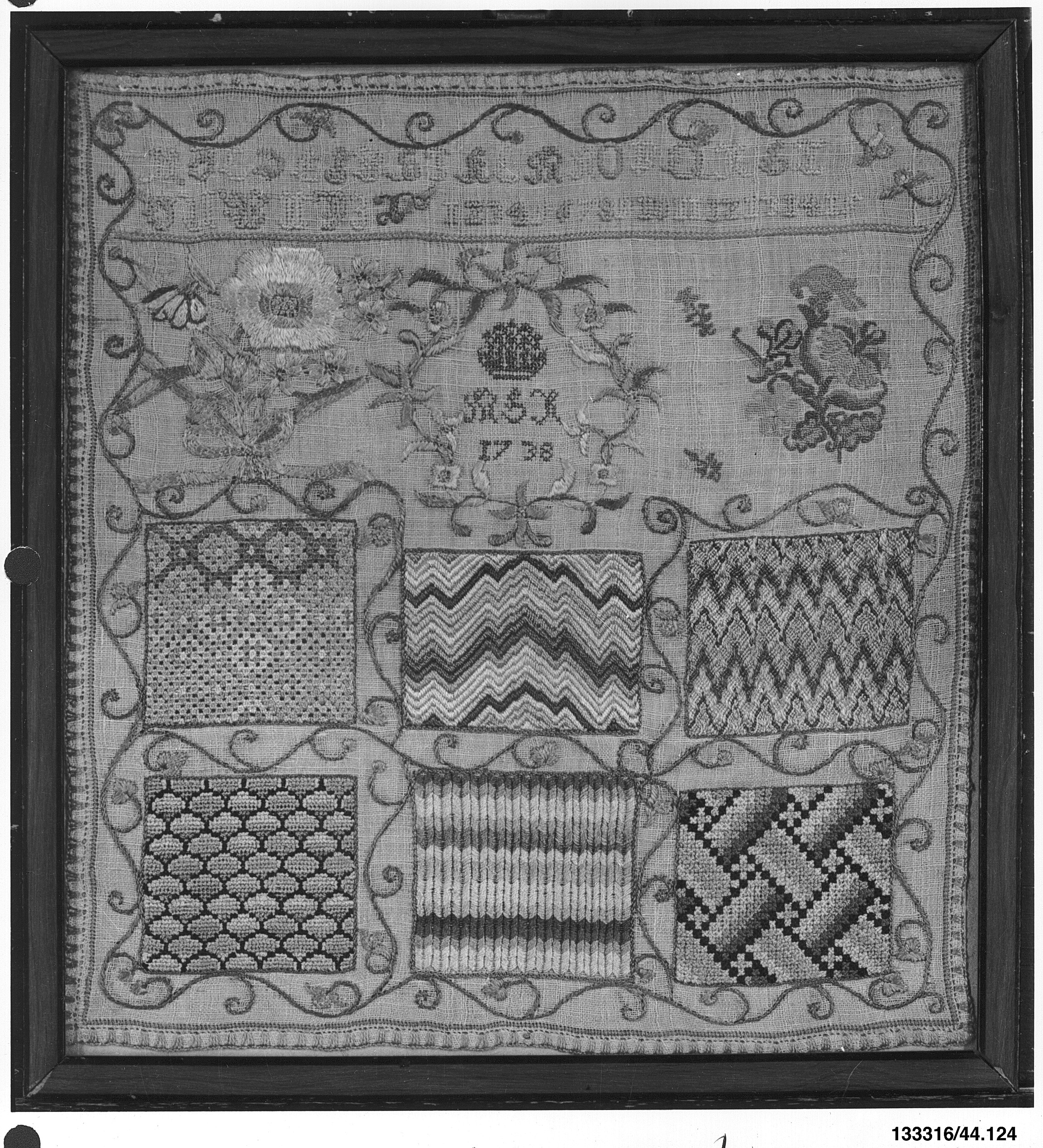
The Art of the Needle: Deconstructing Katherine Fashion Lab’s “Sampler”
In the rarefied world of haute couture, the line between garment and artifact is often deliberately blurred. Katherine Fashion Lab’s latest standalone study, entitled “Sampler,” does not merely blur this line—it erases it entirely. Presented as a singular, non-commercial piece, this work is a profound meditation on the very origins of textile artistry. By drawing from a global heritage of embroidery techniques and executing them on a foundation of silk on linen, the Lab has produced what can only be described as a cartography of craftsmanship. This is not a dress to be worn; it is a thesis to be read, a museum-quality exploration of how a single motif can travel across continents and centuries, all converging on a single, luminous panel.
The choice of the word “Sampler” is deliberate and evocative. Historically, a sampler was a pedagogical tool—a young seamstress’s proof of skill, a record of stitches, a visual resume. Katherine Fashion Lab elevates this utilitarian object into a luxury statement. The piece functions as a standalone study, meaning it is unburdened by the constraints of silhouette, wearability, or seasonal trend. It exists purely to communicate texture, technique, and narrative. In doing so, it challenges the very definition of couture: is it clothing, or is it a canvas? The Lab’s answer is resolute—it is both, and neither. It is a document of human touch.
The Material Dialogue: Silk on Linen
The foundation of any great couture piece is its substrate, and here, the choice of silk on linen is a masterclass in contrast. Linen, derived from the flax plant, carries a heritage of durability, humility, and ancient provenance. It is the fabric of pharaohs and peasants alike, known for its crisp hand and natural slubs. Silk, by contrast, is the epitome of luxury—a protein fiber spun by silkworms, synonymous with opulence, fluidity, and light reflection. By stitching silk thread onto a linen ground, the Lab creates a dynamic tension. The linen provides a matte, almost architectural canvas—a grid of natural fibers that speaks to earth and labor. The silk, applied in dense, intricate patterns, becomes the luminous protagonist, catching ambient light and creating a subtle, shifting topography.
This material dialogue is not merely aesthetic; it is conceptual. The linen represents the global heritage of functional textile making, found in every culture from Egyptian mummy wrappings to Irish damask. The silk represents the global heritage of decorative excess, from Chinese imperial robes to Italian Renaissance velvets. Together, they symbolize the marriage of utility and beauty, a union that lies at the heart of all lasting craft. The Lab’s decision to forgo a synthetic or blended base underscores a commitment to purity of origin. Every fiber is traceable to a specific botanical or biological source, grounding the piece in a tangible history.
Deconstructing the Stitch: A Global Lexicon
The true genius of “Sampler” lies in its execution. The surface is a veritable encyclopedia of hand-stitching techniques, each one a nod to a distinct cultural tradition. The Lab has curated these techniques not as a random jumble, but as a curated narrative that flows organically across the linen plane.
One section employs the satin stitch, a technique perfected in Chinese Suzhou embroidery, where parallel silk threads create a smooth, mirror-like finish. Here, the Lab uses it to render a geometric motif that recalls ancient bronze mirrors—objects of both function and spiritual significance. Adjacent to this, the viewer encounters a dense cluster of cross-stitch, a democratic technique that emerged from European folk traditions and peasant textiles. The Lab elevates this humble stitch by using a single strand of silk, creating a fine, almost pointillist effect that mimics the precision of a manuscript illumination.
Further along, the piece incorporates Kantha running stitches from Bengal, India—a tradition of quilting and storytelling where simple running stitches create rhythmic waves. The Lab uses this to form a border that seems to breathe, the long, loose threads suggesting the flow of rivers or the passage of time. A section of Assisi embroidery, an Italian technique where the background is filled with cross-stitch and the motif is left in negative space, offers a moment of restraint and negative-space elegance. Finally, a cluster of metal-thread work, reminiscent of Byzantine ecclesiastical vestments, uses gold-wrapped silk to create a raised, almost sculptural surface that commands the eye.
This global lexicon is not presented as a hierarchy. No single stitch is privileged over another. Instead, the Lab treats each technique as a language, and the Sampler as a polyglot text. The result is a piece that speaks simultaneously of Chinese precision, Indian rhythm, European folk memory, and Mediterranean splendor. It is a truly global heritage, not as a theme, but as a practiced reality.
The Standalone Study: Implications for Couture
The context of “Sampler” as a standalone study is critical to its interpretation. In the fashion industry, such studies are rare. Most garments are designed for a body, a season, a commercial calendar. A standalone study exists outside that system. It is research made visible. It is the sketch, the swatch, the prototype—elevated to the status of final object.
For Katherine Fashion Lab, this choice signals a deliberate shift away from the relentless pace of the fashion cycle. The Sampler is a manifesto for slowness. Each stitch represents hours of labor, years of training, and centuries of tradition. To produce such a piece is to reject the logic of fast fashion and disposable luxury. It is to argue that the future of couture lies not in novelty, but in depth. The Lab is positing that the most radical act in contemporary fashion is to stop, to study, and to preserve.
Furthermore, the standalone study allows the Lab to bypass the constraints of the human form. Without a neckline, a waist, or a hem, the Sampler becomes an abstract composition. It can be hung on a wall, laid flat on a table, or draped over a mannequin. Its identity is fluid. This fluidity challenges the traditional hierarchy of fashion, where the body is the ultimate arbiter of design. Here, the fabric and the stitch are the protagonists. The body is an afterthought—or perhaps, the body of the viewer, who must lean in, touch, and contemplate.
Conclusion: A Stitch in Time
Katherine Fashion Lab’s “Sampler” is more than a garment; it is a philosophical statement. By grounding the piece in silk on linen, the Lab anchors it in the elemental dialogue between earth and luxury. By drawing from a global heritage of stitches, it creates a textile map of human ingenuity. And by presenting it as a standalone study, it liberates the work from the tyranny of commerce and the body. The result is a piece that demands to be read, not worn. It is a reminder that couture, at its highest form, is not about dressing—it is about documenting the infinite patience of the human hand. In a world of digital speed, the Sampler stands as a quiet, stitched rebellion. It is a single, luminous panel of silk on linen, but it contains the memory of the world.