Deconstructing the Theatrical Silhouette: A Couture Analysis of Azuma Tōzō I as a Woman Carrying Two Bird Cages
Introduction: The Intersection of Ukiyo-e and Modern Luxury
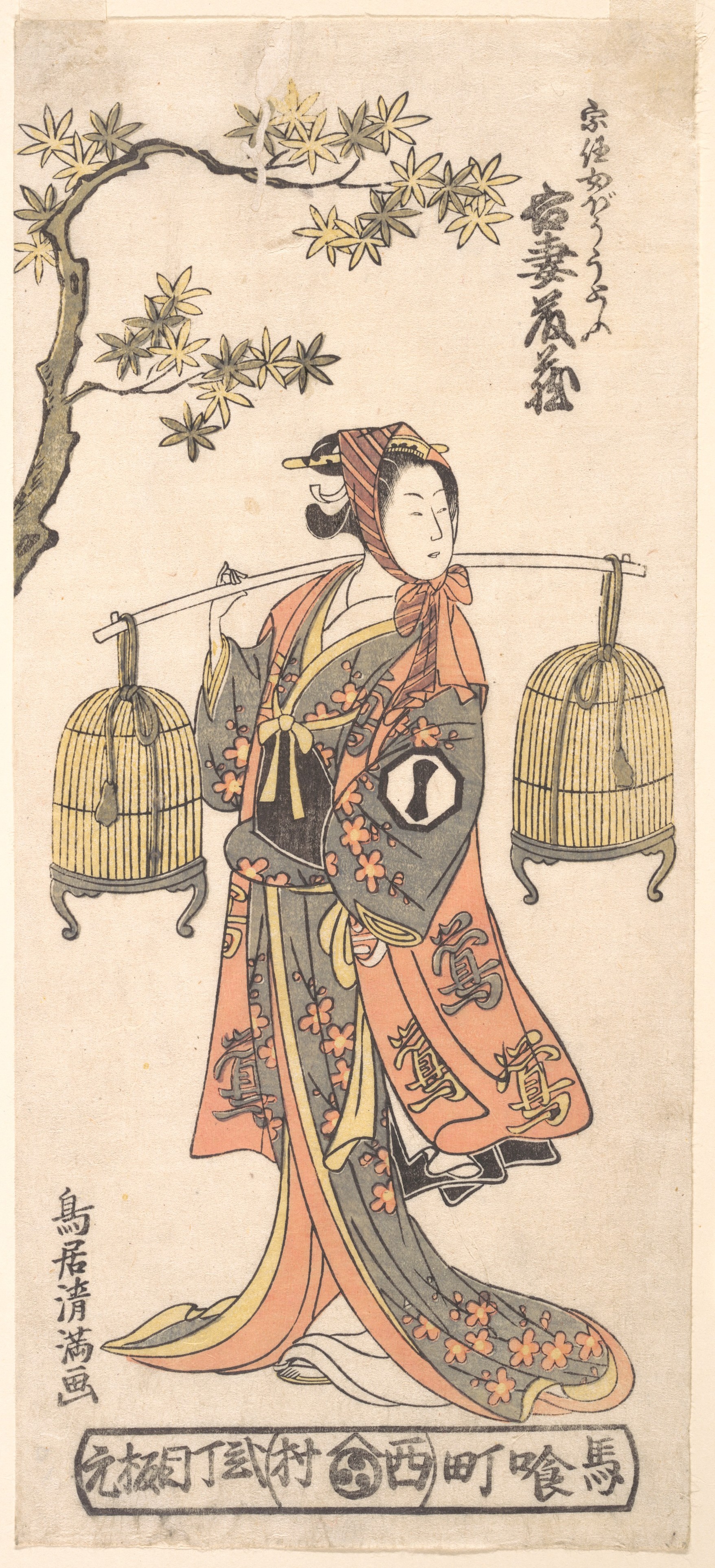
The woodblock print The Actor Azuma Tōzō I as a Woman Carrying Two Bird Cages, a masterwork of ink and color on paper from Edo-period Japan, presents a profound opportunity for couture analysis. At Katherine Fashion Lab, we approach this piece not merely as a historical artifact but as a living blueprint for narrative-driven design. The subject—a male onnagata (female-role actor) in the guise of a woman—embodies a duality that resonates deeply with contemporary luxury fashion’s exploration of gender fluidity, theatricality, and the tension between artifice and authenticity. This analysis dissects the print’s visual lexicon—its silhouette, color theory, texture, and symbolic accessories—to extract principles that can inspire a high-fashion collection. The actor’s pose, the layered garments, and the caged birds serve as metaphors for constraint and liberation, themes that are as relevant in the atelier as they were on the Kabuki stage.
The Silhouette: Layered Geometry and the Illusion of Movement
The print’s central figure is defined by an exaggerated, almost architectural silhouette. The kimono, with its sweeping obi (sash) and trailing sleeves, creates a triangular form that anchors the composition. From a couture perspective, this shape suggests a structured yet fluid garment—a hybrid of a tailored bodice and a voluminous skirt. The actor’s posture, with one hand delicately lifting the bird cage and the other steadying the second, introduces a diagonal tension that breaks the symmetry. This asymmetry is a critical design element: it implies motion, narrative, and a psychological weight.
In modern terms, this silhouette can be reimagined as a deconstructed kimono coat with exaggerated shoulder pads and a trailing train, paired with a high-waisted, pleated skirt that mimics the print’s vertical lines. The obi could be translated into a corseted belt that cinches the waist, creating an hourglass figure that contrasts with the looser outer layers. The sleeves, known as furisode in their most dramatic form, could be reinterpreted as detachable, floor-length panels that flutter with movement. This interplay between structure and flow—between the actor’s controlled pose and the fabric’s potential energy—is the essence of theatrical couture.
Color Palette: The Psychology of Contrast and Restraint
The print employs a restrained yet potent color scheme: deep indigo, muted ochre, soft vermilion, and the stark white of the actor’s face and hands. The indigo dominates the kimono, evoking both the night sky and the somber dignity of the character. The vermilion accents—on the obi, the cage details, and the lips—serve as focal points, drawing the eye to areas of narrative importance. The ochre of the bird cages introduces a natural, earthy counterpoint, while the white of the actor’s oshiroi (white makeup) creates a mask-like abstraction of the face.
For a couture collection, this palette can be deconstructed into a gradient of monochromatic blue tones, punctuated by strategic pops of red and gold. The indigo could be achieved through shibori (Japanese tie-dye) or digital printing that mimics the woodblock’s grain. Vermilion could appear as embroidered thread or lacquered buttons, while ochre might be woven into jacquard patterns that reference the cage’s lattice. The white face is a powerful symbol of transformation—it suggests that the garment itself is a mask, a second skin. This concept can be applied through the use of matte silk panels that frame the neck and wrists, creating a visual boundary between the wearer and the world.
Texture and Pattern: The Language of the Woodblock
The print’s texture is defined by the grain of the woodblock and the layering of pigments. The kimono’s pattern—likely a stylized floral or geometric motif—is rendered with a deliberate unevenness that lends it a handcrafted quality. In couture, this translates to techniques such as hand-painted silk, pleating, or patchwork that celebrates imperfection. The bird cages, with their fine wooden bars, suggest a lattice structure that could be recreated through cutwork or laser-cut leather overlays on a sheer base.
The actor’s hair, styled in an elaborate shimada (a traditional updo), is adorned with kanzashi (hair ornaments) that add a metallic shimmer. This detail inspires the use of gold-leaf embroidery or metal-threaded fringe on headpieces or collars. The contrast between the matte, absorbent paper of the print and the glossy ink highlights the importance of surface variation. A Katherine Fashion Lab garment would juxtapose raw silk with lacquered nylon or velvet with patent leather, creating a tactile dialogue that mirrors the print’s visual depth.
Symbolic Accessories: The Bird Cages as Wearable Sculpture
The two bird cages are the print’s most potent symbols. They represent confinement, performance, and the duality of the actor’s identity—a man trapped within the role of a woman, a bird trapped within its cage. From a couture standpoint, these cages can be reimagined as structured handbags or cage-like crinolines worn over the skirt. The birds themselves, likely small finches, suggest a delicate, fleeting beauty. They could be translated into feather appliqués or 3D-printed resin ornaments that dangle from the sleeves or hem.
The actor’s hands, with their graceful, elongated fingers, are crucial to the narrative. They cradle the cages with a tenderness that belies the constraints of the role. This gesture can inspire glove design—perhaps fingerless gloves with extended cuffs that mimic the sleeves, or gloves with embedded wire frames that allow the wearer to “hold” invisible objects. The cages also evoke the concept of layered transparency: a sheer organza overlay with a printed lattice pattern could suggest the bars, while the body beneath remains visible, trapped yet exposed.
Cultural and Theatrical Context: The Onnagata as Couture Muse
The onnagata tradition is central to understanding this print’s relevance. Azuma Tōzō I was celebrated for his ability to embody femininity with exaggerated grace, a performance that required both technical mastery and emotional depth. In couture, this translates to the idea of dressing as an act of transformation. The garment becomes a tool for embodying a character, whether that character is a historical figure or an abstract concept like power or vulnerability.
This print also reflects the Kabuki theater’s emphasis on mie (a dramatic pose) and kumadori (exaggerated makeup). The actor’s frozen moment—carrying the cages, gazing outward—is a tableau that demands attention. A couture piece inspired by this would prioritize dramatic silhouettes that command space, such as a cape with a 10-foot train or a dress with built-in structural hoops that echo the cages’ geometry. The makeup, with its stark white and red accents, can be reimagined as face-framing collars or hoods that obscure the wearer’s features, emphasizing the garment over the individual.
Conclusion: From Woodblock to Runway
The Actor Azuma Tōzō I as a Woman Carrying Two Bird Cages is not merely a print—it is a manifesto for the intersection of art, identity, and fashion. At Katherine Fashion Lab, we see in its lines, colors, and symbols a roadmap for creating garments that are both historically informed and radically modern. The actor’s duality challenges us to design for the fluid self, while the cages remind us that fashion is both a cage and a key. By translating the woodblock’s textures into tactile fabrics, its asymmetry into sculptural forms, and its narrative into wearable symbolism, we honor the print’s legacy while pushing the boundaries of couture. This is fashion as theater, as art, as liberation.