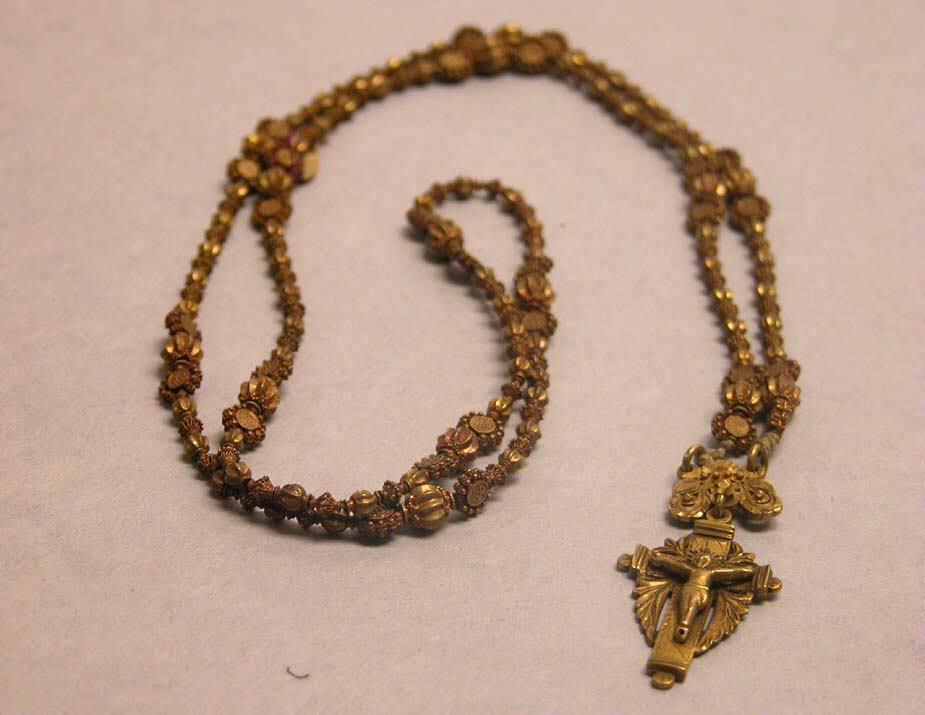
Heritage Analysis: The Philippine Gold Rosary as a Nexus of Symbolic Power and Luxury Strategy
Historical Resonance and DNA Correlation
The Philippine gold rosary, a devotional object crafted in the archipelago’s pre-colonial and colonial periods, embodies a profound duality that resonates with our earlier study on the Mirror with Split-Lea—a piece that juxtaposes “一面是光洁银镜上以黄金镶嵌的纷繁棕叶纹” (a polished silver mirror inlaid with intricate gold palm-leaf patterns) with “另一面是冰冷石棺板上以浮雕诉说的生命叙事” (a cold stone sarcophagus bearing a relief that narrates life). This correlation is not coincidental. Both artifacts mediate between the luminous and the somber, the eternal and the mortal. The rosary, like the mirror, functions as a threshold object: its gold beads reflect divine light, while its tactile sequence of prayers anchors the wearer in the corporeal journey toward salvation. In the Philippine context, the rosary became a hybrid artifact—a Catholic symbol fused with indigenous animist beliefs, where gold represented not only wealth but spiritual potency and ancestral connection. The DNA of this object lies in its ability to hold opposing forces: the opulence of gold and the humility of prayer, the colonial imposition and the native reinterpretation.
Symbolic Power and Historical Adornment
The rosary’s symbolic power in the Philippines is layered. As a historical adornment, it transcended its liturgical function to become a marker of identity, status, and resistance. During the Spanish colonial era (1565–1898), the rosary was both a tool of conversion and a badge of allegiance. Indigenous elites, known as principalía, commissioned gold rosaries to display their Christian piety while simultaneously asserting their pre-existing social hierarchies. Gold, mined locally and worked by Filipino artisans, signified autochthonous wealth—a subtle defiance against European control. The beads, often shaped like sampaguita flowers or palm leaves, echoed pre-colonial motifs of fertility and protection. This fusion created a wearable narrative: each bead a prayer, each prayer a thread connecting the wearer to heaven, ancestors, and community. The rosary thus became a portable altar, a declaration of faith that also whispered of indigenous resilience.
Spiritual Meaning and Material Transcendence
Spiritually, the Philippine gold rosary operates on multiple planes. The gold medium itself is significant: in Catholic theology, gold symbolizes the divine light of Christ; in indigenous cosmology, it is the metal of the sun and the gods. When worn, the rosary is not merely an accessory but a sacramental—a physical conduit for grace. The act of touching each bead while reciting prayers engages the body in a rhythmic meditation, grounding the spiritual in the tactile. This aligns with the Philippine concept of loob (inner self), where external actions reflect internal states. The rosary’s weight on the chest serves as a constant reminder of one’s moral obligations, while its gleam in candlelight evokes the promise of resurrection. For the wearer, it is both a shield against evil and a bridge to the divine—a material theology that elevates gold from mere ornament to sacred instrument.
2026 High-End Luxury Strategy: The Rosary as Heritage Asset
For Katherine Fashion Lab’s 2026 strategy, the Philippine gold rosary offers a blueprint for meaning-driven luxury. In an era where affluent consumers seek authenticity and spiritual depth, this artifact provides a narrative of cultural hybridity and artisanal mastery. The following strategic pillars emerge from this analysis:
1. Narrative-Driven Design: The rosary’s dual heritage—Catholic and indigenous—can be leveraged to create collections that tell stories of convergence. Pieces might incorporate palm-leaf motifs in gold filigree, echoing the Mirror with Split-Lea’s interplay of light and shadow. Each piece would be accompanied by a provenance card detailing its symbolic DNA, appealing to collectors who value intellectual and emotional resonance.
2. Craftsmanship as Luxury: The rosary’s goldsmithing techniques—lost-wax casting, granulation, and filigree—are endangered skills. Katherine Fashion Lab can position itself as a custodian of heritage by collaborating with Filipino master artisans. This not only ensures exclusivity but also aligns with the slow luxury movement, where time and skill are the ultimate markers of value. Limited-edition rosaries, each requiring hundreds of hours, would command premium pricing.
3. Spiritual Wellness and Ritual: The 2026 luxury consumer is increasingly drawn to ritual objects that foster mindfulness. The rosary’s tactile, contemplative nature can be adapted into modern wellness accessories—such as gold prayer beads or meditation rings—that serve as daily anchors for intention-setting. Marketing should emphasize the transformative power of touch and repetition, positioning the piece as a tool for inner peace in a chaotic world.
4. Cultural Diplomacy and Exclusivity: By highlighting the rosary’s role in Philippine resistance and identity, Katherine Fashion Lab can tap into diaspora luxury—appealing to Filipino elites and global collectors who value cultural reclamation. Partnerships with museums or cultural foundations could create exhibition-only pieces, where the rosary is presented as both artifact and art object. This elevates the brand from fashion house to cultural institution.
5. Material Innovation: While gold remains central, the 2026 strategy can introduce sustainable alternatives such as recycled gold or ethically sourced gemstones, reflecting the rosary’s ethos of renewal. The Mirror with Split-Lea correlation suggests a design language of contrasts—polished vs. matte gold, openwork vs. solid forms—that can be explored in modular pieces, allowing wearers to customize their spiritual narrative.
Conclusion
The Philippine gold rosary is far more than a religious artifact; it is a cultural palimpsest where faith, power, and artistry converge. Its DNA—the interplay of light and shadow, life and death, colonial and indigenous—mirrors the Mirror with Split-Lea, offering Katherine Fashion Lab a rich lexicon for 2026 luxury. By honoring this heritage through authentic craftsmanship, spiritual resonance, and strategic storytelling, the brand can create objects that are not merely worn but lived. In a market saturated with ephemeral trends, the rosary stands as a testament to the enduring power of heritage—a gold thread connecting past, present, and the transcendent future.