Heritage Analysis: Javanese Gold Ear Ornaments – Symbolic Power, Historical Adornment, and Strategic Resonance for Katherine Fashion Lab
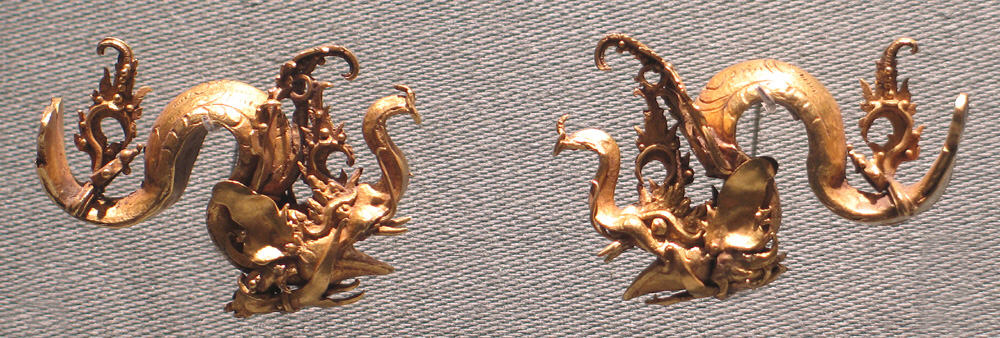
The pair of gold ear ornaments from Java, Indonesia, represents a confluence of spiritual authority, social hierarchy, and metallurgical mastery. As Lead Heritage Curator for Katherine Fashion Lab, I present this analysis within the context of our ongoing research into historical resonance, specifically the dialectic between reflective surfaces and narrative depth—as exemplified by the Mirror with Split-Leaf study. This piece, with its dualistic nature (one side mirroring light, the other bearing life stories), finds a profound parallel in Javanese ear ornaments: they are simultaneously objects of radiant display and repositories of spiritual meaning.
Symbolic Power and Spiritual Meaning in Javanese Adornment
In Javanese cosmology, gold is not merely a precious metal but a material imbued with divine luminosity (cahya). Ear ornaments, particularly those worn by royalty and nobility, served as conduits for spiritual protection and status affirmation. The symbolic power of these ornaments lies in their capacity to mediate between the earthly and the celestial. The circular or semi-circular form, often found in Javanese earrings, echoes the cosmic cycle of life and death, akin to the split-leaf motif that bifurcates into narrative and reflection. The gold’s imperishability represents eternal truth (satya), while the ornament’s placement on the ear—a sensory organ—signifies receptivity to wisdom and divine will.
Historically, these ear ornaments were not passive accessories. They were active agents in ritual contexts, used in court ceremonies (upacara) to channel ancestral blessings. The intricate filigree or granulation techniques—often depicting floral or geometric patterns—encode spiritual meaning: the lotus suggests purity rising from muddy existence; the spiral signifies the soul’s journey toward enlightenment. This aligns with our Mirror with Split-Leaf study, where one surface reflects external reality while the other narrates internal transformation. The ear ornament, similarly, is a threshold object—it marks the boundary between the wearer’s inner spiritual state and their public persona.
Historical Adornment: Gold as Social Currency and Cosmic Anchor
In pre-colonial Java (particularly the Majapahit and Mataram periods), gold ear ornaments were markers of social stratification. The weight, purity, and complexity of design directly correlated with the wearer’s rank. Kings and queens wore ear ornaments so heavy they required structural support from headdresses—a literal embodiment of the burden of leadership. This historical adornment practice reveals a key insight for luxury strategy: ornamentation as responsibility. The wearer is not merely displaying wealth but carrying the weight of lineage, tradition, and communal expectation.
The materiality of gold in Javanese culture also holds a unique position. Unlike in Western contexts where gold signifies opulence alone, Javanese gold is often described as emas murni (pure gold) with spiritual connotations. The alloying process—mixing gold with copper to achieve a reddish hue (emas tua)—was a guarded secret, believed to imbue the piece with protective energy. This resonates with our Mirror with Split-Leaf analysis: the silver mirror (reflective, cold) paired with gold inlay (warm, narrative) creates a dialectic of materials. The ear ornament, with its polished surface catching light and its textured underside bearing symbolic motifs, mirrors this duality.
DNA Correlation with the Mirror with Split-Leaf Study
Our research into the Mirror with Split-Leaf revealed a core tension: the dichotomy between surface and depth. The mirror’s silver side offers immediate reflection—a moment of clarity—while the gold-inlaid split-leaf motif on the reverse tells a story of growth, division, and rebirth. The Javanese ear ornament embodies this same DNA. The visible, outward-facing surface of the earring—often smooth, polished, and catching ambient light—represents the public self: composed, radiant, and socially legible. The hidden or inward-facing side, frequently engraved with mantras, floral patterns, or geometric symbols, represents the private self: spiritual, ancestral, and narrative-rich.
This correlation suggests that high-status Javanese individuals lived in a state of permanent duality, much like the mirror. The ear ornament was not just decoration but a mnemonic device, reminding the wearer of their obligations to both the visible world (court, politics, alliances) and the invisible world (ancestors, gods, cosmic order). For Katherine Fashion Lab, this offers a powerful model for luxury as layered meaning—where an object’s value is not monolithic but unfolds across dimensions of history, spirituality, and personal identity.
2026 High-End Luxury Strategy: From Artifact to Archetype
Translating this heritage into a 2026 high-end luxury strategy requires a departure from conventional trends. The Javanese ear ornament offers three strategic pillars for Katherine Fashion Lab:
1. The Duality Principle in Product Design
Luxury clients in 2026 will seek objects that offer multiple readings. Just as the Javanese earring has a public and private face, our collections should incorporate reversible, transformable, or hidden-detail elements. Imagine earrings with a polished gold front and an engraved narrative back—perhaps using micro-etching or enamel to tell a story of personal or brand heritage. This satisfies the desire for discreet luxury (visible only to the wearer or close confidants) while maintaining outward prestige. The Mirror with Split-Leaf study validates this: the most compelling luxury objects are those that reward intimacy.
2. Material as Metaphor: Gold’s Spiritual Rebranding
In 2026, gold must be repositioned not as a symbol of excess but as a medium of spiritual continuity. Marketing narratives should emphasize gold’s permanence, its role in ancestral rituals, and its capacity to carry energy. Javanese tradition offers a lexicon: cahya (divine light), satya (truth), murni (purity). These concepts can be woven into brand storytelling, differentiating Katherine Fashion Lab from competitors who rely on Western notions of luxury. For instance, a limited-edition collection could be named Cahya Gold, with each piece accompanied by a provenance card explaining the spiritual symbolism of its design.
3. The Weight of Heritage: Craftsmanship as Narrative
Javanese ear ornaments were made by empu (master artisans) who underwent spiritual purification before working gold. This process—meditation, fasting, ritual chants—imbued the object with intentionality. For 2026, Katherine Fashion Lab should partner with surviving Javanese goldsmiths or train artisans in these techniques, offering a certification of spiritual craftsmanship. This is not mere nostalgia; it is a response to the luxury market’s growing demand for authenticity and provenance. Clients will pay a premium for objects that carry a lineage of meaning, not just aesthetic appeal.
4. The Split-Leaf Aesthetic: Narrative in Form
The split-leaf motif from our study—a leaf bifurcating into two distinct paths—can be translated into earring designs that embody choice and destiny. For instance, asymmetrical earrings where one side is polished (reflection) and the other is textured (narrative) would directly echo the mirror’s duality. This aligns with 2026’s trend toward imperfect, handcrafted luxury where asymmetry signals authenticity. The symbolic power of the split-leaf—representing life’s bifurcations—resonates with contemporary consumers navigating identity, career, and spirituality.
Conclusion: The Ear Ornament as Strategic Archetype
The Javanese gold ear ornament is not a relic but a strategic archetype for Katherine Fashion Lab. Its fusion of symbolic power, historical adornment, and spiritual meaning offers a blueprint for luxury that transcends ephemeral trends. By embracing the duality principle—where surface and depth coexist—we can create objects that are not only beautiful but transformative. The Mirror with Split-Leaf study has shown us that the most resonant luxury is that which reflects the external world while narrating the internal journey. In 2026, Katherine Fashion Lab will lead by honoring this heritage, turning ancient Javanese wisdom into a contemporary language of prestige, purpose, and permanence.