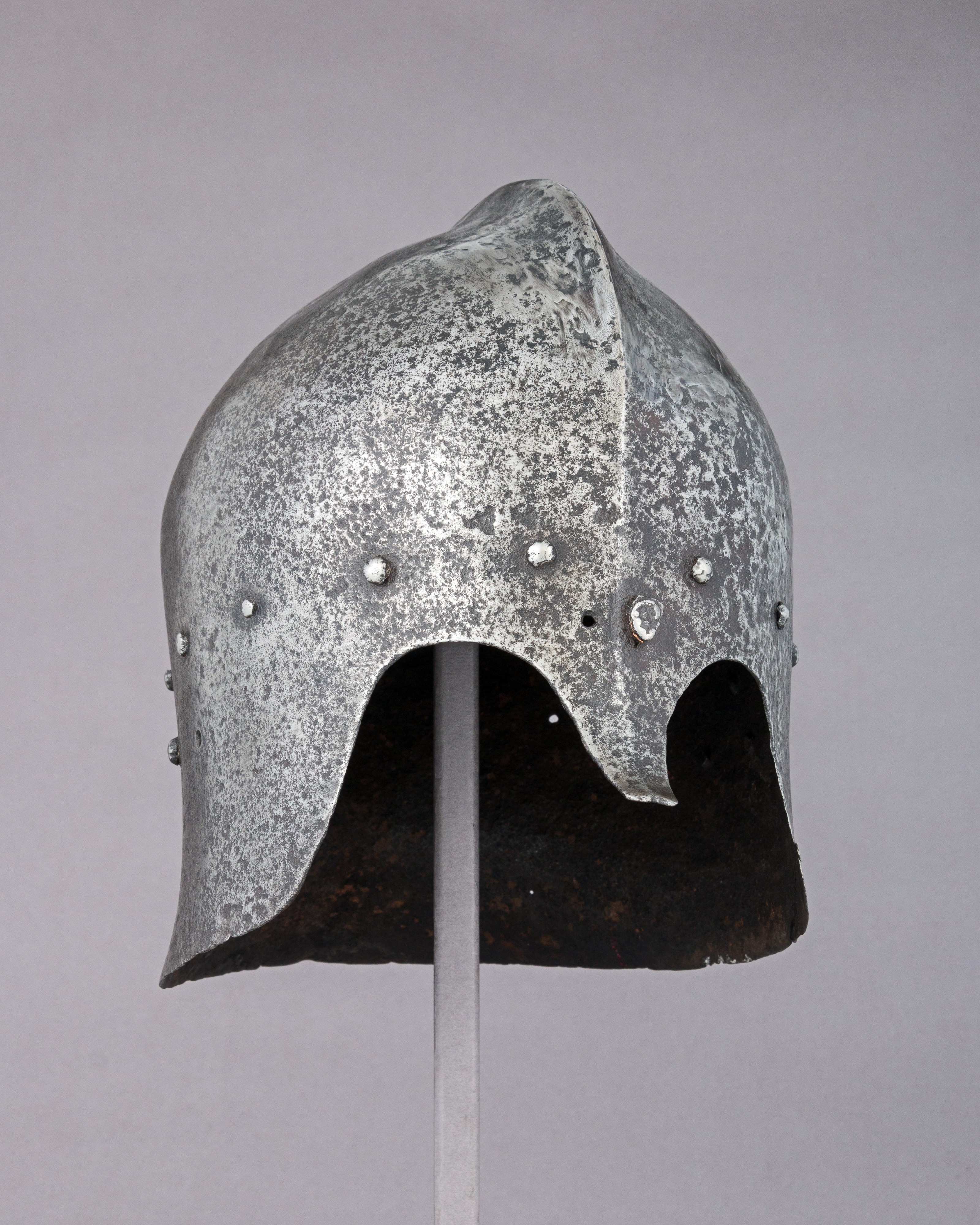
The Barbute with Nasal: A Study in Steel and Silhouette
In the rarefied world of haute couture, inspiration often emerges from the most unexpected intersections of history, craft, and materiality. At Katherine Fashion Lab, our latest standalone study ventures into the realm of medieval armor, specifically the Italian Barbute with Nasal, forged from steel. This piece, a quintessential example of 15th-century Milanese armor, offers a profound dialogue between form and function, protection and expression. Its analysis transcends mere historical curiosity, presenting a masterclass in structural elegance, ergonomic precision, and the enduring power of silhouette—principles that resonate deeply within contemporary fashion design.
The Barbute: A Historical and Aesthetic Framework
The barbute, derived from the Italian barbuta (bearded helmet), emerged in the early Renaissance as a response to evolving combat needs. Unlike its predecessors, the barbute was characterized by a streamlined, close-fitting skull that hugged the contours of the head, often extending to cover the cheeks and jaw. The addition of a nasal—a vertical bar protecting the nose—created a distinct T-shaped facial opening, blending visibility with defense. This design was not merely utilitarian; it reflected the Italian Renaissance’s obsession with proportion, geometry, and the human form.
From a couture perspective, the barbute’s silhouette is a study in negative space and structural balance. The smooth, unadorned dome of the helmet contrasts sharply with the angular, protruding nasal, creating a visual tension that is both aggressive and refined. The steel material, typically polished to a mirror-like sheen, amplifies this duality—its reflective surface simultaneously conceals and reveals, much like the interplay of light and shadow in a draped fabric. For Katherine Fashion Lab, this piece serves as a reminder that the most compelling designs often emerge from the tension between hard and soft, static and dynamic.
Materiality and Craft: Steel as a Couture Medium
Steel, in the context of armor, is a material defined by its contradictions. It is rigid yet malleable under heat, heavy yet capable of being shaped into forms that appear weightless. The craftsmanship required to forge a barbute is akin to the haute couture atelier’s mastery of fabric: both demand an intimate understanding of the material’s limits and possibilities. The Italian armorer’s technique of raising—hammering a flat sheet of steel into a three-dimensional curve—parallels the French moulage method of draping fabric on a dress form. Each strike of the hammer, like each pin and stitch, is a decision that defines the final silhouette.
In our analysis, we focus on the nasal as a focal point. This small, protruding element is not merely functional; it is a statement of intent. Its placement at the center of the face creates a vertical axis that draws the eye downward, elongating the wearer’s profile. The polished steel catches light in a way that mimics the sheen of satin or silk, yet its cold, unyielding surface offers a tactile contrast. In a couture context, this interplay of texture and reflection can inspire treatments such as metallic embroidery, liquid-like finishes, or sculptural draping that echoes the nasal’s linear precision.
Ergonomics and the Body: The Silent Architecture of Fit
The barbute’s genius lies in its ergonomic design. Despite its intimidating appearance, the helmet was crafted to distribute weight evenly across the skull, allowing for prolonged wear without discomfort. The interior was often padded with linen or leather, creating a second skin that absorbed shock and regulated temperature. This attention to the body’s contours is a cornerstone of haute couture, where fit is paramount. The barbute’s close-fitting skull and articulated cheek pieces (when present) prefigure the modern concept of bespoke tailoring—a garment that moves with the wearer, not against them.
For our study, we deconstruct the barbute’s ergonomic principles into three key elements: balance, articulation, and interface. The helmet’s balance ensures that the weight is centered, much like a well-constructed jacket’s shoulder line. The articulation of the nasal, often riveted at its base, allows for slight movement, reducing strain on the nose—a detail that mirrors the flexibility of a gusset in a sleeve. The interface between the steel and the wearer’s skin, mediated by padding, is analogous to the lining of a coat, where comfort and structure converge. These principles inform our approach to designing armor-inspired garments that prioritize wearability without sacrificing aesthetic impact.
Silhouette and Symbolism: The Barbute as a Fashion Statement
Beyond its practical origins, the barbute carries deep symbolic weight. In Renaissance Italy, it was a marker of status, martial prowess, and individual identity—often personalized with crests or gilding. The nasal, while protective, also obscured the face, creating an aura of mystery and authority. This duality resonates in contemporary fashion, where armor-like silhouettes are employed to convey power, resilience, and transformation. Designers from Balenciaga to Rick Owens have drawn on similar visual vocabularies, using exaggerated shoulders, structured collars, and metallic finishes to evoke a sense of invincibility.
Our analysis identifies the barbute’s T-shaped opening as a key design motif. This inverted triangle, formed by the nasal and the brow line, is a framing device that directs focus to the eyes—the windows to the soul. In couture, this concept can be translated into necklines, collars, or even headpieces that frame the face with deliberate geometry. The steel’s reflective quality further enhances this effect, creating a dynamic interaction between the wearer and their environment. The barbute does not merely protect; it transforms the wearer into an object of contemplation, a living sculpture.
From Armor to Atelier: Translating the Barbute into Contemporary Couture
At Katherine Fashion Lab, we view the barbute as a blueprint for innovation. Its design principles—structural integrity, ergonomic fit, and symbolic resonance—are directly applicable to modern garment construction. For instance, the helmet’s dome shape can inspire a cape or a coat’s hood, using rigid materials like structured leather or molded synthetics to recreate its volume. The nasal’s linearity can be echoed in seams, boning, or even jewelry, creating a visual through-line that ties the entire ensemble together.
One potential application is the armored bodice, where steel-inspired panels are integrated into a fabric base. Using techniques like laser-cutting or thermoplastics, we can achieve the barbute’s balance of protection and flexibility. The T-shaped opening can be reinterpreted as a cutout at the neckline, drawing the eye upward and elongating the torso. The reflective surface of steel can be simulated with metallic foils, sequins, or liquid-like finishes that catch light in motion. This approach honors the original piece while pushing the boundaries of what couture can achieve.
Conclusion: The Enduring Legacy of the Barbute
The Italian Barbute with Nasal is more than a relic of medieval warfare; it is a testament to the intersection of art and utility. Its steel construction, ergonomic design, and powerful silhouette offer a rich vocabulary for contemporary fashion. In studying this piece, we are reminded that the most timeless designs are those that speak to the human condition—our need for protection, our desire for expression, and our fascination with form. At Katherine Fashion Lab, we carry this legacy forward, translating the barbute’s lessons into garments that are as functional as they are beautiful. The past, it seems, is always present, waiting to be reinterpreted through the lens of couture.