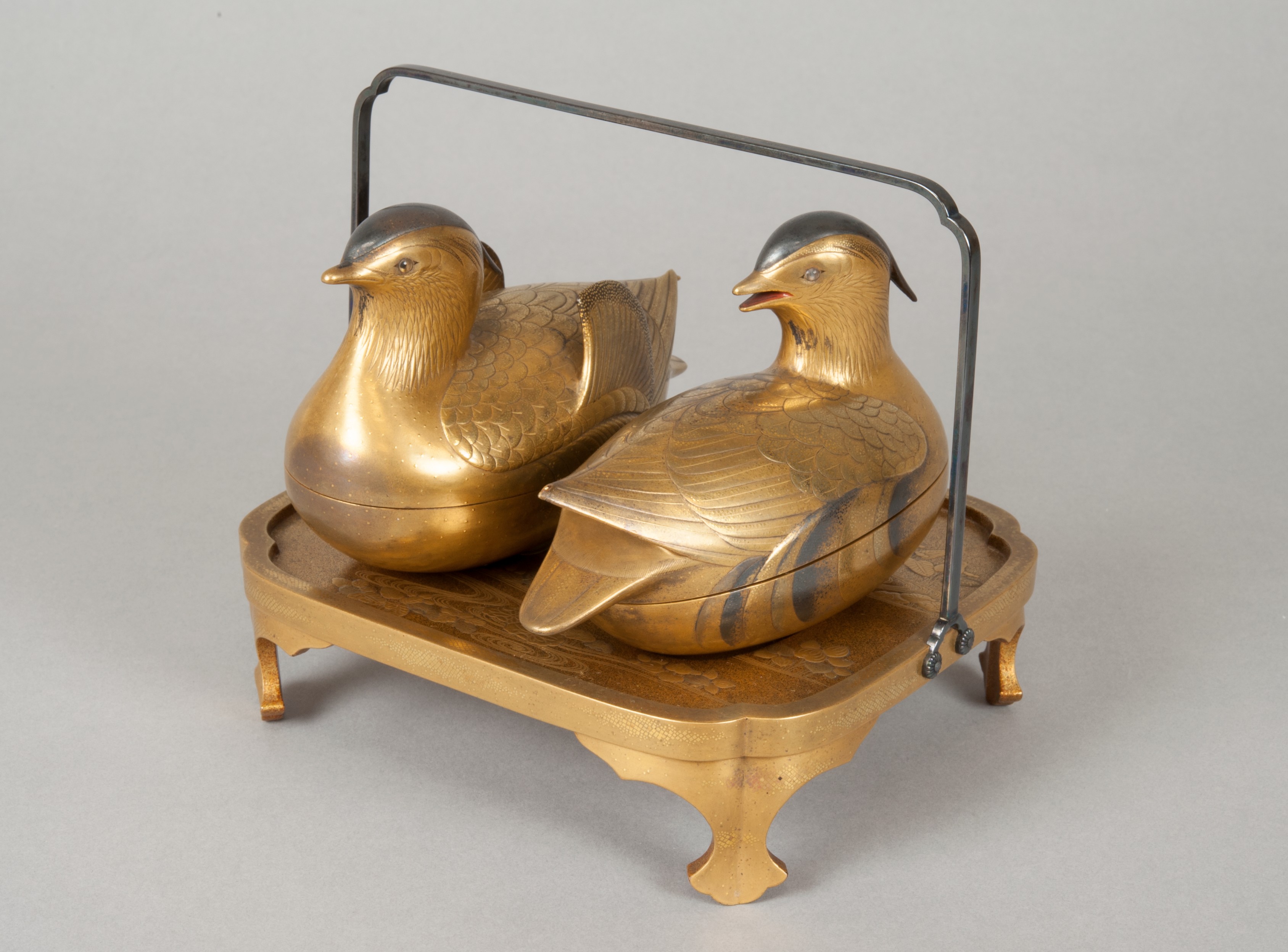
Artisanal Mastery: The Mandarin Duck Kōgō
The Pair of Incense Boxes (Kōgō) in the Shape of Mandarin Ducks represents a pinnacle of Japanese lacquer artistry, a testament to the meticulous craft of maki-e that has been refined over centuries. Created for the Katherine Fashion Lab’s standalone study, these objects transcend their functional role as containers for incense, emerging as profound statements of aesthetic philosophy and technical virtuosity. At first glance, the viewer is struck by the lifelike repose of the ducks, their forms rendered in lacquered wood and adorned with gold, silver, and intricate cutout foil applications. Yet, a deeper analysis reveals a sophisticated dialogue between nature, luxury, and the ephemeral — a hallmark of the highest echelons of decorative art.
The Lacquer as a Canvas: Material and Technique
The foundation of these kōgō lies in the lacquered wood, a material that has been central to Japanese craftsmanship since the Jōmon period. However, the true genius emerges in the application of takamaki-e (raised maki-e), hiramaki-e (flat maki-e), and togidashimaki-e (polished-out maki-e), techniques that require extraordinary precision and patience. The use of gold and silver powders, combined with cutout gold foil, creates a surface that is both tactile and visual — a microcosm of light and shadow. The raised areas of takamaki-e, built up with layers of lacquer and metallic dust, give the ducks’ plumage a sculptural quality, as if the feathers are ready to ruffle in a gentle breeze. In contrast, the hiramaki-e areas provide a smooth, reflective base that captures the ambient light, while the togidashimaki-e technique, where the gold is polished flush with the lacquer, produces a seamless, mirror-like finish that suggests water’s surface.
This interplay of techniques is not merely decorative; it is a narrative device. The cutout gold foil application (kirikane) is strategically placed to highlight the ducks’ eyes and beak details, drawing the observer’s gaze to the creatures’ sentient expressions. The result is a sense of movement frozen in time — a moment of quiet intimacy between two ducks, perhaps a pair, symbolizing fidelity and harmony in Japanese culture. The choice of mandarin ducks is deliberate: in East Asian symbolism, they represent marital bliss and devotion, making these kōgō not just objects of utility but vessels of emotional resonance.
Design Philosophy: The Aesthetics of Wabi-Sabi and Luxury
From a couture analysis perspective, the kōgō embody a paradox central to Japanese aesthetics: the fusion of wabi-sabi (the beauty of imperfection and transience) with opulent materials. The lacquer’s deep, glossy black or dark brown base — a signature of urushi — is a nod to the simplicity of wabi-sabi, yet it serves as a stark contrast to the radiant gold and silver. This tension between austerity and extravagance is a deliberate design choice, reflecting the Japanese concept of iki (refined elegance). The ducks’ forms are naturalistic but not hyper-realistic; they are stylized to evoke the essence of the species rather than a literal depiction. The slight asymmetry in the placement of the foil and the subtle variations in the maki-e layers introduce a human touch, a reminder that these objects were crafted by hand, not machine.
Moreover, the standalone study context elevates these kōgō beyond their original ceremonial use. In traditional tea ceremonies, incense boxes were functional, but here, they are presented as autonomous works of art. This shift in context demands a reevaluation of their design: the ducks are not merely containers but protagonists in a visual narrative. The pair’s orientation — one duck slightly turned toward the other — suggests a dialogue, a silent exchange that invites the viewer to project meaning. This is couture-level storytelling, where every curve and contour is calibrated to evoke an emotional response.
Comparative Analysis: The Kōgō in the Global Luxury Landscape
When placed alongside contemporary luxury objects — such as a Hermès silk scarf or a Cartier jewelry piece — the kōgō hold their own, but on entirely different terms. Western luxury often emphasizes brand identity, innovation in materials, and mass appeal, even in limited editions. In contrast, the kōgō derive their value from cultural lineage and artisanal scarcity. The techniques used — takamaki-e, hiramaki-e, togidashimaki-e — require decades of training to master, and each box is a unique artifact, not a reproduction. The use of precious metals is restrained, applied not for ostentation but for harmony with the lacquer’s depth. This aligns with the Japanese principle of shibui (understated elegance), where beauty is revealed gradually, not shouted.
From a market perspective, these kōgō would appeal to collectors who value heritage craftsmanship over trend-driven design. The ducks’ symbolism — fidelity, peace, and natural beauty — resonates in an era where consumers increasingly seek objects with spiritual or emotional significance. In the realm of high fashion, where brands like Gucci and Louis Vuitton often appropriate Japanese motifs, the kōgō stand as authentic counterpoints: they are not inspired by Japanese culture; they are embodiments of it. For Katherine Fashion Lab, this piece serves as a benchmark for how traditional art can inform modern couture — not through mimicry, but through a deep understanding of material and meaning.
Conclusion: A Masterclass in Artisanal Couture
In conclusion, the Pair of Incense Boxes in the Shape of Mandarin Ducks is a masterclass in the synthesis of technique, symbolism, and design. The lacquered wood, transformed by gold and silver maki-e, becomes a medium for storytelling, while the ducks’ form bridges the natural and the crafted. This is not merely a decorative object; it is a philosophical statement about the intersection of luxury and impermanence. For the connoisseur, it offers a tactile and visual experience that transcends its utilitarian origins. As a standalone study, it challenges the viewer to see beyond function and into the soul of Japanese artistry — a lesson that every couture house should heed: true luxury is not about abundance, but about the deliberate, exquisite choice of every element. The kōgō are, ultimately, a quiet revolution in form, a whisper of gold in a world of noise.