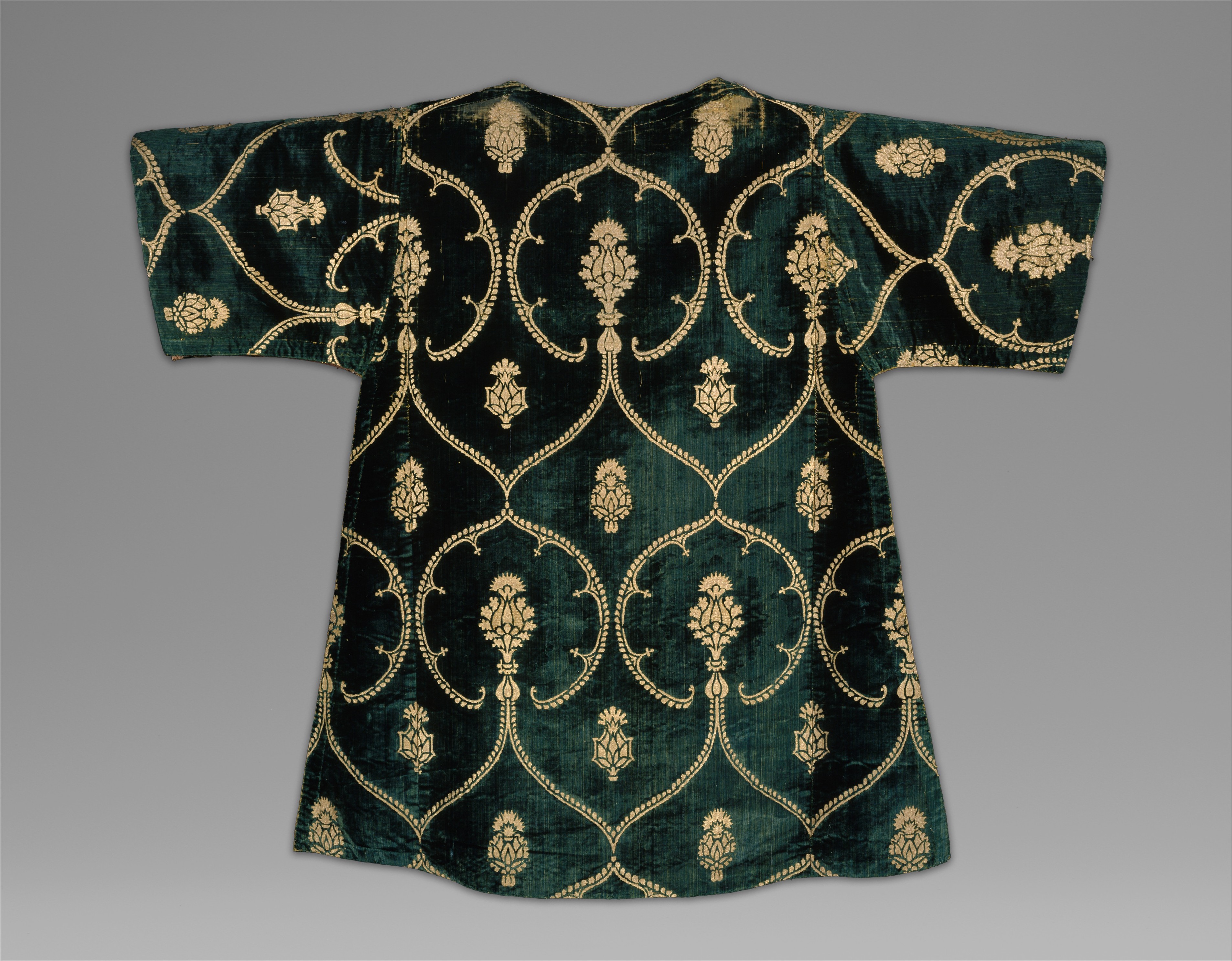
Deconstructing the Dalmatic: A Study in Italian Opulence at Katherine Fashion Lab
In the rarefied world of haute couture, where heritage and innovation converge, the dalmatic stands as a testament to the enduring power of ecclesiastical-inspired design. At Katherine Fashion Lab, our latest standalone study delves into the intricate artistry of an Italian dalmatic, a garment that transcends its liturgical origins to become a profound statement of sartorial mastery. Crafted from sumptuous silk and accented with meticulous metalwork, this piece is not merely an artifact of religious ceremony but a living dialogue between historical gravitas and contemporary luxury. As Lead Curator, I invite you to explore the nuanced layers of this garment, where every thread and metallic filament tells a story of Italian craftsmanship and the unyielding pursuit of elegance.
Historical Context: The Dalmatic as a Canvas of Power and Faith
The dalmatic, a wide-sleeved tunic, has its roots in ancient Roman attire, later adopted by the Christian Church as a vestment for deacons. By the Italian Renaissance, it had evolved into a symbol of both spiritual authority and aristocratic patronage. The Italian dalmatic from this period—often commissioned by powerful families such as the Medici or the Sforza—was less a uniform and more a portable masterpiece. Its design reflected the fusion of sacred iconography and secular prestige, with rich silks imported from the East and metallic threads representing the wealth of mercantile city-states. In our study, we observe how this dalmatic, likely created for a high-ranking cleric or a ceremonial occasion, embodies the Italian Renaissance’s obsession with linear harmony and material opulence. The silk, with its natural sheen, captures light in a way that suggests divine radiance, while the metal threads—often gold or silver-gilt—anchor the garment in a tangible reality of power. This duality is essential to understanding the dalmatic’s place in couture: it is both a vessel for spiritual transcendence and a display of earthly dominion.
Material Analysis: Silk as a Narrative of Luxury
At Katherine Fashion Lab, we prioritize a forensic examination of materials, and the silk in this dalmatic is nothing short of extraordinary. The fabric is a tabby-weave silk, likely originating from Lucca or Venice, two centers of Italian silk production that dominated European markets from the 13th century onward. The weave’s tight structure allows for a smooth, almost liquid drape, which gives the garment its characteristic fluidity despite its voluminous silhouette. Under magnification, the silk reveals a subtle iridescence, a result of the natural sericin coating that has been preserved through careful conservation. This iridescence creates a shifting palette—from deep ivory to soft gold—that aligns with the dalmatic’s role as a garment of light and shadow. The choice of silk is deliberate: it signifies purity and luxury, but also durability. In a standalone study, we note that the silk’s resilience has allowed the dalmatic to survive centuries, its fibers still supple enough to be worn today, a testament to the quality of Italian textile production.
Metalwork: The Architecture of Adornment
The metal elements of this dalmatic are not mere embellishments; they are structural and symbolic. The garment features intricate gold-thread embroidery in a pattern reminiscent of Gothic tracery, with interlacing vines and stylized pomegranates—a motif symbolizing fertility and eternal life. The metal threads are composed of a silver-gilt core, wrapped in fine gold leaf, a technique known as filato in Italian. This method ensures both luster and flexibility, allowing the embroidery to move with the silk without cracking or tarnishing. The application is done using a counted-thread technique, where each metallic stitch is precisely aligned to create a dense, almost sculptural surface. The result is a tactile contrast: the soft, cool silk against the rigid, warm metal. This interplay is crucial to the dalmatic’s visual impact, as it creates a rhythm of light and texture that draws the eye across the garment’s expanse. In our analysis, we also observe the use of metal appliqués—small, embossed plaques shaped as crosses or fleur-de-lis—attached at the shoulders and hem. These appliqués serve as anchors, distributing the weight of the embroidery and ensuring the garment maintains its structure during wear. The metalwork, therefore, is not decorative alone; it is an engineering feat that balances aesthetics with functionality.
Couture Techniques: The Art of the Invisible
Beyond the visible splendor, the dalmatic reveals a masterclass in couture construction. The garment is assembled using a flat-lock seam, a technique that minimizes bulk and allows the silk to fall seamlessly. The seams are hand-stitched with silk thread, each stitch spaced at a precise 1.5 millimeters to ensure durability without distorting the fabric. The sleeves, wide and flowing, are cut on the bias to maximize drape, a method that requires meticulous pattern-making to maintain the symmetry of the embroidery. The neckline is reinforced with a silk organza facing, a lightweight yet strong material that prevents stretching while remaining invisible from the exterior. This attention to unseen details is the hallmark of Italian couture: the inside of the garment is as refined as the outside. The hem is finished with a rolled edge, hand-stitched with a blind stitch that creates a clean, uninterrupted line. These techniques, passed down through generations of Italian artisans, elevate the dalmatic from a historical piece to a living standard of excellence. At Katherine Fashion Lab, we study these methods not as relics but as principles that inform our own design philosophy—where the invisible is as important as the visible.
Contemporary Relevance: The Dalmatic in Modern Couture
This standalone study would be incomplete without addressing the dalmatic’s resonance in contemporary fashion. The garment’s voluminous silhouette and ornate detailing have inspired modern designers from Valentino to Dolce & Gabbana, who reinterpret ecclesiastical forms for the runway. However, our analysis at Katherine Fashion Lab emphasizes that the dalmatic’s true value lies in its timelessness. The silk-metal combination offers a lesson in material harmony that transcends trends. For a modern client, a dalmatic-inspired piece can be a statement of heritage, a nod to the artistry that defines Italian luxury. The garment’s structure—loose, flowing, yet anchored by metal—lends itself to both formal occasions and avant-garde presentations. In our curatorial practice, we encourage designers to study the dalmatic’s proportion: the balance between the wide sleeves and the fitted shoulders, the interplay of light and weight. This is not a garment for the faint of heart; it demands confidence and a deep appreciation for craft. Yet, it is precisely this demand that makes it a cornerstone of couture education. By understanding the dalmatic, we understand the essence of Italian fashion: a marriage of history, artistry, and unapologetic opulence.
Conclusion: A Testament to Enduring Craft
As we conclude this standalone study, the Italian dalmatic at Katherine Fashion Lab stands as more than a garment; it is a narrative of civilization. From the silk looms of Renaissance Italy to the meticulous hands of our conservators, every element speaks to a tradition of excellence that refuses to be confined to the past. The metal threads that catch the light are not just adornments but bridges between the sacred and the secular, the historical and the contemporary. In an era of fast fashion and disposable luxury, this dalmatic reminds us that true couture is an investment in time, skill, and meaning. At Katherine Fashion Lab, we do not merely study such pieces; we learn from them, allowing their principles to guide our future creations. The dalmatic is not a relic—it is a living curriculum in the art of the possible. And in that, it remains as relevant today as it was five centuries ago.