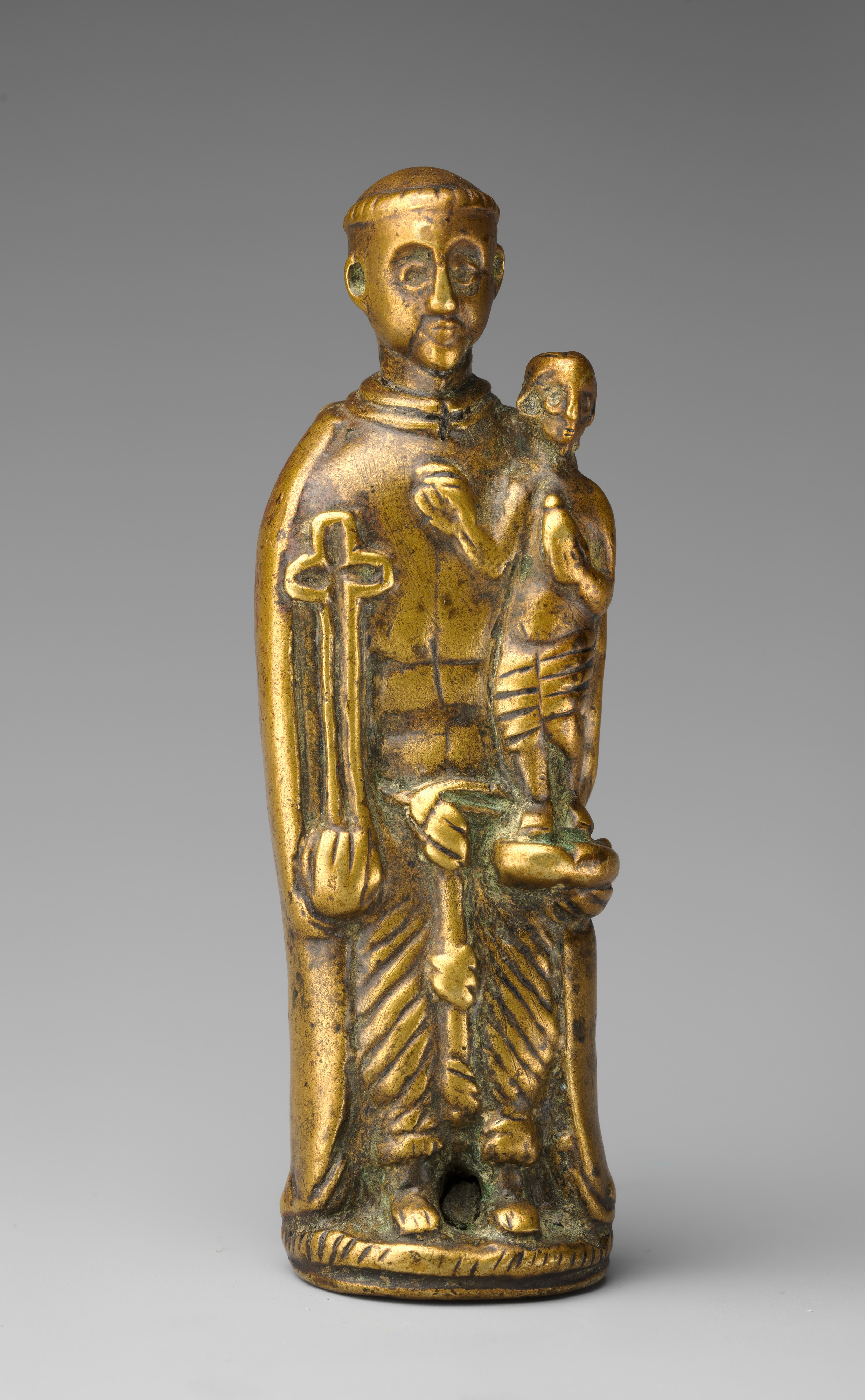
Strategic Heritage Analysis: Pendant of Saint Anthony of Padua, Kongo Kingdom
This analysis examines a partially hollow cast brass pendant depicting Saint Anthony of Padua, originating from the Kongo peoples of the Kongo Kingdom. For Katherine Fashion Lab, this artifact is not merely a historical curio; it is a dense nexus of cross-cultural negotiation, spiritual syncretism, and symbolic authority. As a standalone strategic asset, it offers a profound blueprint for a 2026 high-end luxury strategy predicated on depth, narrative integrity, and the redefinition of heritage as a dynamic, living dialogue. This research deconstructs the object’s inherent power to inform a luxury positioning that transcends superficial ornamentation, speaking instead to contemporary desires for meaning, identity, and spiritual resonance.
Historical Context: Adornment as a Medium of Power and Conversion
The Kongo Kingdom’s engagement with Portugal, initiated in the late 15th century, was a complex exchange of diplomacy, trade, and religion. The adoption of Christianity, particularly by the Kongo elite, was a strategic maneuver to consolidate power and maintain parity with European counterparts. Within this context, religious medals and pendants became critical instruments of adornment and ideology. Cast in brass—a material long associated with prestige and permanence in Central Africa—these objects were far more than imported devotional items. Their local production, indicated by the distinctive partially hollow cast technique, signifies an act of cultural appropriation and reinterpretation. Worn by Kongo nobility, the pendant served as a dual-status symbol: it affirmed the wearer’s connection to the global (Christian) network of power while simultaneously grounding that power in local aesthetic and material traditions. Adornment here was a deliberate, strategic performance of identity at the confluence of two worlds.
Deconstructing Symbolic Power and Spiritual Syncretism
The choice of Saint Anthony of Padua is profoundly significant and reveals the core of the object’s symbolic power. In European hagiography, Saint Anthony is the patron saint of lost items and people, a finder and a reunifier. To the Kongo peoples, this narrative found powerful parallels in pre-existing spiritual frameworks. Saint Anthony was seamlessly syncretized with Nkosi Nzambi, a powerful spiritual intermediary figure who could intercede with the supreme god, Nzambi Mpungu. The saint’s iconography—holding the Christ child, a book, a lily—was interpreted through a Kongo lens. The child could represent lineage and ancestral continuity; the book, a source of hidden wisdom or nkisi power.
Thus, the pendant operated as a potent nkisi (a charm or power object) in its own right. Its hollow core, a technical feature of the casting process, could be conceptually linked to the Kongo practice of preparing minkisi (plural) by inserting sacred substances (bilongo) into cavities to activate their spiritual force. Worn on the body, the pendant was less a statement of passive faith and more an active, portable repository of spiritual agency—a tool for protection, intercession, and connection with both the Christian divine and the ancestral realm. This layered meaning represents a masterclass in symbolic synthesis, where an object’s power is multiplied through cultural translation.
Strategic Imperatives for a 2026 Luxury Positioning
For Katherine Fashion Lab’s 2026 strategy, this pendant provides a foundational narrative far removed from fleeting trends. It champions a luxury paradigm defined by Intellectual Depth, Spiritual Utility, and Crafted Synthesis. The goal is not to replicate the artifact literally, but to distill its core principles into a contemporary luxury language.
Narrative Framework: The "Syncretic Object"
The collection’s overarching theme should be "Syncretic Objects for the Modern Pilgrim." This frames the wearer as a seeker navigating a complex global identity, desiring adornment that offers both aesthetic refinement and personal talismanic value. Marketing must eschew generic heritage claims, instead offering nuanced storytelling about cross-cultural dialogue, the reclamation of narrative, and the personal "activation" of worn objects.
Design Philosophy: Material Intelligence & Symbolic Layering
Design must mirror the pendant’s intelligence. This involves: Material Dialogue: Pairing noble metals (like brass, reinterpreted as modern alloys) with materials sacred in other cultures (e.g., rare woods, ethically sourced stones, advanced ceramics) to speak to a new material hybridity. Structural Symbolism: Incorporating conceptual or literal voids, compartments, or layered constructions that reference the nkisi principle—the idea that true value and power lie within, waiting to be personalized. Iconographic Reinterpretation: Abstracting the specific iconography of Saint Anthony into universal motifs of connection, finding, and guardianship. The "child" could become a symbol of potential; the "book," a tablet of personal data or intention.
Market Positioning & Client Engagement
This strategy targets the post-pandemic luxury consumer who seeks "Spiritual ROI"—Return on Identity. The value proposition is an heirloom that carries a world-making story. Tactics include: Limited Edition "Codex" Collections: Each piece is accompanied by a scholarly booklet (digital and physical) detailing its inspirational heritage, akin to an art catalog. Client Atelier Experience: Offering a service for clients to "charge" their piece—not with substances, but by digitally or physically embedding a personal intention, coordinate, or mantra into the object's narrative record, creating a modern bilongo. Collaborations: Partnering with contemporary artists from the African diaspora and scholars of Africana studies to co-create pieces and ensure authentic, respected intellectual grounding.
Conclusion: Heritage as a Living Algorithm
The Kongo pendant of Saint Anthony of Padua teaches that the most powerful luxury objects are those that successfully algorithmize complex cultural data into a wearable form. For Katherine Fashion Lab, the strategic opportunity for 2026 is to position itself not as a fashion house looking backward, but as a cultural laboratory forging tools for contemporary life. By leveraging this artifact’s legacy of symbolic power, spiritual utility, and crafted synthesis, the brand can cultivate an exclusive, discerning clientele that purchases not just an accessory, but a companion for their own modern pilgrimage—a syncretic object that finds what is lost, connects what is separate, and armors the soul with history transformed. This is the cornerstone of a truly resilient and meaningful luxury strategy.