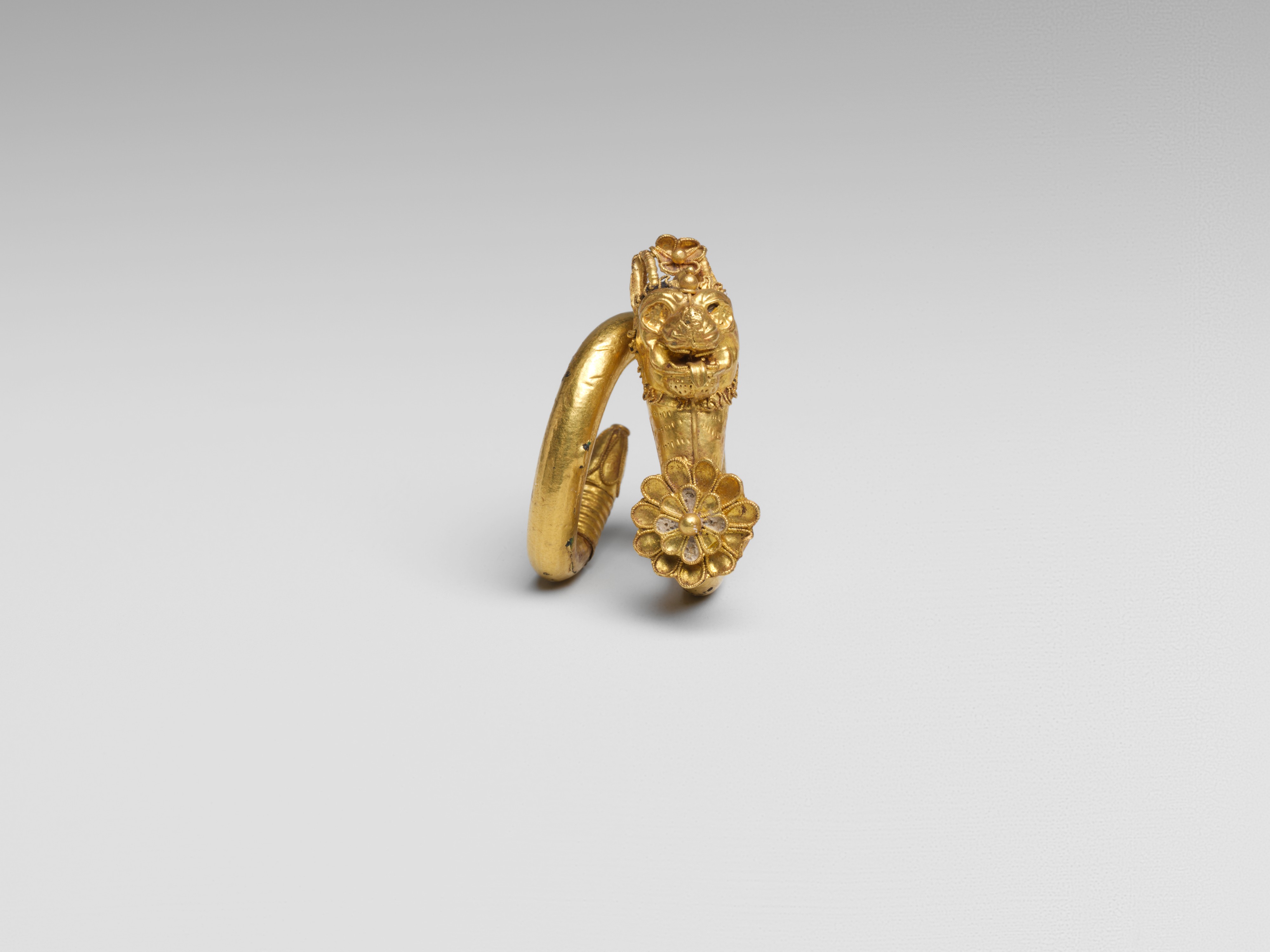
Heritage Analysis: The Gilt Bronze Spiral with Lion-Griffin Terminal
Historical and Cultural Context
The gilt bronze spiral with lion-griffin terminal, originating from Greek Cyprus circa 6th–5th century BCE, represents a pivotal artifact in the study of ancient adornment and symbolic power. Crafted in gold—a medium reserved for deities, royalty, and the elite—this piece embodies the Cypriot synthesis of Greek, Phoenician, and Near Eastern artistic traditions. The lion-griffin, a hybrid creature combining the lion’s terrestrial might with the eagle’s celestial dominion, serves as a guardian of thresholds, a herald of divine authority, and a conduit between mortal and immortal realms. Its spiral form, often associated with cycles of life, death, and rebirth, amplifies the object’s ritualistic and protective functions.
This artifact resonates deeply with our ongoing research at Katherine Fashion Lab, particularly the study titled “Mirror with Split-Leaf: Silver and Gold Narratives of Duality.” That work explored the dichotomy between a polished silver mirror adorned with gold-inlaid palmettes and a cold stone sarcophagus narrating life through relief. The spiral with lion-griffin terminal extends this duality: it is simultaneously a weapon of status (as a possible torque or armlet) and a talisman of spiritual passage. The gold medium, untainted by corrosion, signifies eternal light and indestructibility, while the spiral’s unbroken line mirrors the infinity of the soul—a concept central to Cypriot funerary and votive practices.
Symbolic Power and Historical Adornment
In the ancient Mediterranean, adornment was never merely decorative; it was a lexicon of power. The lion-griffin terminal on this spiral asserts dominance over chaos, a motif borrowed from Assyrian and Persian iconography where such creatures flanked thrones and palace gates. For a Cypriot aristocrat or priest, wearing this spiral would communicate not only wealth but also a sacred mandate: the wearer was a mediator between earthly law and cosmic order. The gold itself, mined from sources like the Pactolus River or Egyptian deserts, was believed to carry the sun’s essence, imbuing the bearer with vitality and invulnerability.
The spiral’s open-ended design suggests it was worn as a flexible brace or neck adornment, conforming to the body while retaining its structural integrity. This physical intimacy—gold against skin—created a constant tactile reminder of the wearer’s elevated status. Historical records from Cypriot sanctuaries, such as those at Kourion and Idalion, indicate that similar objects were deposited as votive offerings to deities like Aphrodite (in her Cypriot aspect) or Apollo. Thus, the spiral transcended personal ornament to become a permanent record of devotion, its gold surface reflecting the divine light of temple lamps and the sun’s rays.
Spiritual Meaning and Cyclical Resonance
The spiral is one of humanity’s oldest sacred symbols, representing the journey from birth to death and beyond. In Cypriot funerary contexts, spirals often appear on tomb walls and sarcophagi, guiding the deceased’s soul through the underworld’s labyrinth. The lion-griffin terminal adds a protective layer: its dual nature—lion (earth, strength) and griffin (sky, vigilance)—ensures safe passage. This aligns with the “Mirror with Split-Leaf” study’s central thesis: that objects of adornment serve as threshold artifacts, mediating between states of being. The mirror’s reflective surface captured the living self, while the sarcophagus’s relief narrated the eternal self. Similarly, the spiral with lion-griffin terminal operates at the intersection of life and death, protection and transformation.
Gold’s incorruptibility reinforces this spiritual dimension. Unlike silver, which tarnishes, or bronze, which patinates, gold remains unchanged—a metaphor for the soul’s permanence. For the Cypriot elite, gold adornments were not just wealth displays but esoteric tools. The spiral’s continuous curve, when combined with the lion-griffin’s gaze, was believed to deflect evil and attract benevolent forces. This function recalls the apotropaic eye motifs common on Greek ceramics and Cypriot jewelry, where the spiral’s vortex draws in malevolent energy and neutralizes it.
2026 High-End Luxury Strategy: Translating Heritage into Modern Desire
For Katherine Fashion Lab’s 2026 luxury strategy, the gilt bronze spiral with lion-griffin terminal offers a blueprint for narrative-driven exclusivity. The modern luxury consumer—particularly in the Gen Z and Alpha demographics—seeks objects that transcend materialism, favoring pieces with embedded mythology, craftsmanship, and spiritual resonance. Our strategy will leverage three core pillars derived from this artifact:
1. Symbolic Recontextualization: The lion-griffin terminal will be reinterpreted as a brand emblem of guardianship and duality. In 2026, luxury is increasingly defined by protection—of heritage, of the self, of the planet. A limited-edition collection, “Spiral of Guardians,” will feature gold-plated bronze cuffs and necklaces with stylized lion-griffin finials, each piece numbered and accompanied by a digital provenance certificate linking to the Cypriot original. This creates a bridge between ancient ritual and modern identity, appealing to collectors who value storytelling over seasonal trends.
2. Material Ethics and Alchemy: Gold remains the ultimate luxury medium, but its sourcing must align with 2026’s demand for transparency. Our strategy will partner with certified artisanal mines in Cyprus and Greece, reviving ancient smelting techniques while ensuring ethical labor practices. The spiral’s original gilt bronze construction—a fusion of base and precious metals—will inspire a new “Gilt Alchemy” line, where recycled bronze is plated with Fairmined gold, symbolizing transformation and sustainability. Each piece will carry a QR code tracing its metal’s journey from ore to ornament, echoing the spiral’s unbroken narrative.
3. Ritualistic Experience: The spiritual dimension of the spiral—its role as a protective talisman—will be activated through immersive retail and digital rituals. Katherine Fashion Lab boutiques in 2026 will feature “Threshold Rooms,” where clients participate in a guided ceremonial wearing of the piece, accompanied by curated soundscapes of Cypriot temple bells and wind over limestone ruins. A companion app will offer augmented reality visualizations of the lion-griffin in motion, allowing wearers to “activate” the spiral’s protective properties via their smartphone camera. This merges ancient apotropaic function with contemporary tech, creating a luxury experience that is both intimate and shareable.
Conclusion: The Spiral as a Living Archive
The gilt bronze spiral with lion-griffin terminal is not a static relic but a living archive of human desire for transcendence. Its gold surface, spiral form, and hybrid guardian speak to enduring needs: to mark status, to seek protection, and to connect with the eternal. For Katherine Fashion Lab, this artifact validates our core belief that heritage is not a past to be preserved but a resource to be reimagined. By translating its symbolic power, historical adornment, and spiritual meaning into a 2026 luxury strategy, we ensure that the spiral continues to turn—not in a museum case, but around the wrists and necks of those who seek meaning in the material.
This analysis, in dialogue with the “Mirror with Split-Leaf” study, confirms that the most potent luxury objects are those that hold contradictions: light and shadow, life and death, gold and bronze. The spiral with lion-griffin terminal does not resolve these tensions—it wears them as its greatest strength.