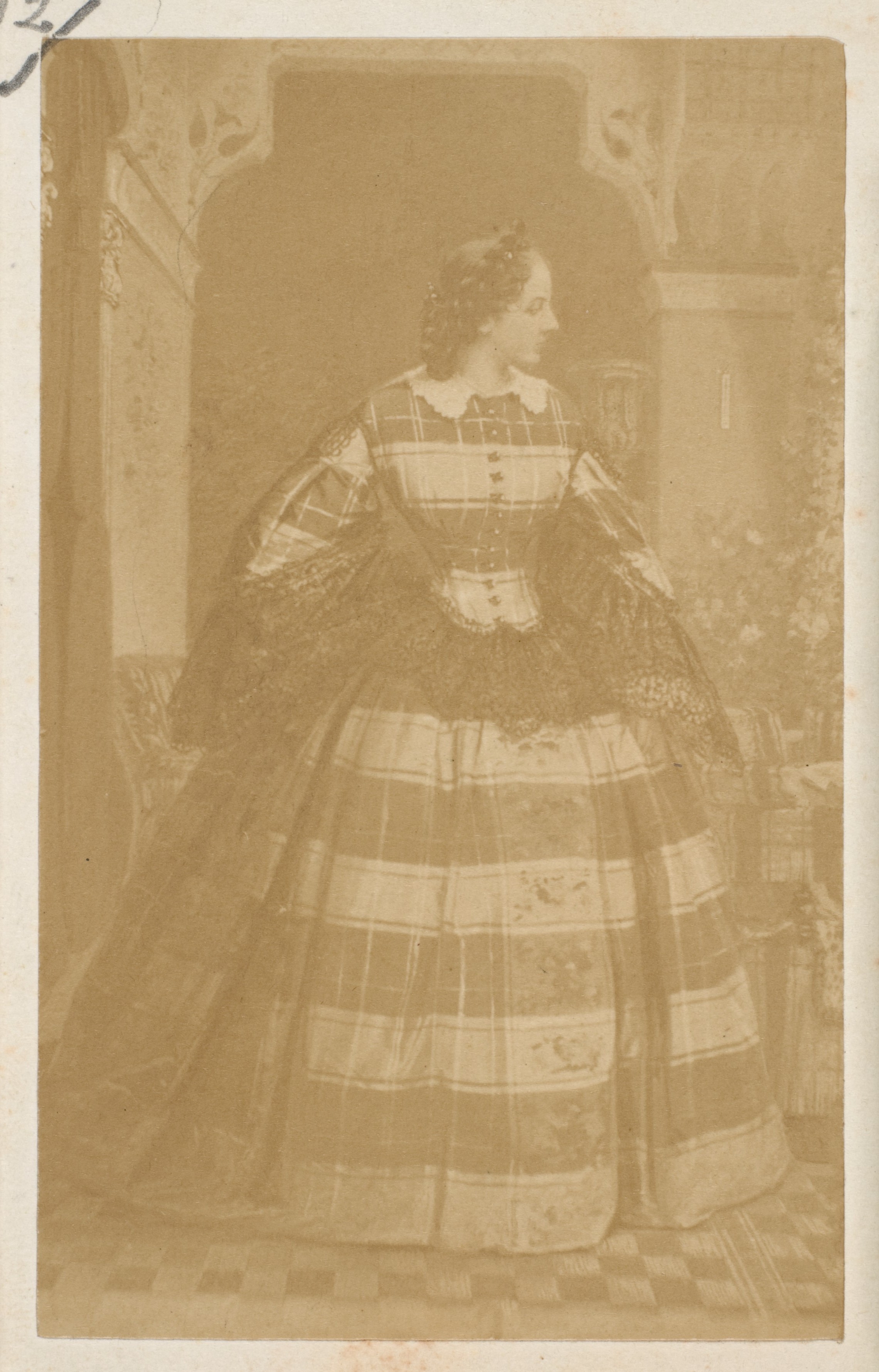
La Robe Écossaise: A Dialectic of Heritage and Modernity in the Albumen Silver Print
The archival albumen silver print from a glass negative, a medium synonymous with permanence and historical record, presents a compelling paradox when its subject is La Robe Écossaise. This is not merely a photograph of a garment; it is a complex artifact where the very essence of global heritage—the Scottish tartan—is captured, frozen, and reinterpreted through a 19th-century photographic technology that was itself a globalizing force. For Katherine Fashion Lab, this standalone study offers a profound case study in how couture functions as a vessel for cultural narrative, where materiality, pattern, and medium engage in a silent yet potent dialogue on identity, appropriation, and timelessness.
The Medium as Context: Albumen Silver and the Illusion of the Concrete
Before deconstructing the robe, one must first acknowledge the frame: the albumen silver print. Popularized in the 1850s, this process created images of exquisite detail and tonal range, often used to document ethnographic "types," aristocratic portraiture, and works of art. Its use here to capture a tartan gown is significant. The medium implies documentary authority and archival intent. It suggests this robe is worthy of preservation, of study—an object lifted from the ephemeral flow of fashion and granted the status of a permanent artifact. The glass negative, a unique and fragile matrix, further underscores the preciousness of the subject. However, this permanence is an illusion. The albumen print, with its susceptibility to fading and yellowing, mirrors the very vulnerability of cultural heritage it seeks to immortalize. The photograph does not capture a robe; it captures a specific, luminous moment in the robe's long life, translating its vibrant colors into a monochrome spectrum of grays, thus forcing the viewer to intellectually reconstruct its symbolic hues.
Deconstructing the Tartan: From Clan Marker to Global Couture Lexicon
The central subject, the tartan pattern, is a textile code of formidable cultural density. Its origin lies in the Scottish Highlands, where specific sett patterns (arrangements of stripes) were intimately tied to geography, clan kinship, and social status. By the time this photograph was taken, tartan had already undergone a dramatic journey. Following the Romantic revival and the patronage of Queen Victoria, it was transformed from a proscribed symbol of rebellion into a commodified emblem of a mythologized Scottish heritage. In the context of La Robe Écossaise, we witness the final stage of this transformation: its absorption into the rarefied language of couture.
The gown’s cut—presumably a sophisticated, late-19th or early-20th century silhouette—imposes a modern, likely Parisian, structure upon the ancient pattern. This is not a belted plaid (féileadh mòr) but a tailored gown. The couturier’s scissors have redirected the tartan’s lines, making the warp and weft of clan identity conform to the lines of the contemporary female form. This act is a powerful form of cultural translation. The pattern is respected, even showcased, but its context is utterly transmuted. It becomes a heritage signifier divorced from its original socio-political meaning, repurposed as an aesthetic motif denoting tradition, rugged elegance, and perhaps a hint of aristocratic wanderlust. The robe speaks to a globalized appreciation of "local" patterns, a phenomenon where couture acts as both curator and innovator of world textiles.
The Silhouette and the Unseen Hand of the Couturier
While the photograph may obscure precise tailoring details, the very fact of its being a "robe" (a dress) rather than traditional Scottish attire is analytically critical. The creation of such a garment required a couturier of technical mastery. Tartan, especially in fine wool, presents challenges: matching seams perfectly at the bodice, sleeves, and skirt to maintain the continuity of the sett is a task of precision engineering. The choice of where to place the dominant lines of the pattern—centering a stripe on the bodice, aligning checks at the waist—reveals an artistic hand mediating between the rigid grid of the tartan and the fluid curves of the body.
This negotiation results in a dialectical silhouette: the structured, almost architectural quality of the repeated pattern plays against the softness of the draped or tailored form. It creates a visual tension between order and romance, between the collective identity embedded in the cloth and the individual identity sculpted by the cut. The albumen print, with its capacity for sharp detail, would have captured the texture of the wool, the fall of the skirt, and the play of light on the woven ridges, further emphasizing this dialogue between textile and form.
A Standalone Study in Cultural Capital
As a standalone study, this artifact transcends mere fashion history. It represents a node in the network of cultural capital exchange. The Scottish tartan, the French (or possibly Anglo-American) couture construction, and the universally adopted photographic technology together form a triangulation of global heritage. The robe is a portable, wearable testament to this exchange. In the rarefied air of couture, the tartan is sanitized of its historical baggage of Jacobite strife and colonial suppression, yet it retains an aura of authentic "otherness" that adds value and narrative depth to the garment.
The albumen silver print finalizes this transformation into cultural capital. By placing the robe in this medium, it is elevated to the status of art object and historical document. It becomes part of a canon. Katherine Fashion Lab’s analysis must conclude that La Robe Écossaise, as encountered in this print, is a palimpsest. Its layers include: the ancient thread of Celtic identity, the 19th-century romantic nationalist revival, the technical prowess of the haute couture atelier, and the documentary gaze of early photography. It is a testament to couture’s unique power to consume, refine, and re-present global heritage, creating new meanings that are both resonant and radically detached from their origin. The garment is frozen in silver, but its cultural implications continue to evolve.