The Inrō as Sartorial Sculpture: A Couture Analysis of Material, Motif, and Micro-Narrative
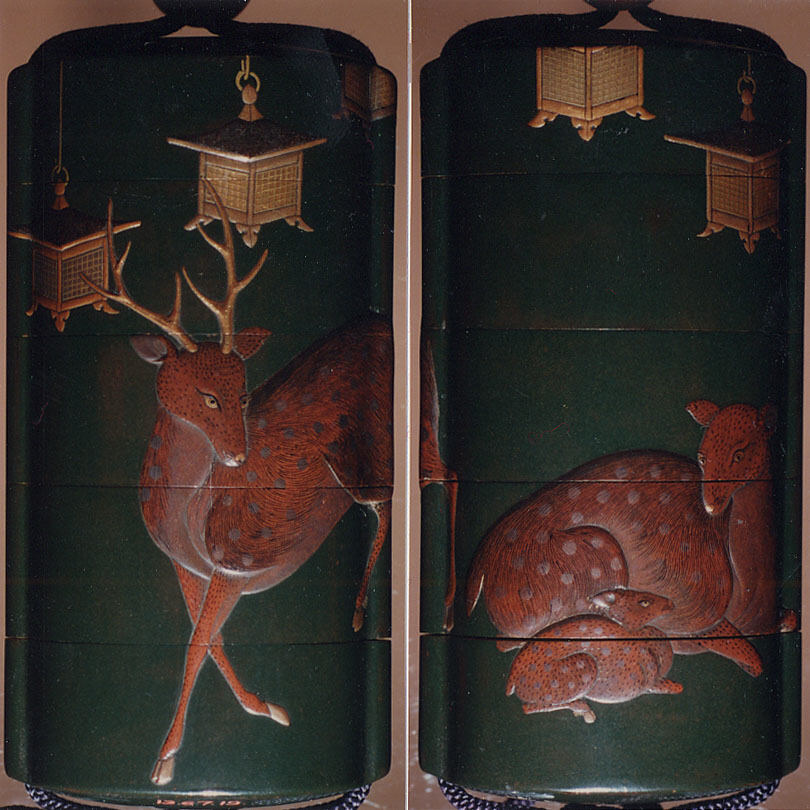
In the rarefied lexicon of haute couture, the garment is not merely a covering but a canvas for narrative, a testament to the convergence of artistry and wearability. The Japanese inrō, a tiered case traditionally suspended from the obi (sash) of a kimono, represents one of history’s most sophisticated expressions of this ideal. At Katherine Fashion Lab, we approach the inrō not as a historical artifact but as a living blueprint for contemporary luxury design. The subject of this analysis—a case adorned with gold and silver maki-e and pewter on dark green lacquer, depicting deer and lanterns at Kasuga Shrine—offers a masterclass in how surface decoration, material hierarchy, and symbolic density can elevate an accessory into a sculptural statement. This piece, accompanied by a coral ojime bead and a carved wood netsuke in the form of a mouse on a mushroom, is a standalone study in micro-narrative, demanding that we reimagine the relationship between the wearer and their ornamentation.
I. The Lacquer Ground: A Canvas of Depth and Restraint
The foundation of this inrō is a dark green lacquer ground, a choice that immediately signals both opulence and restraint. In the couture context, the base material is the equivalent of a perfectly cut silhouette—it must be flawless to support the embellishment. The deep green, achieved through multiple layers of urushi (natural lacquer), is not a flat color but a luminous, almost aqueous depth. It evokes the shadowed forests of the Kasuga Shrine precinct, a sacred space in Nara, Japan. This is not a passive background; it is an active participant in the visual drama. The green shifts in tone depending on the light, creating a subtle, living surface that mirrors the way a high-quality silk or wool responds to movement. For the modern designer, this teaches the value of a foundational hue that is both neutral and emotionally resonant. The dark green is a statement of quiet power—a far cry from the aggressive brightness of many contemporary accessories. It whispers of longevity, of a patina earned through time, rather than shouting for immediate attention.
II. Maki-e: The Gold and Silver Calligraphy of Light
The primary decorative technique, maki-e (literally “sprinkled picture”), is where the piece transcends craftsmanship and enters the realm of haute couture embroidery. Fine gold and silver powders are meticulously sprinkled onto wet lacquer to create the scene of deer and lanterns. This is not painting; it is a process of building light. The gold maki-e captures the flickering glow of the shrine’s bronze lanterns, while the silver suggests the ethereal moonlight filtering through the trees. In couture terms, this is analogous to the use of hand-embroidery with metallic threads—each stitch, each grain of powder, is a deliberate act of creating texture and luminosity.
The design’s composition is deceptively simple: a pair of deer, sacred messengers in Shinto belief, stand amidst stone lanterns. Yet the execution is profoundly complex. The deer are rendered with a soft, almost calligraphic line, their forms suggested rather than detailed. This restraint is a hallmark of the highest level of design—knowing when to stop. The lanterns, by contrast, are more geometric, providing a structural counterpoint to the organic curves of the animals. This tension between the natural and the architectural is a recurring theme in luxury fashion. Consider how a Dior jacket might pair soft, flowing silk with a sharp, tailored shoulder. Here, the maki-e achieves the same dialogue: the deer represent life, motion, and the ephemeral; the lanterns symbolize permanence, ritual, and the man-made.
III. Pewter Inlay: The Unexpected Structural Accent
The inclusion of pewter inlay is a critical detail often overlooked in cursory analyses. Pewter, a metal alloy with a muted, silvery-gray finish, is not as precious as gold or silver, yet its presence here is deliberate. It is used to outline certain elements, providing a crisp, linear definition that the maki-e alone cannot achieve. In a couture context, pewter functions like a fine, matte metal thread used in a tweed or a structural boning in a corset—it is the invisible skeleton that gives shape to the softness. The pewter inlay anchors the floating gold and silver particles, preventing the design from becoming overly ethereal. It introduces a tactile contrast: the smooth, cool metal against the warm, glossy lacquer. This interplay of materials—precious and semi-precious, shiny and matte—is a lesson in material hierarchy. The couture house that masters this can elevate a simple piece of fabric into a multi-sensory experience.
IV. The Ojime and Netsuke: The Micro-Architecture of Adornment
No analysis of this inrō is complete without examining its supporting components: the ojime and the netsuke. These are not mere functional closures; they are the buttons and brooches of the Edo-period wardrobe, each a miniature sculpture demanding its own design consideration.
The ojime, a coral bead, is a burst of warm, organic color against the cool green and metallic palette. Coral, in Japanese culture, is associated with longevity and protection. Its inclusion is a strategic accent, much like a single, bold gemstone at the neckline of an evening gown. It draws the eye and provides a visual resting point. The bead’s spherical form is a perfect counterpoint to the rectangular tiers of the inrō. In contemporary design, this teaches the power of a single, contrasting element to unify an entire composition.
The netsuke, a carved wood toggle in the shape of a mouse on a mushroom, is the piece’s most subversive element. At first glance, it seems whimsical—a tiny creature perched on a fungal form. Yet it is deeply symbolic. The mouse is a symbol of resourcefulness and prosperity in Japanese folklore, while the mushroom, particularly the shii-take, is associated with vitality and the natural cycle of decay and rebirth. Together, they form a micro-narrative of humility and survival, a stark contrast to the sacred grandeur of the Kasuga Shrine scene on the inrō itself. This juxtaposition is the ultimate couture move: the ability to layer multiple, even contradictory, stories within a single garment. The netsuke is the hidden pocket, the secret lining, the detail that only the most discerning eye will appreciate. It transforms the wearer from a passive model into a storyteller.
V. From Artifact to Inspiration: Lessons for the Modern Atelier
For Katherine Fashion Lab, this inrō is not a relic to be copied but a philosophy to be absorbed. Its lessons are manifold. First, it demonstrates that luxury is not about volume but about density of intention. Every square inch of this case is loaded with meaning, from the choice of lacquer to the placement of a single pewter line. Second, it proves that narrative can be both explicit and implicit. The deer and lanterns are a clear reference to a specific place and ritual, while the mouse and mushroom are a private joke or a personal talisman. A truly couture piece must operate on multiple levels: the public, the private, and the intimate.
Third, the inrō teaches the importance of material integrity. The gold and silver are not applied as a thick, heavy layer; they are integrated into the lacquer, becoming one with the surface. This is the opposite of fast-fashion embellishment, where sequins and beads are glued on with abandon. True luxury is integrated, not applied. Finally, the piece underscores the role of the accessory as a functional sculpture. The inrō was worn daily, yet it was also a work of art. This duality—utility and beauty, the everyday and the extraordinary—is the holy grail of contemporary design. The most successful couture accessories are those that can be worn, touched, and lived in, yet still retain their power to transport the wearer to another world.
In conclusion, the case with design of deer and lanterns at Kasuga Shrine is a testament to the Japanese aesthetic of iki—a refined, understated elegance that is both sophisticated and subtle. It challenges the modern fashion industry to slow down, to consider the weight of each material, and to embed narrative into every stitch and surface. For the designer who studies it, the inrō is not a lesson in history but a masterclass in how to create objects that are not merely worn, but inhabited.