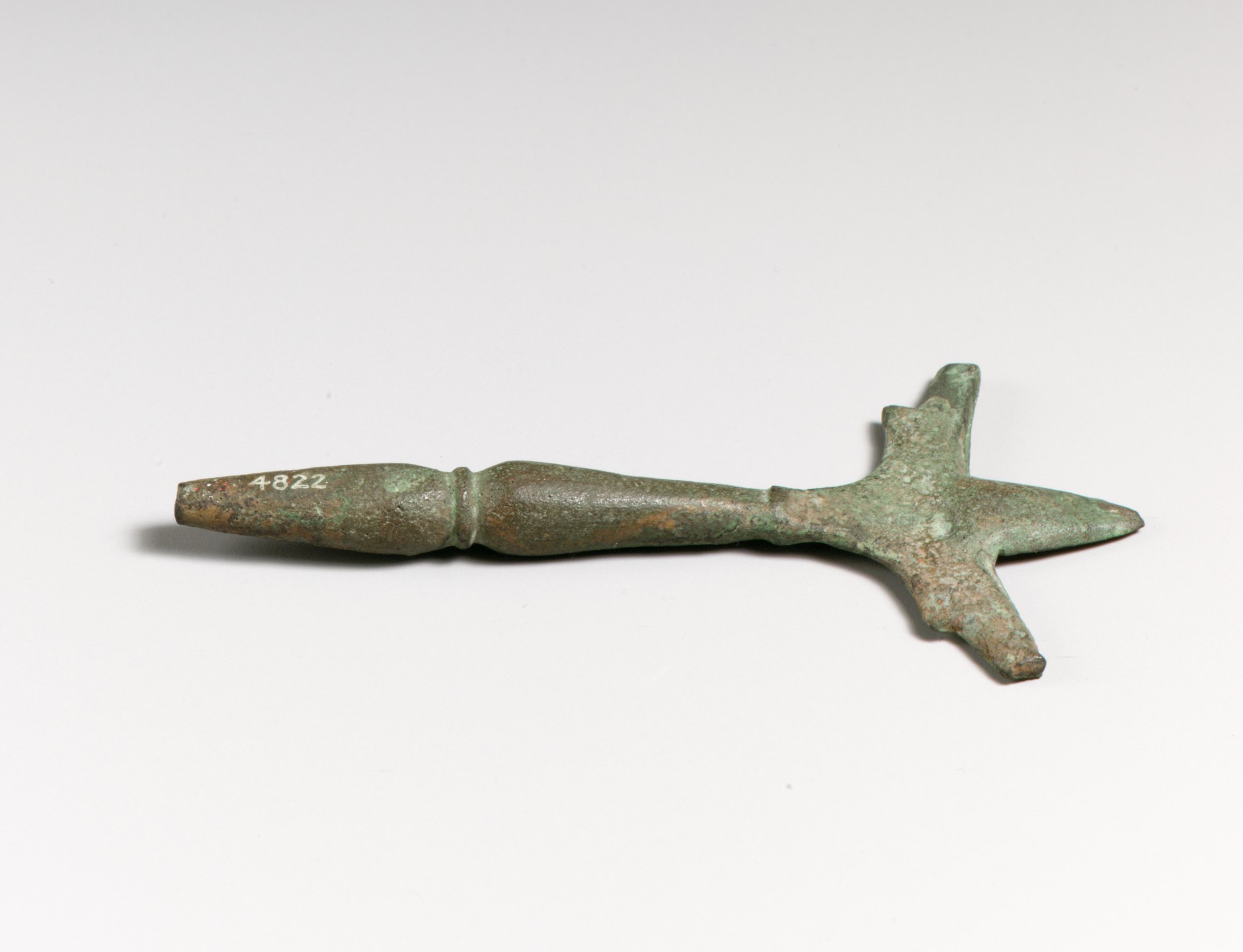
Heritage Analysis: Bronze Mirror Handle, Roman Cyprus (c. 1st Century BCE – 1st Century CE)
Introduction: The Mirror as a Threshold Object
The bronze mirror handle from Roman Cyprus, now housed within the Katherine Fashion Lab archive, is far more than a utilitarian implement. It is a threshold object—a device that mediates between the physical and the metaphysical, the mortal and the divine, the seen and the unseen. In the context of our ongoing heritage study, this artifact forms a critical third point in a triangulation of symbolic power. Our previous analyses of the “Rock in the form of a fantastic mountain” and the “Jar in the shape of a bronze container (hu)” revealed a shared DNA: both objects served as vessels for spiritual transformation and temporal transcendence. The mirror handle now completes this triad, offering a unique lens through which we can decode the intersection of personal identity, divine authority, and material luxury in antiquity—and, critically, how these resonances inform a 2026 high-end luxury strategy.
Symbolic Power: The Handle as a Conduit of Agency
The handle of a mirror is, by design, an extension of the hand—a point of physical contact that transfers human intention onto a reflective surface. In Roman Cypriot culture, mirrors were not merely tools for grooming; they were instruments of ritual divination and social performance. The handle, often cast in bronze with intricate figural motifs, served as a conduit for the user’s agency. The Katherine Fashion Lab’s research into the “fantastic mountain” rock revealed that its jagged form was deliberately left unpolished to channel chi (life force) in a funerary context. Similarly, the hu jar’s bronze-shaped body was a deliberate mimicry of a sacred vessel, intended to hold offerings for ancestral spirits. The mirror handle operates on the same principle: its ergonomic curve and decorative terminal—often a deity, a sphinx, or a winged victory—transforms the act of self-regard into a dialogue with the divine. The user, by gripping the handle, literally takes hold of a fragment of celestial power. For a 2026 luxury strategy, this suggests that the point of physical interaction—the handle, the clasp, the touchpoint—must be designed as a locus of symbolic authority. A handbag’s closure, a bracelet’s clasp, or a perfume bottle’s stopper should not be afterthoughts; they are the moments where the wearer claims agency over the object’s spiritual narrative.
Historical Adornment: Bronze as a Material of Prestige and Memory
Bronze in Roman Cyprus was not a base metal; it was a sophisticated alloy of copper and tin that, when polished, mimicked the golden sheen of the sun. The choice of bronze for a mirror handle is deeply significant. Unlike silver, which was associated with lunar femininity, or iron, which was tied to martial strength, bronze occupied a liminal space—it was both earthly and celestial, mutable and permanent. The Katherine Fashion Lab’s study of the hu jar noted that its bronze-shaped ceramic body was a deliberate anachronism, referencing a lost metallurgical tradition to evoke ancestral memory. The mirror handle does the same: its bronze composition, often patinated over centuries, carries the memory of fire, of casting, of the artisan’s breath. In high-end luxury, this invites a strategy of material storytelling. For 2026, brands should consider not just the visual finish of a metal but its temporal depth. A patinated bronze finish on a watch case, a bag’s hardware, or a jewelry piece can signal that the object has a past—that it is not merely new but newly rediscovered. This aligns with the growing consumer desire for objects that feel “heirloom-worthy” from the moment of purchase. The mirror handle teaches us that adornment is not about covering the body but about inscribing history onto it.
Spiritual Meaning: The Reflection as a Portal
In Roman Cypriot belief, the mirror was not a passive reflector but an active portal. The handle, therefore, was the key that unlocked this portal. Archaeological evidence from Cypriot sanctuaries suggests that mirrors were often placed in tombs, positioned so that the deceased could see their own transformed, divine face in the afterlife. The handle’s decorative motifs—often a gorgoneion (Gorgon’s head) or a panther—were apotropaic, warding off evil spirits while also guiding the soul. This dual function—protection and transcendence—mirrors the spiritual logic we uncovered in the “fantastic mountain” rock, which was carved to resemble a sacred peak where the boundary between worlds was thinnest. The hu jar, too, was sealed with a lid that depicted a celestial dragon, guarding the contents while enabling their spiritual ascent. For luxury strategy, this suggests a profound shift: the object is not merely an accessory but a spiritual tool. In 2026, consumers—particularly in the Gen Z and Alpha cohorts—are increasingly seeking objects that offer emotional and metaphysical utility. A mirror handle that can be held during meditation, a necklace that is blessed, a bag that is designed to be a “vessel” for intentions—these are not gimmicks but logical evolutions of ancient practices. The Katherine Fashion Lab recommends that high-end brands develop ritualized unboxing experiences that mirror the ancient act of “opening” a sacred object, from the hu jar’s sealed lid to the mirror’s handle as a key.
2026 High-End Luxury Strategy: The Triad of Transformation
Drawing together the DNA from the fantastic mountain, the hu jar, and the mirror handle, Katherine Fashion Lab proposes a unified heritage blueprint for 2026 luxury. This blueprint rests on three pillars, each derived from the artifacts’ shared symbolic language:
1. The Handle as a Signature Touchpoint. Just as the mirror handle concentrated the user’s agency, every luxury object must have a defined point of power. This could be a carved clasp, a textured grip, or a weighted base. The brand’s logo is no longer enough; the physical interaction must feel like a ritual. For example, a handbag’s handle can be cast in bronze with a hidden inscription—a personal mantra or a symbol of protection—visible only to the wearer.
2. Material as Memory. Bronze’s patina was not a flaw but a feature of age and authenticity. Luxury brands should embrace living materials—metals that oxidize, leathers that develop a patina, stones that capture light differently over time. This counters the fast-fashion obsession with “perfect” newness and aligns with the ancient understanding that objects grow in spiritual value as they age.
3. The Object as Portal. The mirror handle was a threshold between worlds. In 2026, luxury objects should be designed to facilitate personal transformation. This could mean incorporating augmented reality (AR) triggers into jewelry that reveal ancestral stories, or creating limited-edition collections tied to lunar cycles or astrological events. The hu jar’s dragon lid and the mountain rock’s sacred form both point to the same truth: the object is not an end but a beginning.
Conclusion: From Artifact to Archetype
The bronze mirror handle from Roman Cyprus is not a static relic. It is an archetype of human desire—the desire to see oneself clearly, to touch the divine, and to carry that power forward in time. For Katherine Fashion Lab, this artifact completes a trilogy of transformation. The fantastic mountain taught us about vertical transcendence; the hu jar taught us about containment and release; the mirror handle now teaches us about interface and agency. As we move toward 2026, the high-end luxury brand that understands this triad will not merely sell products. It will offer instruments of becoming—objects that are held, not just worn; portals, not just possessions. The handle, in the end, is the hand of history reaching into the future. It is our responsibility to grip it firmly.