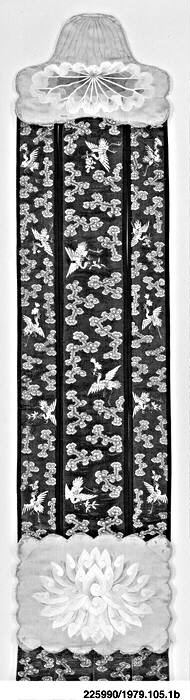
The Temple Banner: A Study in Devotional Textiles and Structural Artistry
In the annals of textile artistry, few artifacts capture the intersection of spiritual reverence and material mastery as profoundly as the Chinese Temple Banner from the Katherine Fashion Lab collection. This standalone study—comprising plaques of silk on a silk ground, backed with cardboard, and streamers of silk lined with cotton—offers a singular opportunity to dissect the technical, aesthetic, and cultural dimensions of a devotional object that transcends mere decoration. The banner, likely originating from a Buddhist or Daoist temple context, functions not only as a ceremonial emblem but as a testament to the sophisticated understanding of material hierarchy, structural integrity, and symbolic resonance that defined Chinese textile traditions. This analysis will deconstruct the banner’s construction, material choices, and visual language, arguing that its design principles—particularly the interplay of rigidity and fluidity—represent a masterclass in couture-level engineering applied to sacred art.
Material Hierarchy and the Logic of Devotion
The banner’s composite structure reveals a deliberate stratification of materials, each chosen for its symbolic and functional properties. The primary surface—plaques of silk applied onto a silk ground—introduces a dialogue between opacity and translucency. Silk, as a medium, carries profound cultural weight in China: it is associated with imperial authority, celestial purity, and the labor of sericulture, a practice mythologized as a gift from the goddess Leizu. By using plaques, the artisan creates raised, textured zones that catch light differently, mimicking the effect of illuminated manuscripts or gilded icons. The cardboard backing, though seemingly utilitarian, is a strategic choice. It provides a rigid substrate that prevents the silk from sagging or distorting under its own weight, ensuring that the banner maintains a planar, almost architectural presence when hung. This is not a flimsy textile; it is a statement of permanence, designed to withstand the environmental stresses of a temple—humidity, incense smoke, and the passage of time.
Equally instructive are the streamers: silk panels lined with cotton. Here, the cotton serves as a stabilizing counterweight, adding density to the lower extremities of the banner. This is a textbook example of functional couture: the streamers must move gracefully in air currents (a metaphor for the breath of the divine), yet not flutter uncontrollably. The cotton lining introduces a slight stiffness that ensures the streamers fall in clean, vertical lines, echoing the calligraphic strokes of Chinese characters. The juxtaposition of the rigid, plaque-studded upper section with the flowing, cotton-weighted streamers creates a visual rhythm—a tension between stillness and motion that mirrors the dual nature of the sacred: the immutable and the dynamic.
Structural Engineering in Textile Form
From a construction standpoint, the Temple Banner embodies principles that align with modern haute couture techniques. The use of plaques—appliquéd shapes likely cut from densely woven silk or satin—requires precision in both cutting and adhesion. In traditional Chinese textile practice, such plaques were often reinforced with a thin layer of paper or paste before being stitched or glued onto the ground fabric. The cardboard backing in this piece amplifies this reinforcement, suggesting a workshop that prioritized longevity over lightness. This is reminiscent of the armature construction seen in high-end fashion, where boning, interfacing, and underlinings create silhouette and structure. The banner’s top edge, where it would be suspended, likely incorporates a hidden rod or channel—a detail invisible to the viewer but essential to its function. This unseen engineering is a hallmark of couture: the marriage of beauty and utility, where the latter is sacrificed to the former only in appearance, never in fact.
The streamers, meanwhile, are a study in drape management. The silk outer layer offers a lustrous, smooth face, while the cotton lining provides a matte, absorbent interior. This dual-layer construction prevents the streamers from clinging together or to the central panel—a common issue in multi-panel textiles. The weight distribution is carefully calibrated: the streamers are likely narrower than the main body, reducing wind resistance while maintaining visual balance. In fashion terms, this is analogous to the design of a train on a gown: it must trail elegantly without dragging or tripping the wearer. Here, the “wearer” is the temple itself, and the banner’s movement must amplify the sacred atmosphere without becoming a distraction.
Symbolic Imagery and the Language of Ornament
Though this study does not specify the exact motifs on the plaques, we can infer from context and material evidence. Temple banners typically feature iconography such as lotus blossoms, dragons, phoenixes, or Buddhist symbols like the endless knot or wheel of dharma. The use of plaques—raised, distinct shapes—suggests a desire to create a relief effect, making the symbols physically palpable. This tactile quality is significant: in Chinese devotional practice, touching or circumambulating sacred objects is a form of veneration. The plaques invite the fingers to trace their outlines, transforming the banner from a passive visual object into an interactive devotional tool.
The color palette, though not described in detail, would likely adhere to the five primary colors of Chinese cosmology: red (fire, vitality), yellow (earth, imperial power), blue/green (wood, growth), white (metal, purity), and black (water, mystery). Silk’s natural ability to absorb dyes with remarkable depth would make these hues luminous, especially under the flickering light of oil lamps or candles. The contrast between the plaques and the ground fabric—perhaps a darker, more subdued hue—would create a focal hierarchy, drawing the eye to the sacred symbols while the streamers provide a rhythmic, almost musical punctuation.
Contextualizing the Standalone Study
Examining this banner as a standalone artifact—rather than as part of a larger liturgical set—allows for a microscopic focus on its intrinsic qualities. Without the distraction of companion pieces, we can appreciate the banner’s self-contained narrative. Every stitch, every layer of silk, every gram of cotton contributes to a singular purpose: to mediate between the earthly and the divine. The decision to back with cardboard, for instance, might be seen as a concession to modernity or a pragmatic response to a specific temple’s environment. Yet, in the context of couture analysis, it reveals a designer’s (or artisan’s) willingness to innovate within tradition, much as a contemporary fashion house might use unconventional materials to achieve a desired silhouette.
The banner also challenges Western notions of textile art as inherently soft or pliable. Here, the textile is a hybrid—part fabric, part sculpture. The cardboard gives it a rigidity that aligns it with painted panels or carved wood, while the silk and streamers assert its textile identity. This hybridity is a hallmark of Chinese decorative arts, where boundaries between media are fluid. A banner is not merely a cloth; it is a vessel for prayer, a marker of sacred space, and a demonstration of the patron’s piety and wealth. The use of silk—a material once reserved for the elite—underscores this status function, even within a religious context.
Implications for Contemporary Couture
For the modern designer, the Temple Banner offers a template for integrating structure and fluidity. The principle of using a rigid core (cardboard) beneath a luxurious face (silk) is directly applicable to architectural fashion—think of a coat with a structured back panel that flows into a silk train, or a bodice that combines boning with a draped overlay. The streamers, meanwhile, prefigure the trend of detachable or kinetic elements in runway collections, where movement is choreographed rather than accidental. The banner’s ability to function both as a static icon and a dynamic participant in ritual performance is a lesson in designing for multiple states of being—an increasingly relevant consideration in an era of wearable technology and transformable garments.
In conclusion, the Temple Banner from Katherine Fashion Lab is far more than a historical curiosity. It is a sophisticated synthesis of material science, symbolic logic, and structural design. Its plaques of silk on a silk ground, backed with cardboard, and its cotton-lined streamers, represent a refined understanding of how textiles can be made to stand, move, and signify. As a standalone study, it invites us to look beyond the surface and recognize the couture-level thinking embedded in every fiber. This is not merely a banner; it is a blueprint for the sacred in fabric form.