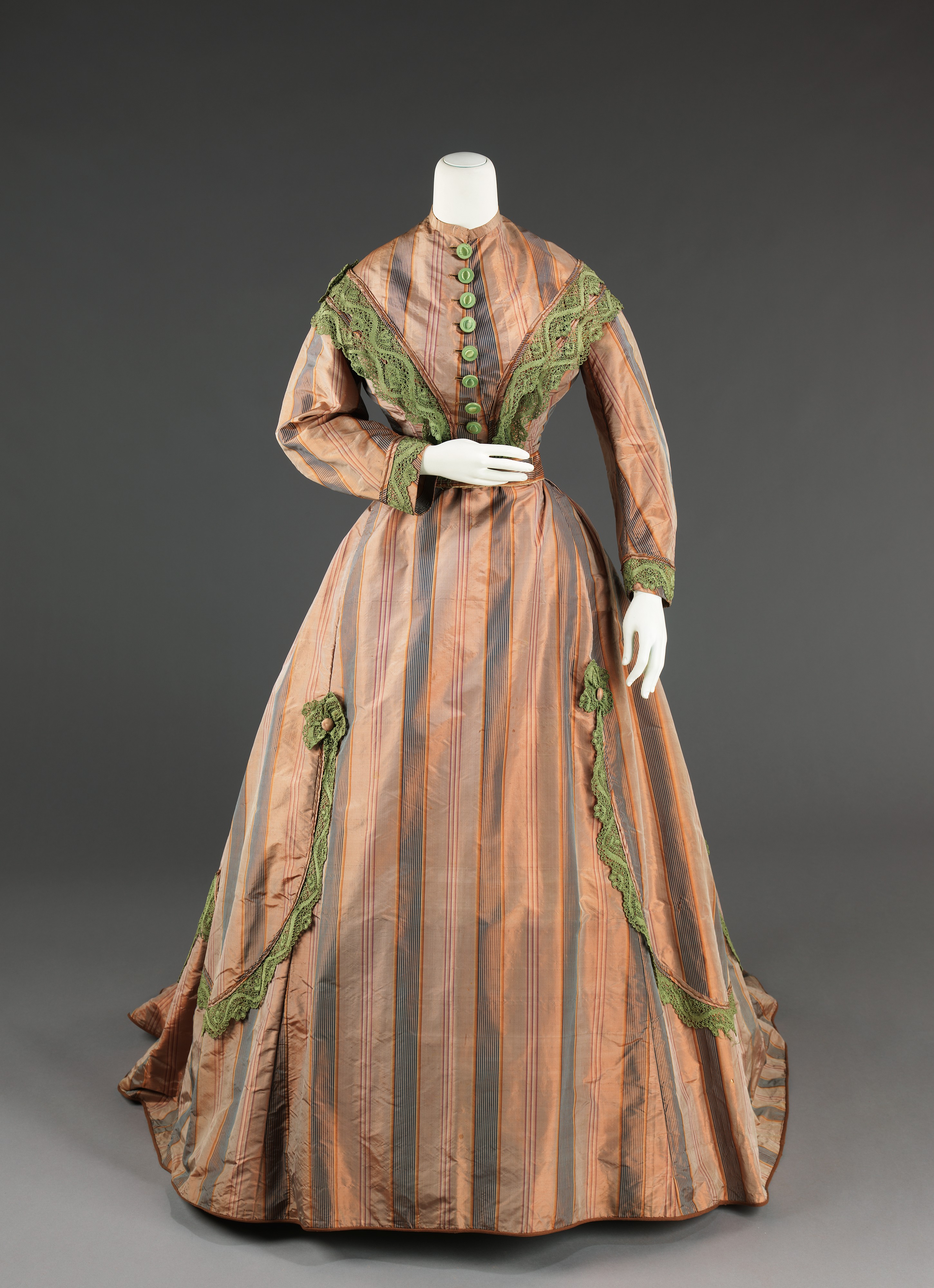
The Art of Afternoon Elegance: A Couture Analysis of an American Silk Dress
Introduction: The Afternoon Dress as a Cultural Artifact
The afternoon dress, a staple of American fashion from the mid-19th through the early 20th centuries, represents a nuanced intersection of social ritual, textile innovation, and aesthetic refinement. Unlike the overt formality of evening gowns or the utilitarian simplicity of daywear, the afternoon dress occupied a liminal space—designed for semi-public engagements such as teas, luncheons, and matinee visits. In the context of Katherine Fashion Lab’s standalone study, this garment becomes a case study in how American couture leveraged domestic silk production and tailoring prowess to articulate a distinct identity of understated luxury. The dress under analysis, crafted from American silk circa 1905, exemplifies the technical mastery and cultural signaling embedded in this genre.
Material Mastery: American Silk and Its Tactile Narrative
The choice of silk as the primary material is not merely decorative but deeply strategic. American silk, particularly from mills in Paterson, New Jersey, and later California, was prized for its tensile strength, luster, and ability to hold complex dyes. In this afternoon dress, the silk is a lightweight, semi-sheer charmeuse with a subtle slub texture—a deliberate departure from the glossy, heavy silks of French origin. This material choice signals a distinctly American pragmatism: the fabric drapes elegantly without excessive weight, allowing for ease of movement during afternoon social calls. The dress’s bodice is lined with a fine cotton batiste, a hallmark of American couture that prioritized comfort without compromising silhouette. The silk’s hand-feel suggests a matte finish, reducing glare and emphasizing the garment’s sculptural lines over ornamental excess.
Silhouette and Structure: The Architecture of Afternoon Formality
The dress’s silhouette adheres to the Edwardian “S-curve,” a corseted shape that thrusts the bust forward and the hips back, creating a sinuous, almost avian profile. However, the American interpretation softens this extreme contour. The bodice is fitted but not rigid, achieved through intricate boning channels sewn into the silk itself—a technique that required exceptional precision to avoid puckering. The waist is defined by a tailored cummerbund of self-silk, cinched with a hidden hook-and-eye closure. The skirt falls in a gentle A-line, terminating just above the ankle, a length deemed appropriate for afternoon visibility without impropriety. The hem is finished with a weighted silk cord, a detail that ensures the dress hangs with architectural precision even in the absence of petticoats. This structural restraint—eschewing the voluminous trains of evening wear—underscores the dress’s purpose: to be seen in motion, during conversation, not static display.
Color and Dyeing: The Palette of Social Nuance
The dress is dyed in a muted “ashes of roses” hue—a dusty pink with undertones of taupe and lavender. This color, achieved through aniline dyes imported from Germany but refined in American labs, was a fashionable compromise between the bright pastels of morning wear and the dark, saturated tones of mourning or formal evening attire. The dyeing process here is uniform, with no visible striations, indicating a level of quality control that American mills aggressively marketed as superior to European hand-dyeing. The color’s subtlety serves a dual purpose: it flatters a range of skin tones under the soft, filtered light of afternoon parlors, and it signals the wearer’s awareness of chromatic hierarchy—neither too bold for daytime nor too somber for leisure. The dress also features a narrow band of embroidered silk velvet at the neckline, dyed a slightly deeper rose, creating a monochromatic contrast that draws the eye upward without overwhelming the overall palette.
Construction and Craftsmanship: The Invisible Language of Couture
The dress’s construction reveals the hallmarks of American couture’s emphasis on mechanical precision. The seams are French-seamed throughout, a technique that encases raw edges within the seam allowance, preventing fraying and ensuring a clean interior finish—a detail invisible to the observer but critical to the garment’s longevity. The armholes are cut with a gusset of silk organza, allowing for a range of motion that European corseted dresses often sacrificed for visual rigidity. The closure system is equally deliberate: a series of tiny silk-covered buttons and looped thread eyes run down the left side, a placement that facilitated independent dressing, a growing expectation among American women of means. The buttons themselves are hand-wrapped in the same silk as the dress, a labor-intensive process that underscores the garment’s bespoke nature. Each button is spaced exactly 1.5 inches apart, a mathematical consistency that speaks to the pattern-maker’s adherence to proportion.
Ornamentation and Restraint: The American Aesthetic of Understatement
In contrast to the lavish beading and lace of French afternoon dresses, this American garment employs ornamentation with strategic restraint. The sole embellishment is a single row of hand-embroidered silk floss in a running-stitch pattern along the bodice’s princess seams, echoing the line of the cummerbund. This embroidery is not decorative in the traditional sense; it functions as a visual guide that accentuates the wearer’s verticality, elongating the torso. The sleeves, three-quarter length and slightly puffed at the cap, are unadorned except for a narrow cuff of self-silk. This minimalism is not an absence of artistry but a deliberate expression of American modernism—a belief that the fabric’s quality and the cut’s precision were sufficient to convey status. The dress’s neckline is a shallow V, edged with a rolled hem so fine it appears almost invisible, further emphasizing the silk’s natural drape over any applied decoration.
Cultural Context: The Afternoon Dress as Social Capital
To fully appreciate this garment, one must understand its role as a tool for social navigation. The afternoon dress was a uniform of upper-middle-class respectability, worn during the hours when women engaged in “calling” rituals—visiting acquaintances, leaving cards, and participating in the informal economy of social alliances. The American silk dress, with its refined material and restrained silhouette, communicated a specific message: the wearer was modern, tasteful, and economically productive (as American silk was linked to industrial progress), yet sufficiently leisured to participate in afternoon rituals. The dress’s lack of ostentatious trim also aligned with the Progressive Era’s critique of conspicuous consumption, positioning the wearer as both fashionable and morally upright. In this sense, the dress is not merely a garment but a material argument for American values of efficiency, innovation, and quiet confidence.
Conclusion: The Enduring Legacy of American Afternoon Couture
This afternoon dress, as curated within Katherine Fashion Lab’s standalone study, transcends its historical moment to offer insights into the evolution of American design philosophy. The dress’s technical execution—from the tensile strength of its silk to the mathematical precision of its buttons—reflects a culture that valued substance over spectacle. Its color and silhouette negotiate between the demands of social ritual and the emerging ethos of personal comfort. For the contemporary observer, the garment serves as a reminder that couture is not solely the domain of the fantastical or the extravagant. In the hands of American makers, the afternoon dress became a canvas for understated excellence, proving that true luxury often resides in the invisible details: the weight of a hem, the feel of a seam, the quiet authority of a well-chosen hue. As a standalone artifact, it invites us to reconsider the afternoon dress not as a relic of a bygone etiquette, but as a foundational text in the narrative of American fashion identity.