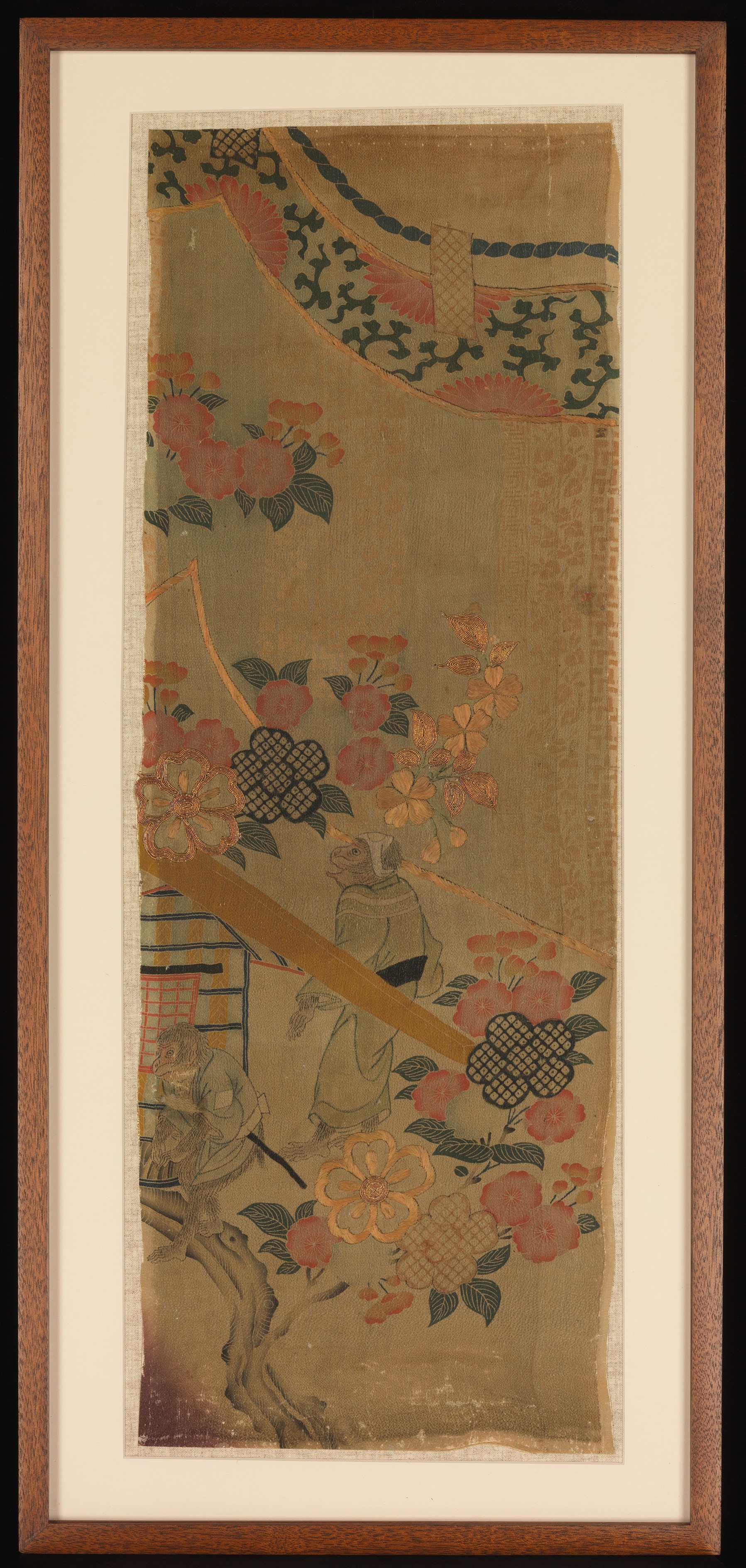
Deconstructing the Kosode: A Study in Narrative, Craft, and Cultural Semiotics
In the rarefied world of haute couture, the garment is rarely merely a covering; it is a manifesto, a narrative, and a technical marvel. Katherine Fashion Lab’s latest standalone study—a singular piece from a Robe (Kosode) featuring Cherry Blossoms and Monkeys with a Palanquin—offers a profound opportunity to dissect the intersection of artisanal mastery and cultural storytelling. Originating from Japan and executed in resist-dyed and painted silk crepe, with embroidery in silk and metallic thread, this fragment is not a relic but a living text. It demands a reading that transcends its historical context, positioning it as a benchmark for contemporary luxury design’s relationship with heritage, technique, and narrative depth.
The Kosode as a Canvas: Materiality and Technique
To appreciate this piece, one must first understand the Kosode—a precursor to the modern kimono, distinguished by its small wrist openings and its role as a foundation garment that evolved into a primary vehicle for artistic expression. The fabric selected, silk crepe, is a masterstroke of material choice. Its subtle, granular texture provides a dynamic surface that catches light unevenly, creating a living, breathing backdrop for the imagery. The crepe’s inherent drape and resilience allow the resist-dyeing process—known in Japan as shibori or yūzen—to achieve both precision and fluidity. The resist technique, where areas are sealed to prevent dye absorption, is executed here with extraordinary finesse. The cherry blossoms, rendered in soft pinks and whites, appear almost weightless, as if suspended in a perpetual spring breeze. This is not mere decoration; it is a dialogue between control and spontaneity, a hallmark of the Japanese aesthetic principle of wabi-sabi—the beauty of impermanence and imperfection.
The addition of painted details elevates the piece from craft to art. Pigments are applied directly onto the silk, allowing for gradations of tone that mimic the natural world. The cherry blossoms, for instance, are not uniform; some are fully opened, others are buds, and a few are falling petals—a deliberate evocation of mono no aware, the bittersweet awareness of transience. This philosophical layer is essential for any couture analysis, as it challenges the modern luxury industry’s obsession with permanence and perfection. Katherine Fashion Lab’s study of this piece underscores that true luxury lies in the ephemeral, the hand-touched, and the emotionally resonant.
Narrative Architecture: Monkeys, Palanquin, and the Social Fabric
The focal imagery—monkeys with a palanquin—introduces a narrative complexity that rewards deep reading. In Japanese art and folklore, monkeys (saru) are potent symbols. They are tricksters, guardians, and intermediaries between the human and divine realms. The palanquin, a portable carriage historically reserved for nobility and deities, suggests a journey or procession. But what story is being told? The monkeys, often depicted in a playful or mischievous posture, may be carrying the palanquin as a parody of human social hierarchy, a subtle critique of class and power. Alternatively, they could represent the Sannō (Mountain King) belief, where monkeys are sacred messengers of the gods, bearing a divine burden. This ambiguity is intentional; it invites the viewer to construct meaning, much like a couture client co-creates a garment’s identity through wear.
The cherry blossoms frame this narrative, serving as both a literal and metaphorical backdrop. They are the sakura, Japan’s national flower, symbolizing the fleeting nature of life. Their placement alongside the monkeys and palanquin creates a tension: the eternal cycle of nature versus the constructed, transient journey of human ambition. This juxtaposition is a masterclass in visual storytelling. For the modern designer, it underscores the power of narrative layering—where imagery is not merely ornamental but carries multiple, often contradictory, meanings that engage the wearer and observer in an ongoing dialogue.
Embroidered Details: The Invisible Hand of Mastery
While the resist-dyeing and painting establish the piece’s visual foundation, the embroidery in silk and metallic thread provides the final, defining layer. The silk threads, lustrous and fine, are used to outline the monkeys’ fur and the palanquin’s latticework, adding definition without overpowering the painted forms. The metallic threads—likely gold or silver-wrapped silk—catch the light, creating a subtle shimmer that suggests the palanquin’s gilded edges or the monkeys’ playful energy. This is not heavy-handed embellishment; it is surgical precision. Each stitch is a decision, a breath of intention that transforms a flat textile into a three-dimensional, tactile experience.
From a technical standpoint, the embroidery here serves multiple functions. It reinforces structural integrity, particularly along the seams and edges of the Kosode piece, where wear and tension are highest. It also directs the viewer’s gaze, guiding the eye from the cherry blossoms to the monkeys to the palanquin in a choreographed sequence. This is a lesson in design hierarchy: the embroidery is not an afterthought but a deliberate tool for visual navigation. For contemporary couture, where every detail must justify its existence, this piece demonstrates how handwork can elevate a garment from the beautiful to the indispensable.
Cultural Semiotics: Translating Heritage for the Global Stage
Katherine Fashion Lab’s standalone study of this Kosode piece is not an act of appropriation but of deep translation. The lab positions this fragment as a lens through which to examine how cultural symbols are encoded and decoded. The cherry blossom, for instance, is a universal signifier of beauty and transience, but its specific Japanese context—rooted in samurai ethos and Buddhist philosophy—adds layers unavailable to a purely Western interpretation. The monkeys, with their dual nature as sacred and profane, challenge the binary thinking often found in Western iconography. The palanquin, a symbol of status and movement, becomes a metaphor for the fashion industry itself: a vehicle that carries meaning across time and space.
This analysis is particularly relevant for the luxury sector today, where consumers increasingly seek authenticity and narrative depth. A piece like this cannot be mass-produced or replicated by machine; its value lies in the singularity of its creation. The resist-dyeing, painting, and embroidery are all processes that require years of training, an intimate relationship with materials, and a willingness to embrace imperfection. In an era of fast fashion and digital sameness, this Kosode piece stands as a quiet rebellion—a reminder that true luxury is born from time, skill, and cultural literacy.
Implications for Contemporary Couture Design
What can the modern designer learn from this study? First, the importance of material as message. Silk crepe is not chosen arbitrarily; its texture, weight, and light-reflecting properties are integral to the narrative. Second, the power of layered techniques. Resist-dyeing, painting, and embroidery are not competing elements but collaborators, each contributing a distinct voice to the overall composition. Third, the necessity of narrative ambiguity. The monkeys and palanquin do not offer a single, easy interpretation; they demand engagement, reflection, and reinterpretation. This is the hallmark of a piece that transcends fashion to become art.
Finally, the Kosode piece teaches us about scale and focus. As a standalone study, it is a fragment, yet it contains a universe. This suggests that in couture, a single sleeve, a collar, or a panel can be a canvas for the most profound expression. Designers need not always create full garments to make a statement; sometimes, a carefully studied piece—like this one—offers more insight into the intersection of craft, culture, and commerce than a complete collection ever could.
In conclusion, Katherine Fashion Lab’s analysis of this Piece from a Robe (Kosode) with Cherry Blossoms and Monkeys with Palanquin is a masterclass in couture as critical practice. It reminds us that the finest garments are not just worn; they are read, felt, and remembered. They are, in the truest sense, narratives woven in silk and thread, waiting for a discerning eye to unlock their stories.