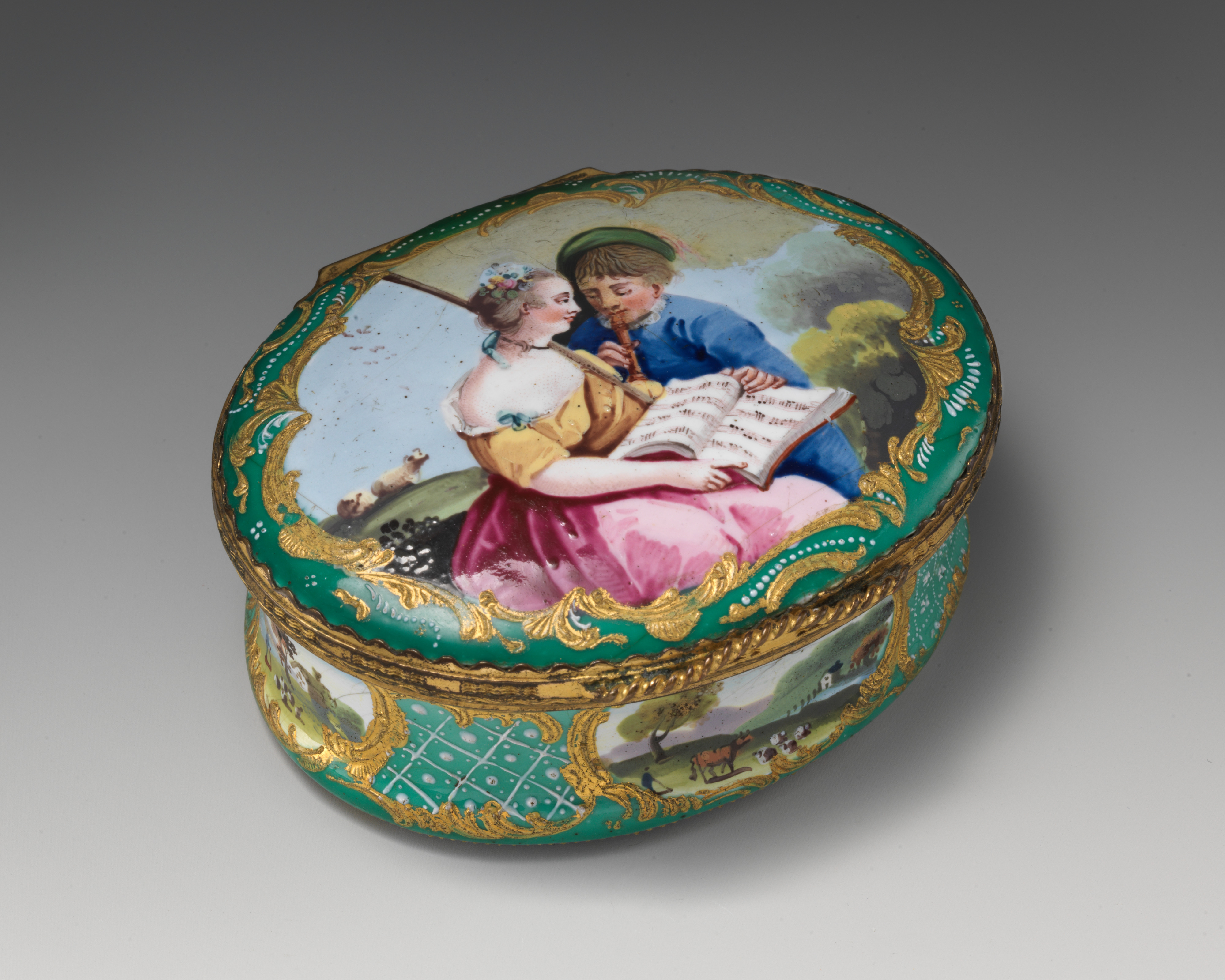
The Enameled Echo: Deconstructing the Snuffbox as a Couture Artifact
In the rarefied air of haute couture, where fabric meets fantasy and craftsmanship transcends utility, the snuffbox emerges as an unexpected yet profound muse. At Katherine Fashion Lab, we do not merely observe historical artifacts; we dissect their narrative DNA, seeking the structural, chromatic, and symbolic codes that can be transposed into a contemporary sartorial language. This standalone study of a Global Heritage snuffbox—crafted from enameled copper and depicting a music lesson scene—reveals a microcosm of 18th-century social ritual, artistic ambition, and material mastery. For the modern couture house, it is not a relic but a blueprint for a collection.
The Object as Narrative: A Music Lesson in Miniature
The snuffbox, a portable luxury of the European aristocracy, was a stage for intimate performance. This particular piece, with its enameled copper surface, presents a music lesson—a scene laden with subtext. The teacher, likely a figure of authority and refinement, leans toward a student whose posture suggests both concentration and deference. A harpsichord or lute, rendered in minuscule strokes of enamel, anchors the composition. The choice of a music lesson is deliberate: it symbolizes the transmission of culture, the discipline of beauty, and the erotic tension of proximity within prescribed social boundaries. For Katherine Fashion Lab, this narrative becomes a core thematic axis: the interplay between instruction and inspiration, structure and improvisation, restraint and release.
The enamel technique itself is a lesson in precision. Copper, a humble metal, is transformed through multiple firings of vitreous enamel into a lustrous, permanent canvas. The colors—muted ochres, deep greens, and ivory highlights—are not applied but fused, creating a depth that mimics the patina of time. This process echoes the haute couture atelier’s own alchemy: raw materials (silk, wool, metal threads) are subjected to heat, pressure, and hand-finishing to achieve an irreproducible finish. The snuffbox’s miniature scale forces the artisan to work with microscopic tools, a discipline that finds its parallel in the couture seamstress’s invisible stitches and the embroiderer’s single-thread precision.
Materiality as a Couture Vocabulary
Enameled copper offers a rich palette for translation. The copper base suggests a structural foundation—a boned corset or a sculptural silhouette that holds its shape against the body. The enamel overlay, glossy and unyielding, evokes a lacquered finish: think of a tailored jacket with a patent leather collar, or a skirt panel that catches light like a polished gem. The snuffbox’s lid, often hinged, implies a secret reveal—a detachable cape or a hidden pocket within a gown’s lining. In the music lesson scene, the figures’ clothing—embroidered waistcoats, flowing gowns—offers direct inspiration for sleeve treatments, neckline cuts, and the play of opacity and transparency.
The global heritage of this object cannot be overstated. While the snuffbox tradition is European, the enamel technique traveled from Byzantium to Limoges, absorbing influences from Chinese cloisonné and Persian miniature painting. This cross-cultural pollination is a cornerstone of Katherine Fashion Lab’s design philosophy. The music lesson, a universal trope, becomes a lens through which we examine cultural hybridity. The student’s posture might echo a Mughal court dancer; the teacher’s hand gesture could recall a Japanese calligraphy master. The couture collection would thus incorporate motifs from multiple geographies—Indian zardozi embroidery, Japanese shibori indigo dyeing, and French broderie anglaise—all unified by the enameled copper’s glossy, protective surface.
Structural and Chromatic Transpositions
From a structural standpoint, the snuffbox’s compartmentalization—its ability to contain a precious substance (snuff) while displaying a narrative—suggests a garment with architectural pockets and layered panels. Imagine a coat with a removable, enamel-printed silk lining that reveals a hidden scene when opened. The music lesson’s composition, with its diagonal lines of teacher and student, can be translated into asymmetrical draping: a single-shoulder gown with a train that mimics the teacher’s outstretched arm, or a jumpsuit with a diagonal zipper that references the harpsichord’s keyboard.
Chromatically, the snuffbox offers a restrained yet potent palette. The deep green of the background—a color associated with wealth and nature—becomes an emerald velvet for an evening gown. The ivory of the figures’ faces suggests a pearlized silk for a blouse. The ochre of the instrument’s wood finds expression in a burnished gold lamé for a skirt panel. The enamel’s glossy finish inspires a high-shine treatment: patent leather, vinyl, or a resin-coated fabric that mimics the object’s tactile allure. However, the couture interpretation must avoid literal mimicry. Instead, the colors are abstracted, saturated, and placed in unexpected juxtapositions—a green bodice with ivory sleeves, an ochre train against a copper-toned foundation.
The Standalone Study: From Object to Collection
This analysis is not a prelude to a single garment but a conceptual framework for an entire collection. The snuffbox, as a standalone study, provides a microcosm of themes: intimacy, ritual, cultural transmission, material transformation. Each garment in the collection would explore one of these themes through a specific design lens. For example:
Garment 1: The Harpsichord Gown – A floor-length gown with a structured, boned bodice (copper base) and a full, pleated skirt (enamel overlay). The pleats are heat-set to hold a lacquered sheen, and the back features a hidden zipper shaped like a keyboard. The color palette: deep emerald green with ivory piping.
Garment 2: The Student’s Corset – A corset that mimics the student’s posture of deference. It is cut on the bias to create a slight forward lean, with a detachable collar that evokes the teacher’s hand. The enamel influence appears in a glossy, resin-coated front panel that features a hand-painted miniature of a lute.
Garment 3: The Teacher’s Cape – A dramatic, floor-length cape in burnished copper silk. The interior is lined with a digital print of the music lesson scene, visible only when the cape is swept aside. The closure is a single, enameled copper brooch in the shape of a musical note.
Conclusion: The Snuffbox as a Living Archive
In the hands of Katherine Fashion Lab, a Global Heritage snuffbox ceases to be a static object and becomes a living archive of design possibilities. Its enameled copper surface, its intimate narrative, its global lineage—all are decoded and re-encoded into a couture language that speaks to contemporary luxury. The music lesson scene reminds us that fashion, too, is a lesson: in history, in craft, in the discipline of beauty. This standalone study is not an end but a beginning—a dialogue between past and present, object and garment, artisan and wearer. The snuffbox’s lid may close, but its stories remain open, waiting to be worn.