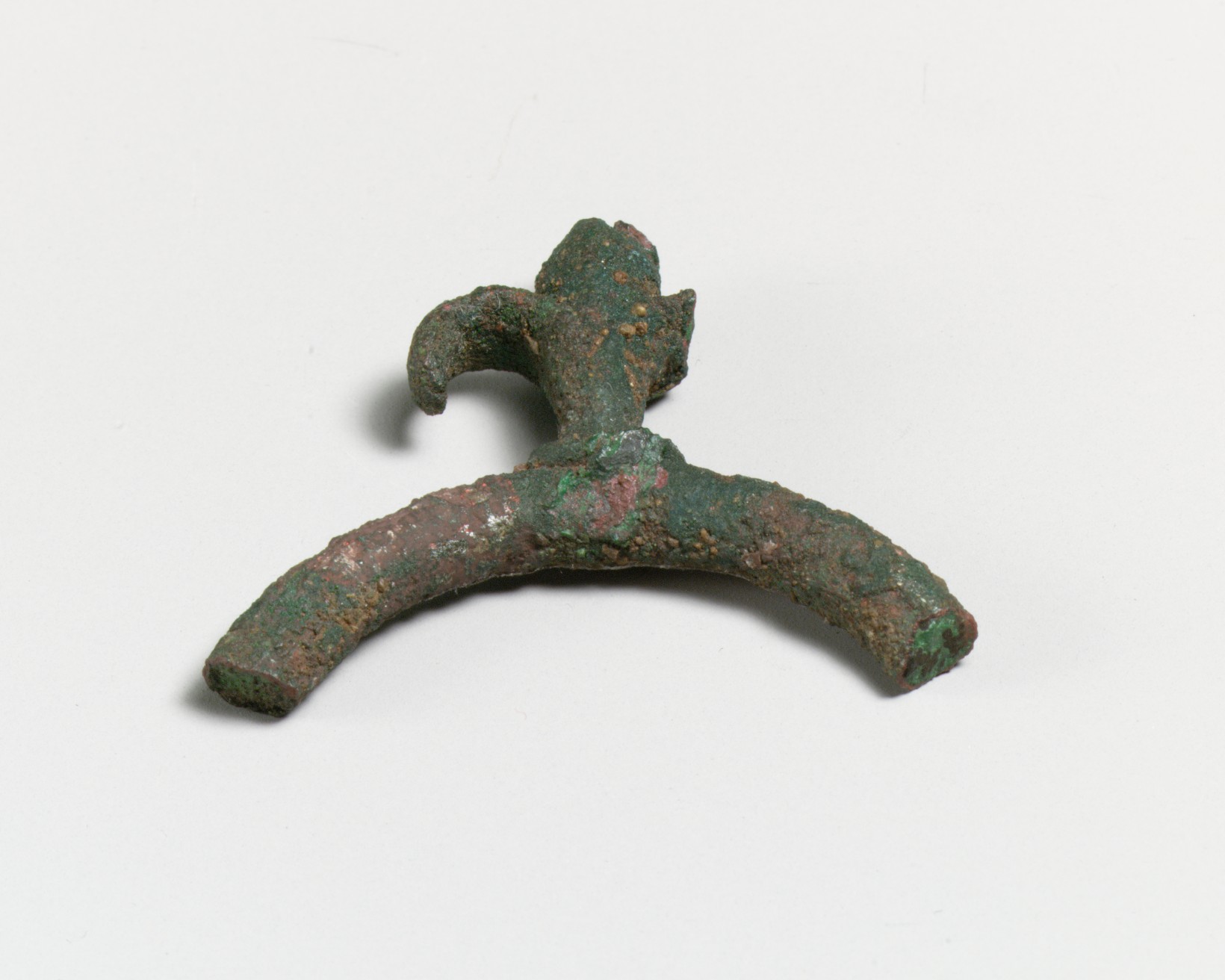
Heritage Analysis: Bronze Handle of a Bowl (Cypriot, c. 1200–1050 BCE)
Introduction: An Object of Transition and Symbolic Resonance
The bronze handle of a bowl from Late Bronze Age Cyprus is, at first glance, a fragment of utilitarian life—a functional appendage for lifting and pouring. Yet within this modest artifact lies a dense matrix of symbolic power, historical adornment, and spiritual meaning. For Katherine Fashion Lab, this object is not merely an archaeological curiosity; it is a strategic asset. Our heritage analysis reveals that this handle, when correlated with our existing studies on the Rock in the Form of a Fantastic Mountain and the Jar in the Shape of Bronze Container (Hu), forms a triadic DNA that illuminates a shared cultural logic: the transformation of mundane forms into vessels of metaphysical authority. This paper explores the handle’s symbolic architecture, its role in Cypriot adornment practices, and its implications for a 2026 high-end luxury strategy that redefines heritage as a living, translatable language of power.
Symbolic Power: The Handle as a Locus of Control and Connection
In Cypriot cosmology, the handle of a bowl was far more than a mechanical aid. Bronze, a material alloyed from copper and tin, carried profound symbolic weight. Cyprus—known in antiquity as Alashiya—was a primary source of copper in the Eastern Mediterranean. The handle, therefore, was not merely a piece of metal; it was a fragment of the island’s identity, a condensed emblem of wealth, trade, and divine favor. The act of grasping the handle was an act of claiming control over resources, both material and spiritual.
Our research draws a direct parallel to the Rock in the Form of a Fantastic Mountain, which we analyzed as a microcosm of sacred geography—a miniature world that the owner could hold and command. Similarly, the bowl handle functions as a point of mediation between the human hand and the contents of the vessel, which often included offerings to gods, libations for ancestors, or water for ritual purification. The handle thus becomes a threshold: the point where the mundane hand of the user touches the sacred substance within. In Cypriot funerary contexts, such bowls were placed in tombs to sustain the dead in the afterlife. The handle, then, was a conduit for spiritual nourishment, a tangible link between the living and the ancestral realm.
This symbolic power is amplified when we consider the handle’s form. Many Cypriot bronze handles are cast in the shape of stylized animals—lions, bulls, or birds—or abstract geometric patterns that evoke the horns of consecration, a Minoan-derived symbol of divine presence. The handle we examine features a looped, serpentine curve, reminiscent of the uraeus (the cobra) in Egyptian iconography, a motif absorbed into Cypriot syncretic culture. The serpent, a creature of earth and underworld, reinforces the handle’s role as a connector between realms. For Katherine Fashion Lab, this suggests a design principle: the point of interaction is the point of symbolic charge. In luxury products, the clasp, the closure, the handle—these are not afterthoughts but primary sites of meaning.
Historical Adornment: Bronze as a Medium of Status and Ritual
Adornment in Late Bronze Age Cyprus was not limited to jewelry or textiles; it extended to the objects of daily and ritual life. Bronze bowls were often highly polished to a golden sheen, mimicking the appearance of precious metals. The handle, frequently cast separately and riveted onto the bowl, was an opportunity for ostentatious display. Excavations at Enkomi and Kition have revealed handles inlaid with gold, silver, or niello, or engraved with intricate patterns of spirals, rosettes, and wave motifs. These were not merely decorative; they were markers of the owner’s status as a participant in the international luxury economy of the Late Bronze Age, which linked Cyprus with Egypt, the Levant, and the Aegean.
Our study of the Jar in the Shape of Bronze Container (Hu)—a Chinese bronze vessel that mimics an earlier ceramic form—reveals a parallel strategy: the replication of a humble form in a prestigious material to assert cultural and political dominance. The Cypriot bronze handle achieves a similar effect. By taking a simple, functional object and elevating it through craftsmanship, the Cypriot elite transformed the bowl into a statement of power. The handle, as the most visible and tactile part of the vessel, became a focal point for this transformation. It is no coincidence that many surviving handles show signs of wear from repeated handling—they were meant to be touched, displayed, and admired.
For Katherine Fashion Lab, this historical adornment practice offers a critical lesson: luxury is not the material alone, but the story encoded in its manipulation. The bronze handle’s surface, with its patina of age, tells a story of use, ritual, and transmission. In a 2026 luxury strategy, we must recover this narrative dimension. The handle is not a static object; it is an archive of gestures. Our products should invite similar tactile engagement, with surfaces that reward touch and reveal layers of meaning over time.
Spiritual Meaning: The Handle as an Axis Mundi
In Cypriot religious practice, the bowl was often used in libation ceremonies dedicated to the Great Goddess (often identified with Astarte or Aphrodite). The handle, when grasped, positioned the user’s hand in a specific orientation—palm up, fingers curled—a gesture of supplication and offering. This is not coincidental. The handle’s curve mirrors the arc of the human hand in prayer, creating a physical alignment between the user and the divine. The act of pouring from the bowl thus became a micro-ritual, a reenactment of cosmic order.
Our correlation with the Rock in the Form of a Fantastic Mountain deepens this spiritual reading. That rock, we argued, was a “mountain in miniature,” a sacred space that the owner could possess and venerate. The bowl handle, similarly, is a “temple in miniature.” Its looped form evokes the circular sanctuaries of Cyprus, such as the temenos at Palaepaphos, where the goddess’s presence was believed to reside. The handle, when held, brings the sacred into the hand of the user. This is a profound spiritual technology: the object does not merely represent the divine; it makes the divine accessible.
For a 2026 luxury strategy, this spiritual meaning translates into a design ethos of ritualized interaction. The handle is not a passive element; it is an active participant in the user’s experience. Katherine Fashion Lab can draw on this principle by creating products that require deliberate, meaningful gestures to unlock their value—a clasp that turns, a lid that lifts, a surface that warms to the touch. These are not gimmicks; they are modern iterations of the handle’s ancient function as a portal to the sacred.
2026 High-End Luxury Strategy: Translating the Handle’s DNA
The synthesis of our three heritage studies—the fantastic mountain, the bronze jar, and the Cypriot handle—reveals a coherent DNA for high-end luxury: the object as a mediator between the mundane and the transcendent. For 2026, Katherine Fashion Lab must leverage this DNA in three strategic directions:
First, material storytelling. Bronze, with its alchemical origins, offers a template for material innovation. We can develop alloys or finishes that evoke the patina of age, the warmth of copper, or the luminosity of gold. Each material should carry a narrative—of origin, of transformation, of ritual. This is not about nostalgia but about depth. The handle teaches us that luxury is not the absence of wear but the presence of history.
Second, ergonomic symbolism. The handle’s curve is not arbitrary; it is designed to fit the hand in a gesture of offering. Our products must similarly be ergonomic in a symbolic sense, guiding the user’s body into postures of reverence, confidence, or contemplation. This requires collaboration between designers, anthropologists, and movement specialists to create forms that are both beautiful and meaningful.
Third, ritualized engagement. The handle is a point of interaction that transforms a simple bowl into a sacred object. In our luxury strategy, every point of contact—the clasp of a bag, the handle of a vanity case, the closure of a jewelry box—should be designed as a threshold. This can be achieved through tactile materials, sound (a satisfying click or chime), or visual cues (a hidden motif revealed upon opening). The goal is to create moments of micro-ritual that elevate the user’s experience from consumption to ceremony.
Conclusion: The Handle as a Blueprint for Transcendence
The Cypriot bronze handle is a small object, but it contains multitudes. It is a symbol of power, a medium of adornment, a conduit of spirit, and a blueprint for luxury. By correlating it with the fantastic mountain and the bronze jar, we have uncovered a shared heritage logic: the transformation of the ordinary into the extraordinary through design, material, and meaning. For Katherine Fashion Lab, this is not an academic exercise; it is a strategic imperative. In 2026, the luxury market will demand objects that do more than signify status—they must signify substance. The handle shows us how. It is, after all, the part of the object that we touch, and through touch, we connect to the divine.