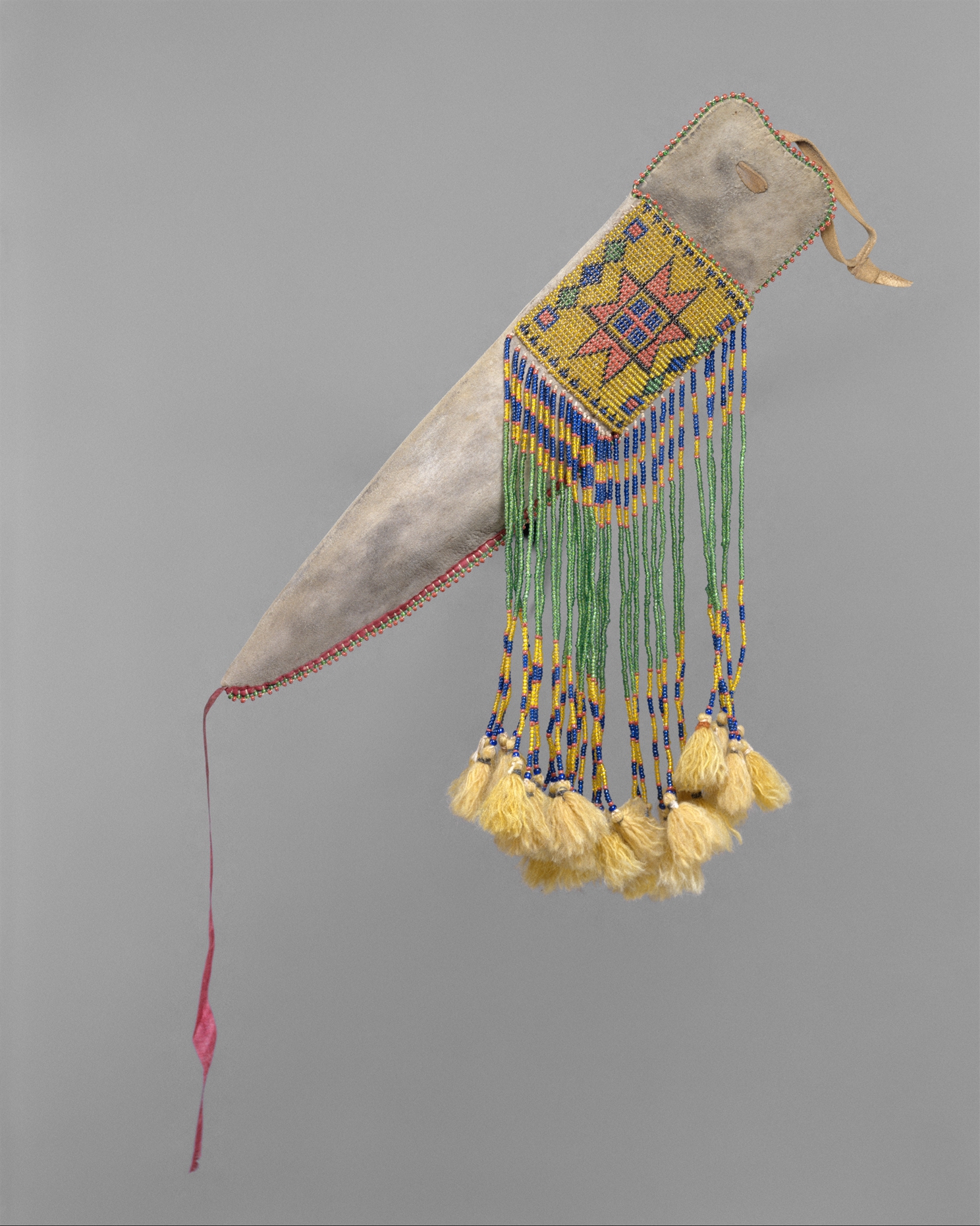
Deconstructing the Knife Case: A Couture Analysis of Ojibwa Craft at Katherine Fashion Lab
At Katherine Fashion Lab, we do not simply observe artifacts; we interrogate them as primary texts of material culture, design intelligence, and embodied aesthetics. The subject of this standalone analysis is an Ojibwa knife case, a seemingly utilitarian object that, upon closer examination, reveals a profound sophistication in its construction, material logic, and symbolic economy. Crafted from native-tanned skin, glass beads, silk ribbon, and wool cloth, this piece transcends its functional role as a blade sheath. It becomes a wearable sculpture, a narrative vessel, and a testament to a design philosophy that seamlessly integrates form, function, and identity. This study will dissect the knife case through the lens of haute couture—examining its materiality, structural engineering, and the cultural kinetics that render it a masterpiece of Indigenous fashion.
Material Alchemy: The Couture Logic of Native-Tanned Skin and Glass
The foundation of the knife case is native-tanned skin, often deer or moose hide processed through brain-tanning—a method that yields a material of unparalleled suppleness, durability, and breathability. From a couture perspective, this is not mere leather; it is a living textile, responsive to the wearer’s body heat and movement. The tanning process, a labor-intensive ritual involving animal brains, smoke, and hand-stretching, imbues the hide with a soft, suede-like nap that resists moisture and retains flexibility. In the atelier of Katherine Fashion Lab, we recognize this as a precursor to modern luxury leathers, yet it surpasses them in ecological intelligence and haptic richness. The skin’s natural grain is preserved, offering a unique textural canvas that no synthetic can replicate.
Adorning this skin are glass beads, typically imported through trade networks but recontextualized by Ojibwa artists into a medium of extraordinary precision. The beads are applied using a spot-stitch or lazy-stitch technique, where each bead is individually sewn onto the hide, creating dense, mosaic-like patterns. This is not decorative excess; it is structural reinforcement. The beads act as a protective layer, guarding the skin against abrasion while simultaneously catching light to create a shimmering, kinetic surface. The color palette—often featuring deep blues, whites, reds, and greens—is not arbitrary. These hues carry cultural significance: blue for sky and water, white for purity and spirit, red for life and warfare. The beadwork transforms the knife case into a coded language, a visual declaration of clan affiliation, personal history, or spiritual protection.
The inclusion of silk ribbon and wool cloth further elevates the piece. Silk, a trade good from European settlers, is here repurposed as a binding or fringe element. Its lustrous sheen contrasts with the matte hide, introducing a play of textures that would please any couturier. Wool, often from trade blankets, is used for linings or appliqué, adding warmth and a grounded, tactile weight. Together, these materials form a dialogue between Indigenous tradition and external influence, a negotiation of value and aesthetics that mirrors the hybridity of contemporary fashion.
Structural Engineering: The Geometry of the Sheath and the Kinetics of Wear
From a structural standpoint, the knife case is a masterclass in ergonomic design. The typical Ojibwa knife case is constructed as a flat, elongated pouch, often with a flap closure and a belt loop or thong for suspension. The dimensions are calibrated to hold a blade—usually a hunting or utility knife—snugly, while allowing for rapid deployment. The seam construction is critical: the skin is stitched with sinew or strong thread using a running stitch or whipstitch, creating a durable seam that can withstand tension. The flap is often reinforced with beadwork or a wool band, preventing the blade from slipping.
What distinguishes this piece as couture is its consideration of the kinetic relationship between object and body. When worn on a belt or sash, the knife case does not hang rigidly; it sways with the wearer’s gait, the fringe of beads or silk ribbons brushing against the hip. This movement is intentional, a choreographed display of grace and readiness. The weight distribution is balanced—the beads add mass near the flap, while the hide remains lightweight, ensuring the case does not drag or impede movement. In the language of fashion design, this is dynamic tailoring, where the garment or accessory is engineered for motion, not static display.
The flap closure is another point of ingenuity. Rather than a button or buckle, the case often uses a leather thong or a bead-tipped toggle that loops over a corresponding stud or slit. This system is both secure and tactile, requiring a deliberate gesture to open—a ritual that honors the blade’s significance. The act of unsheathing becomes a performance, a moment of intention that would be lost in a modern snap or zipper. This is couture as ceremony.
Cultural Kinetics: The Knife Case as a Narrative of Identity and Power
To analyze the knife case solely as a functional object is to miss its deeper resonance. In Ojibwa culture, the knife is not merely a tool; it is an extension of the self—a symbol of survival, skill, and autonomy. The case, therefore, is a protective garment for this extension, a marker of status and craftsmanship. The beadwork patterns often incorporate geometric motifs such as diamonds, triangles, and stepped lines, which reference the four directions, the sky world, or the trail of life. These are not mere decorations; they are mnemonic devices, encoding stories and teachings that the wearer carries into daily life.
From a fashion theory perspective, the knife case operates as a sartorial statement of sovereignty. In the 19th and early 20th centuries, when Ojibwa communities faced displacement and cultural erasure, the creation and wearing of such items became acts of resistance. The use of native-tanned skin, despite the availability of commercial leather, was a deliberate choice to maintain ancestral knowledge. The incorporation of trade goods like glass beads and silk ribbons demonstrates a strategic adaptation—a way of incorporating new materials without losing cultural integrity. This mirrors the contemporary couture practice of using heritage techniques with modern fabrics, as seen in the work of designers like Iris van Herpen or Rick Owens.
Comparative Analysis: The Knife Case in the Context of Global Couture
When placed alongside other luxury accessories—a Hermès Kelly bag, a Chanel tweed jacket, or a Dior saddle bag—the Ojibwa knife case holds its own. The Hermès bag is celebrated for its saddle-stitching and leather quality; the knife case shares that reverence for hide and handwork. The Chanel jacket is lauded for its intricate weave and weight; the knife case’s beadwork achieves a similar density and textural complexity. The Dior bag is iconic for its silhouette; the knife case’s form is equally distinctive, a sculptural wedge that commands attention.
Yet the knife case differs in one crucial aspect: it is not mass-produced nor designed for a passive consumer. It is made by a specific artist for a specific wearer, often as a gift or commission. This bespoke nature aligns it with the highest echelons of couture, where each piece is a one-of-a-kind collaboration between maker and client. The knife case’s value is not monetary but relational—it embodies the skill of the artisan, the identity of the wearer, and the continuity of a living tradition.
Conclusion: The Knife Case as Couture Artifact
In the lexicon of Katherine Fashion Lab, the Ojibwa knife case is not a relic but a living design document. Its use of native-tanned skin, glass, silk, and wool reveals a sophisticated understanding of material properties, structural integrity, and cultural symbolism. It challenges the Western hierarchy that separates art from craft, fashion from function. As we continue to study and honor Indigenous design systems, we recognize that true couture is not defined by labels or runways, but by the depth of intention, the mastery of technique, and the ability to tell a story through every stitch. The knife case does all of this—and it carries a blade, ready for the next chapter.