Strategic Heritage Analysis: Nineveh and the Archaeology of Awe
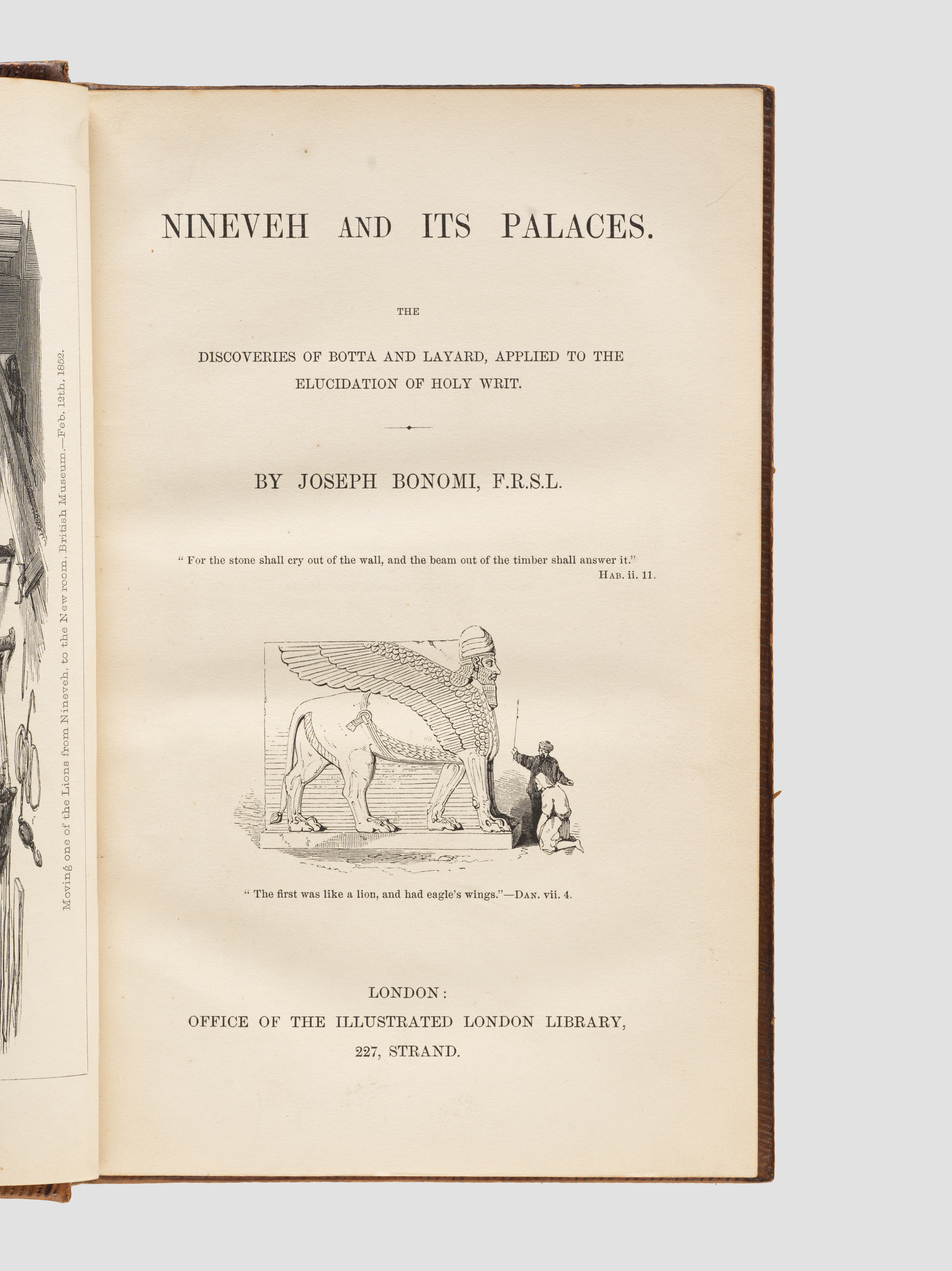
This analysis examines the 19th-century publication Nineveh and Its Palaces: The Discoveries of Botta and Layard, Applied to the Elucidation of Holy Writ as a core heritage artifact for Katherine Fashion Lab. Originating from the zenith of British archaeological exploration and imperial confidence, this volume is not merely a book but a curated object of symbolic power. Its medium—paper, board, and leather—encases a narrative of rediscovery that fundamentally altered the Western world’s relationship with antiquity, myth, and adornment. For a luxury maison, this artifact provides a profound strategic blueprint: it demonstrates how the unearthing of a buried past can be framed as an act of supreme cultural and spiritual elucidation, creating a legacy of authority and awe that is directly applicable to a 2026 high-end luxury strategy centered on intellectual depth and symbolic reclamation.
Deconstructing the Artifact: Board, Leather, and the Framing of Authority
The physical object itself is a primary text on historical adornment. The bound volume, likely in quarter or full leather with gilt lettering, performs a critical function. It domesticates and codifies the chaotic, sublime discoveries from the mounds of Mesopotamia into an acceptable format for the libraries of the British elite. The board and leather act as a cultural reliquary, transforming raw archaeological data into a sacred-secular testament. This process mirrors the core luxury strategy of transformation through curation. Just as Botta and Layard extracted winged bull lamassu from the earth, the publishers extracted their narratives and plates, refining them into a desirable commodity. The book’s very existence proclaims that the most powerful stories—those verifying Biblical scripture and astounding the academic world—are worthy of preservation in precious materials. For KFL, this underscores a fundamental principle: heritage must be physically manifested in objects that feel both archival and contemporary, where the materiality (leather as board, leather as garment) communicates custodianship.
The Symbolic Power of Recovered Narrative
The book’s subtitle, Applied to the Elucidation of Holy Writ, reveals the central symbolic power mechanism at play. The discoveries at Nineveh were not presented as mere historical interest; they were framed as keys unlocking the literal truth of the Bible’s most formidable narratives, from the prophecies of Nahum to the repentance under Jonah. This provided an unassailable spiritual and intellectual justification for the endeavor. The Assyrian reliefs of royal hunts, banquets, and deities were thus baptized into a Western Christian context, their awe transferred to the institutions that discovered and interpreted them. For a luxury strategy, this is a masterclass in narrative anchoring. KFL can similarly position its creations not as mere apparel, but as elucidation—of a cultural motif, a forgotten craft, or a silenced historical voice. The "power" derives from connecting the product to a deeper, almost revelatory story, granting the wearer not just status, but insight and belonging to a continuum of meaning.
Historical Adornment as a Language of Dominion
The plates within this volume would have detailed the most potent aspect of the finds: the adornment of empire. Assyrian reliefs are meticulous catalogs of symbolic dress—the fringed robes of kings, the intricate bracelets, the elaborate hairstyles and headdresses denoting rank and divinity. Every tassel, every pattern on a garment, was a deliberate communication of power, piety, and territorial control. The book translates this visual language for a Victorian audience, effectively creating a pattern book of ancient authority. For KFL, this is a direct source code. The analysis moves beyond aesthetic appropriation to a understanding of adornment as a syntactic system. In 2026, high-end luxury must communicate complex values instantly. Studying these ancient grammars—how a fringe denoted priesthood, how a specific fold indicated royalty—inspires a modern system of intentional detailing where every seam, fastening, and textile choice carries reconstituted meaning, speaking a silent language of cultivated power and spiritual alignment.
Strategic Application: A 2026 Luxury Framework from the Ruins
For Katherine Fashion Lab’s 2026 strategy, this artifact provides a robust, tripartite framework for a standalone luxury collection or maison identity.
1. The Archaeology of the Atelier
Position the design process as an archaeological dig. Collections can be presented as "finds" or "excavations." Utilize techniques that feel unearthed—fragmented prints reassembled like pottery shards, embroidery that replicates erosion patterns, leather worked to mimic sun-baked clay or patinated bronze. The narrative is one of rediscovery and reconstruction, not invention. This appeals to a 2026 consumer seeking authenticity and intellectual rigor over blatant novelty. The "Discoveries of Botta and Layard" become the "Discoveries of the KFL Atelier."
2. Spiritual Meaning Through Symbolic Re-contextualization
Directly emulate the book’s act of "elucidation." Identify a specific myth, spiritual text, or philosophical system (e.g., Neo-Platonism, Gnostic texts, indigenous cosmologies) and position the collection as its modern sartorial interpretation. This is not religious branding, but deep symbolic engagement. A fold can reference a scroll; a color palette can derive from alchemical processes; a garment’s structure can mirror a architectural floor plan of a temple. This grants the wearer an aura of esoteric knowledge and contemplative depth, the modern equivalent of the Victorian reader feeling connected to Biblical truth through Assyrian art.
3. Curatorial Power and the Limited Edition as Relic
The book is a curated selection of the most impactful finds. Similarly, KFL’s 2026 strategy should emphasize extreme curation and the "limited edition artifact." Each piece should be accompanied by its own "monograph"—digital or physical—explaining its symbolic references, material provenance, and craft technique with scholarly detail. The medium (cashmere, silk, leather) is the new board and leather; the garment is the preserved treasure. This transforms consumption into acquisition and custodianship, elevating the product to heirloom status before it is even purchased. It creates a standalone universe of value, independent of seasonal trends.
Conclusion: From Assyrian Reliefs to Future Legacy
Nineveh and Its Palaces stands as a testament to the moment a civilization’s aesthetic and symbolic lexicon was recovered and repurposed to bolster another’s cultural authority. For Katherine Fashion Lab, this is the operative model. The strategic opportunity lies in becoming the modern Botta and Layard—not of geography, but of forgotten symbolic languages and artisanal grammars. By framing design as archaeological elucidation, embedding spiritual meaning into construction, and presenting each creation as a curated relic of a rediscovered past, KFL can construct a 2026 luxury position of unassailable depth and desire. The goal is to make the wearer feel not just adorned, but enlightened; not just wealthy, but as a custodian of a beautifully elucidated secret. In this way, the house builds its own enduring palace, not on the plains of Mesopotamia, but in the annals of meaningful luxury.