Deconstructing the Vessel: A Couture Analysis of the Globular Bottle
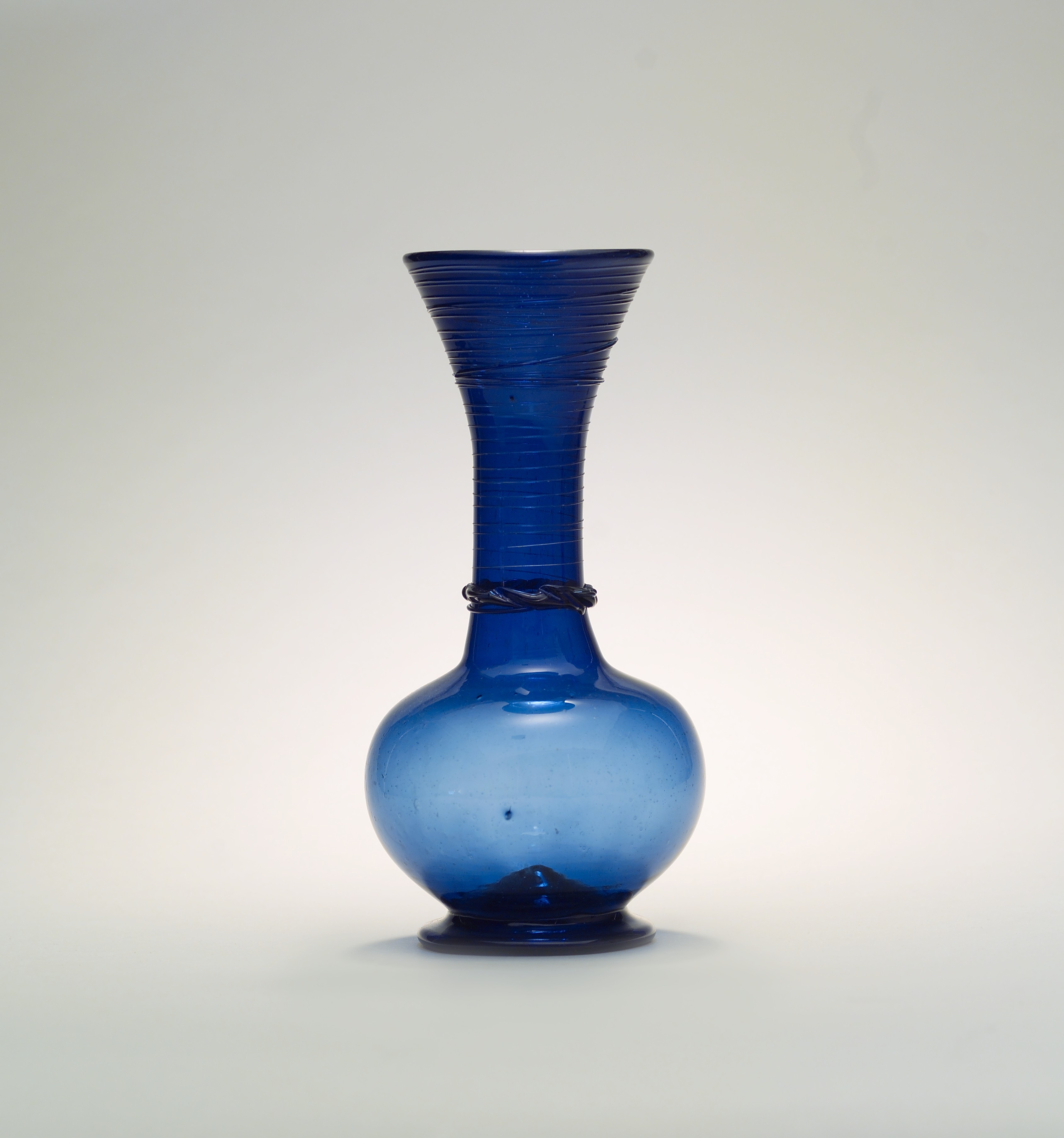
In the rarefied world of haute couture, inspiration often emerges from the most unexpected sources. At Katherine Fashion Lab, we look beyond the conventional confines of fabric and silhouette to find the architectural and philosophical underpinnings of design. Our current subject of study is a seemingly simple object: a bottle with a globular body, crafted from free-blown blue glass, featuring a folded foot and applied decoration. This artifact, a testament to global heritage and artisanal mastery, offers a profound lexicon for the creation of a modern couture piece. The analysis that follows deconstructs this vessel not as a container, but as a living garment—a study in volume, tension, materiality, and the dialogue between structure and ornament.
The Globular Form: Sculpting Volume and Silhouette
The most arresting feature of this bottle is its globular body—a sphere of perfect, yet organic, proportion. In couture, this translates directly into the foundational silhouette. The garment is not merely fitted to the body; it is a volume that the body inhabits. We envision a cocoon coat or a balloon-sleeved gown where the primary mass is concentrated at the torso or the hips, creating a dramatic, almost gravitational center. This is a departure from the linear, body-conscious shapes that dominate ready-to-wear. The globular form demands a study in negative space, where the fabric is allowed to billow and fall, creating a sphere of air and movement. The challenge for the atelier is to engineer this volume without it becoming cumbersome. The solution lies in the internal architecture: strategic darts, hidden tucks, and a masterful use of horsehair braid or lightweight crinoline to support the shape, much like the glassblower’s breath gives life to the molten silica. The silhouette is not static; it is a living, breathing orb that shifts with the wearer’s gait, echoing the vessel’s own sense of contained energy.
Free-Blown Glass: The Art of Imperfect Perfection
The technique of free-blowing is central to the object’s soul. Unlike mold-blown glass, which is constrained and uniform, free-blown glass is a dance between the artisan and the material. It bears the subtle asymmetry, the slight tilt, the unique bubble trails that mark its handcrafted origin. In couture, this is a powerful metaphor for the rejection of industrial perfection. The garment must feel organic, as if it has been sculpted by the hands of a master rather than cut by a machine. This translates into a fabric choice that can be manipulated like a viscous liquid. We propose a double-faced satin or a liquid silk crepe that drapes with a similar fluidity. The seams are not hidden; they are celebrated as visible gestures, much like the glassblower’s tool marks. The hemline, instead of being a perfect circle, might be cut on the bias to create a subtle, undulating wave, mirroring the irregular rim of the bottle’s mouth. The entire construction process becomes a performance, with each stitch a deliberate, imperfect stroke that adds to the garment’s narrative of human touch.
The Blue of the Glass: Chromatic Psychology and Depth
Color in couture is never arbitrary. The deep, translucent blue of the glass is not a simple pigment; it is a phenomenon. It is the blue of a glacial crevasse, of a twilight sky reflected in a still lake, of the deepest part of the ocean. This is not a flat color but one with inherent depth and luminosity. To capture this in fabric, we must move beyond standard dyeing techniques. We envision a layered approach: a base of midnight-blue silk chiffon, overlaid with a sheer organza in a slightly lighter cerulean, and perhaps a third layer of a gossamer-thin tulle in a shimmering cobalt. The effect is a chromatic stratification that shifts with the light, creating the illusion of transparency and interior volume that the glass possesses. The color is not just seen; it is experienced. It evokes a sense of calm, of depth, of the infinite. In the context of the garment, this blue becomes a statement of introspective luxury, a color that does not shout but rather invites the viewer to look deeper, to see the light trapped within the folds.
The Folded Foot: Foundation and Structure
The folded foot of the bottle is an elegant solution to a structural problem: creating a stable base for a spherical body. It is a discreet, yet essential, architectural element. In our couture piece, this translates to the foundation of the garment—the hem, the waistband, or the structural underlayer. We propose a rigid, folded band at the hem of the cocoon coat, perhaps crafted from a stiffened grosgrain or a metal-encased ribbon, which is then covered in the same blue fabric. This band does not merely finish the edge; it anchors the entire volume, preventing the garment from collapsing and giving it a sense of groundedness. Alternatively, the folded foot can be interpreted as a sculptural waistband for a gown, a solid ring from which the globular skirt cascades. This element speaks to the importance of hidden structure in couture—the unseen bones that allow the fabric to achieve its most dramatic forms. It is a reminder that true luxury lies in the details that are felt, not just seen.
Applied Decoration: The Narrative of Ornament
The applied decoration on the bottle—likely a trail of glass or a delicate prunt—is not an afterthought. It is a deliberate interruption of the smooth, spherical surface. It adds texture, rhythm, and a point of focus. In our garment, this ornamentation is reimagined as three-dimensional embroidery or appliqué. We envision a pattern that mimics the fluid, molten trails of glass, perhaps using couched metallic threads in silver and pale gold, intertwined with tiny glass beads that catch the light. This decoration is applied asymmetrically, following the natural flow of the garment’s volume. It might spiral from the shoulder down to the hip, or cluster near the neckline like a frozen splash. The ornament is not merely decorative; it is a structural narrative, guiding the eye and creating tension against the smooth blue expanse. It echoes the glassblower’s final, decisive gesture—a signature that transforms a vessel into an artifact. In couture, this is the moment where the garment becomes a piece of art, a wearable sculpture that tells a story of craft, heritage, and the enduring beauty of the handmade.
Conclusion: From Vessel to Vestment
This globular bottle, born of fire and breath, is more than a study in form. It is a manifesto for the future of couture at Katherine Fashion Lab. It teaches us that true innovation lies not in rejecting the past, but in reinterpreting its principles through a contemporary lens. The globular volume challenges our notions of the body; the free-blown technique celebrates imperfection; the blue glass demands a new vocabulary of color; the folded foot emphasizes structure; and the applied decoration reminds us of the power of the singular gesture. By translating these elements into fabric, thread, and silhouette, we create a garment that is not just worn, but inhabited. It is a vessel for the spirit, a wearable piece of global heritage that connects the ancient art of glassblowing to the modern art of couture. This is the essence of our work: to find the extraordinary in the ordinary, and to transform the functional into the sublime.