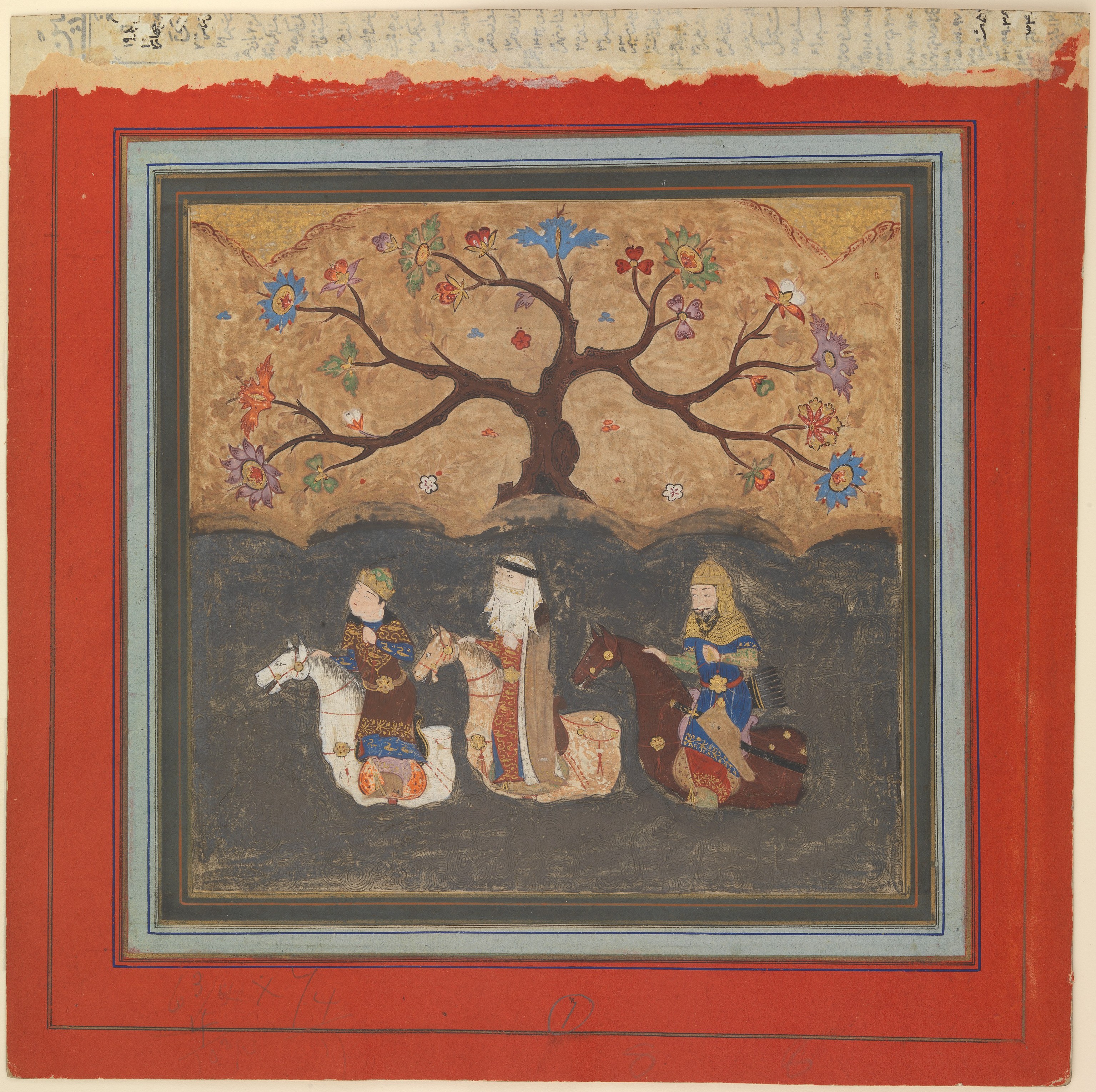
Poetry in Pigment: A Couture Analysis of the Shahnama Folio
In the rarefied world of haute couture, the dialogue between textile and narrative is often the cornerstone of artistic transcendence. At Katherine Fashion Lab, we approach historical artifacts not merely as static objects of veneration, but as profound sources of design vocabulary. The folio titled “Kai Khusrau, Farangis and Giv Crossing the River Jihun (Oxus)” from the Shahnama (Book of Kings) offers an extraordinary lexicon for the contemporary couturier. Executed with ink, opaque watercolor, silver, and gold on paper, with margins adorned in ink and gold on dyed paper, this work transcends its Persian miniature origins to become a standalone study in texture, luminosity, and spatial storytelling. For the discerning fashion scholar, this folio is not a historical relic; it is a blueprint for a sartorial epic.
The Architecture of Narrative: Composition as Silhouette
The first and most immediate couture insight from this folio lies in its compositional architecture. The crossing of the River Jihun is not a static depiction; it is a dynamic, diagonal movement that propels the eye from the lower left to the upper right. In fashion design, this diagonal force translates directly into a powerful, asymmetrical silhouette. The river itself becomes a structural seam, a bias cut that bisects the garment. Imagine an evening gown where the bodice, rendered in deep, opaque watercolor blues and greens, represents the turbulent waters, while the train—a cascade of gold and silver leaf—symbolizes the heroic figures’ passage. The figures of Kai Khusrau, Farangis, and Giv are not just characters; they are three distinct points of structural tension within a single garment. Kai Khusrau, the king, would anchor the neckline with a regal, structured collar. Farangis, the princess, would inform a fluid, draped sleeve that catches the light. Giv, the warrior, would inspire a sharp, armored shoulder pad. The couturier’s task is to weave these three personalities into a single, cohesive form—a dress that tells a story of peril, grace, and valor through its very cut.
Material Alchemy: The Language of Silver and Gold
The folio’s materiality is where Katherine Fashion Lab finds its deepest resonance. The use of silver and gold on paper is not decorative; it is narrative. The silver, now tarnished to a soft, lunar grey, speaks to the ephemeral nature of glory and the cold, perilous waters of the Oxus. The gold, still luminous, represents the divine right and immortal legacy of Kai Khusrau. In a couture context, these metals are not mere embellishments but structural elements. Consider a gown where the base fabric is a matte, ink-black silk—the paper support. Upon this, panels of hand-painted silver leaf are applied in irregular, water-like patterns, mimicking the river’s flow. Over these, gold thread is embroidered in a complex, geometric lattice that echoes the folio’s marginal decorations. The technique would require a master artisan to apply each leaf with the same precision as the miniature painter, creating a surface that shifts from matte to reflective depending on the viewer’s angle. This is not surface decoration; it is material storytelling, where the silver oxidizes and changes over time, mirroring the aging of the artifact itself—a living, breathing garment.
Color Palette as Emotional Cartography
The opaque watercolor palette of this folio is a masterclass in chromatic restraint and impact. The deep, almost lapis lazuli blues of the river contrast with the warm, terracotta reds and ochre yellows of the figures’ garments. The margins, dyed in a rich, burnt sienna, frame the narrative like a protective, earthen border. For the couture collection, this palette dictates a monochromatic base with strategic bursts of intensity. The primary silhouette would be executed in a deep, midnight indigo—a nod to the river’s depth. Accents of vermilion and saffron would appear in the form of a detachable cape or a single, dramatic sleeve, referencing the heroes’ cloaks. The margins inspire a bold, wide hem or cuff, executed in a dyed silk that gradients from deep rust to pale apricot, as if the garment itself were a page from the manuscript. The gold is not used liberally; it is reserved for the key structural points—the neckline, the waist seam, the hem—where it acts as a visual punctuation, drawing the eye to the narrative’s climax.
Texture and Surface: The Illusion of Depth
What elevates this folio from illustration to couture inspiration is its tactile illusionism. The opaque watercolor creates a flat, velvety surface, while the silver and gold leaf introduce a reflective, almost metallic dimension. The dyed paper margins offer a third texture—a soft, absorbent ground. In a garment, this translates to a layering of surface treatments. The base fabric could be a heavy, matte crepe (opaque watercolor). Over this, panels of sheer, metallic organza (silver and gold) are appliquéd in irregular, organic shapes, creating a sense of movement and water. The margins inspire a subtle, hand-dyed border on the train or the back of the gown, where the color bleeds into the fabric like ink into paper. The effect is a garment that changes with light and movement—a living tapestry that reveals new depths with each step.
Silhouette and Movement: The River as a Structural Line
The crossing of the River Jihun is not a static pose; it is a moment of transition, of movement against resistance. The couture silhouette must capture this dynamic tension. The gown’s primary line would follow the diagonal of the river—a bias-cut dress that drapes asymmetrically, with one shoulder bare and the other heavily embellished, representing the struggle between the heroes and the current. The train would be long and flowing, mimicking the river’s course, but structured with internal seams that create the illusion of waves. The waist would be cinched with a belt of oxidized silver discs, each one a nod to the folio’s silver leaf. The overall silhouette is not about volume but about controlled chaos—a garment that appears to be in motion even when still.
Cultural Resonance: From Folio to Global Runway
Finally, this analysis must address the artifact’s global heritage. The Shahnama is a Persian epic, but its themes of heroism, love, and sacrifice are universal. Katherine Fashion Lab’s interpretation is not an act of cultural appropriation but of design translation. The folio’s materials—ink, watercolor, gold, silver—are universal artistic tools. The couture garment inspired by it must honor the original’s spirit while speaking a contemporary, global language. This means avoiding direct replication of Persian motifs (such as specific floral patterns or calligraphy) and instead focusing on the underlying principles: the diagonal composition, the metallic narrative, the chromatic restraint. The result is a garment that feels ancient in its depth and modern in its execution—a bridge between cultures and centuries, much like the river crossing itself.
In conclusion, the folio of Kai Khusrau, Farangis, and Giv is not merely a historical illustration; it is a complete design system. From its compositional diagonals to its material alchemy, it offers a rich, multi-sensory vocabulary for the couturier. At Katherine Fashion Lab, we see this artifact as a call to create garments that are not worn but inhabited—pieces that carry the weight of epic narrative, the shimmer of precious metals, and the depth of global heritage. The river Jihun is crossed; the story continues, stitched in gold and silver on the fabric of time.