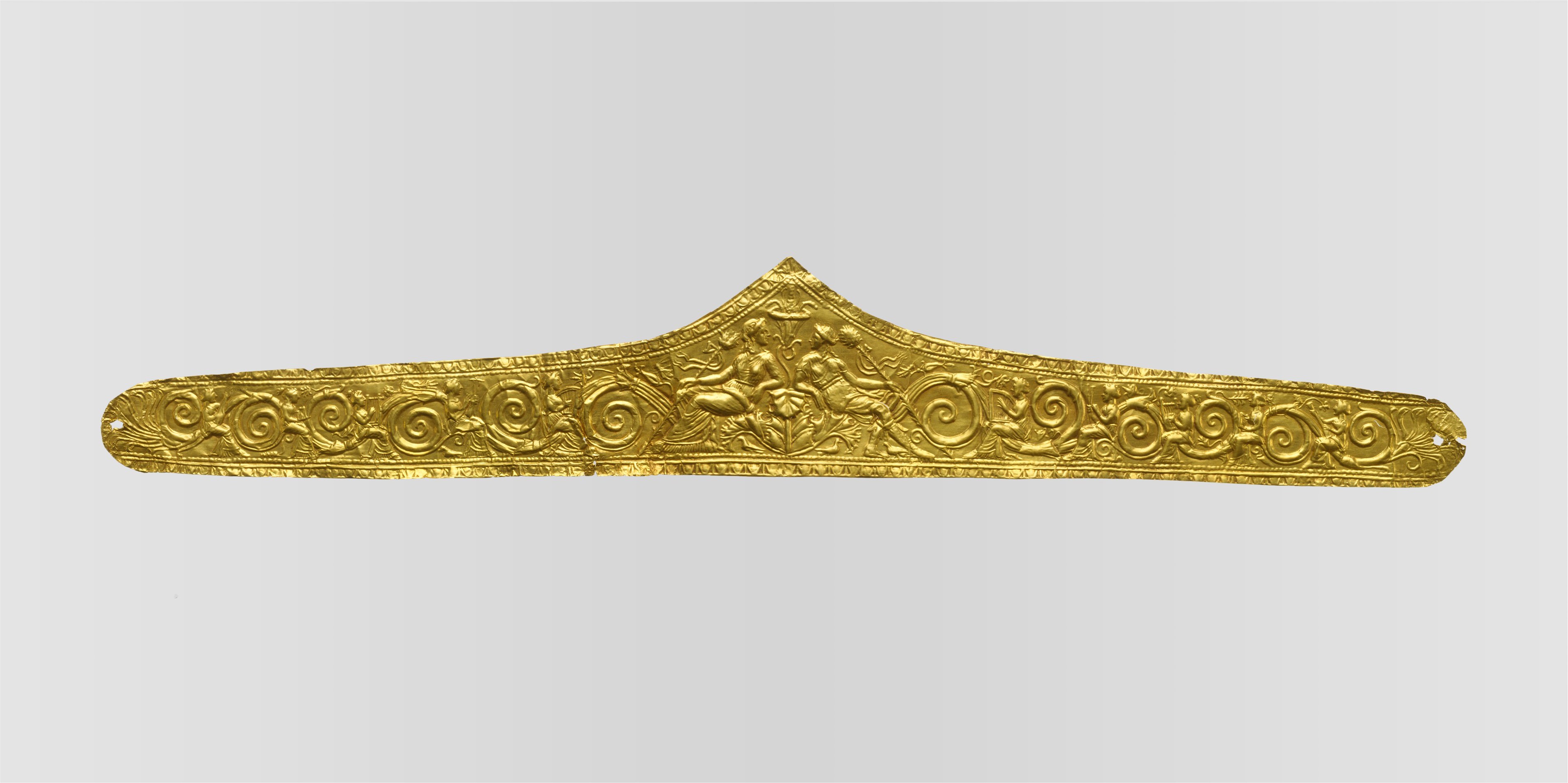
Heritage Analysis: The Pediment-Shaped Gold Diadem as a Source of Luxury Brand Strategy
The pediment-shaped gold diadem from ancient Greece represents a convergence of architectural monumentality and personal adornment, offering a profound template for Katherine Fashion Lab’s 2026 high-end luxury strategy. This artifact, crafted from pure gold and echoing the triangular façade of a temple, transcends mere ornamentation to embody symbolic power, spiritual meaning, and a historical resonance that directly correlates with our ongoing study on the duality of reflective and narrative surfaces—exemplified by the Mirror with Split-Leaf motif, where one side presents a polished silver mirror inlaid with intricate gold palmettes, while the other side narrates life’s journey through stone relief. By decoding the diadem’s cultural DNA, we can construct a luxury narrative that marries heritage authority with contemporary exclusivity.
Symbolic Power: The Diadem as a Crown of Divine and Temporal Authority
The pediment-shaped diadem was not merely a decorative item; it was a potent symbol of divine favor and earthly sovereignty. In ancient Greek culture, the pediment—the triangular gable of a temple—was the architectural frame for scenes of gods and heroes, often depicting the apotheosis of a mortal or the intervention of deities. When this form was miniaturized into a gold diadem, the wearer effectively crowned themselves with the same symbolic weight as a temple pediment. The gold medium amplified this authority: gold was associated with the immortal ichor of the gods, a material that did not tarnish or decay, signifying eternal power.
Hierarchy and Social Signaling
In Hellenistic courts, such diadems were reserved for queens, priestesses, and elite women who acted as intermediaries between the human and divine. The diadem’s triangular shape directed the viewer’s gaze upward, toward the heavens, while its gold surface caught sunlight, creating a halo effect that visually separated the wearer from commoners. This hierarchical signaling is directly transferable to Katherine Fashion Lab’s 2026 strategy: high-end luxury must not only signify wealth but also cultural gatekeeping. By referencing the pediment form in future collections—through geometric necklines, triangular brooches, or architectural headpieces—the brand can position itself as a guardian of heritage, offering clients a “crown” that confers historical legitimacy rather than mere status.
Historical Adornment: The Diadem as a Bridge Between Architecture and Body
The pediment-shaped diadem exemplifies the Greek principle of symmetria—the harmonious proportion of parts to the whole. Just as a temple pediment was designed to balance the columns below, the diadem was crafted to frame the face and neck, creating a visual continuum between the wearer’s body and the architectural ideals of classical Greece. This concept of embodied architecture is critical for Katherine Fashion Lab’s product development. The diadem’s goldsmiths used techniques such as repoussé and granulation to create intricate patterns—often palmettes, acanthus leaves, or rosettes—that mirrored the decorative programs of temples.
Correlation with the Mirror with Split-Leaf Study
Our concurrent research on the Mirror with Split-Leaf reveals a parallel duality: the silver mirror’s polished surface reflects the external world (the “light” of reality), while the gold palmettes represent the internal, decorative self (the “shadow” of narrative). The diadem, by contrast, is a singular object that unifies these dualities. Its gold surface is both reflective (in its polished state) and narrative (through its embossed motifs). For the 2026 strategy, this suggests a unified material philosophy: luxury objects should not merely separate functions (e.g., a mirror only reflects; a diadem only adorns) but should synthesize them. A Katherine Fashion Lab diadem-inspired piece could incorporate a hidden mirror surface or a reversible design that shifts from architectural form to narrative relief, echoing the split-leaf motif’s interplay of light and story.
Spiritual Meaning: The Diadem as a Vessel for Immortality
In Greek funerary contexts, gold diadems were often placed on the heads of the deceased, serving as psychopompic objects that guided the soul to the afterlife. The pediment shape, reminiscent of the temple’s sacred space, transformed the diadem into a portable sanctuary. The wearer, in life or death, carried a piece of the divine realm. This spiritual dimension is often overlooked in modern luxury, which tends to prioritize material value over metaphysical resonance. For the 2026 strategy, Katherine Fashion Lab can reclaim this spiritual meaning by positioning its diadem-inspired pieces as heirlooms of transcendence—objects that connect the wearer to ancestral narratives and future legacies.
Ritual and Personal Devotion
The diadem was also used in religious ceremonies, where priestesses would wear it during rites to Demeter or Artemis. The act of donning the diadem was a ritual of transformation: the wearer became a vessel for the goddess’s power. This concept of ritual adornment can inform Katherine Fashion Lab’s client engagement strategy. Instead of merely selling a product, the brand should create a ceremonial experience—a private viewing where the client is guided through the historical and spiritual significance of the piece, culminating in a “crowning” moment that mirrors ancient rites. This elevates the purchase from a transaction to a rite of passage, aligning with the 2026 luxury trend of experiential exclusivity.
2026 High-End Luxury Strategy: The Diadem as a Strategic Archetype
Based on this heritage analysis, Katherine Fashion Lab’s 2026 strategy should center on three pillars: Architectural Authority, Dual-Narrative Materiality, and Ritualized Exclusivity. These pillars are directly derived from the pediment-shaped diadem’s symbolic, historical, and spiritual dimensions.
Architectural Authority
The pediment’s triangular form is inherently authoritative—it is the apex of a structure. In 2026, Katherine Fashion Lab should introduce a “Pediment” collection featuring bold, geometric silhouettes that reference temple architecture. This includes not only headwear but also structural jewelry (e.g., triangular cuffs, chokers with pediment-inspired clasps) and architectural ready-to-wear (e.g., capelets with triangular shoulders). The brand’s marketing should emphasize the verticality and monumentality of these pieces, positioning the wearer as a living monument—a modern-day priestess or queen.
Dual-Narrative Materiality
Inspired by the Mirror with Split-Leaf study, the 2026 strategy should explore surface duality. The diadem’s gold can be reimagined through dual-finish techniques: one side polished to a mirror shine (reflecting the external world), the other side matte with engraved narrative scenes (telling the wearer’s personal story). This aligns with the luxury market’s growing interest in personalization and storytelling. Clients could commission a diadem with a hidden narrative—a family crest, a symbolic motif, or a personal mantra—etched on the reverse side, visible only to the wearer. This creates an intimate, secret luxury that resonates with the 2026 consumer’s desire for authentic connection over conspicuous display.
Ritualized Exclusivity
The diadem’s spiritual function as a ritual object suggests that Katherine Fashion Lab should adopt a “ceremonial acquisition” model. Instead of standard retail, the brand could host invitation-only “Crowning Ceremonies” in heritage venues—such as museums or restored temples—where clients are presented with their diadem in a ritualistic setting. This taps into the 2026 luxury trend of “slow luxury” and experiential branding. The ceremony would include a historian’s lecture on the diadem’s origins, a guided meditation on the piece’s spiritual meaning, and a formal “crowning” by a brand curator. This transforms the product into a talisman of legacy, justifying a premium price point and fostering deep brand loyalty.
Conclusion: The Diadem as a Strategic North Star
The pediment-shaped gold diadem is more than a historical artifact; it is a strategic archetype for Katherine Fashion Lab’s 2026 high-end luxury positioning. Its symbolic power (divine authority), historical adornment (embodied architecture), and spiritual meaning (vessel for immortality) offer a cohesive narrative that bridges the ancient and the contemporary. By integrating the Mirror with Split-Leaf study’s emphasis on duality—light and shadow, reflection and narrative—the brand can create products that are not merely beautiful but meaningful and transformative. In a luxury market increasingly saturated with digital ephemera, the diadem reminds us that true luxury is eternal, rooted in the gold of history and the architecture of the human spirit. Katherine Fashion Lab’s 2026 strategy should therefore be a crowning achievement—a collection that elevates the client to the status of a living monument, adorned with the weight of heritage and the light of future possibility.