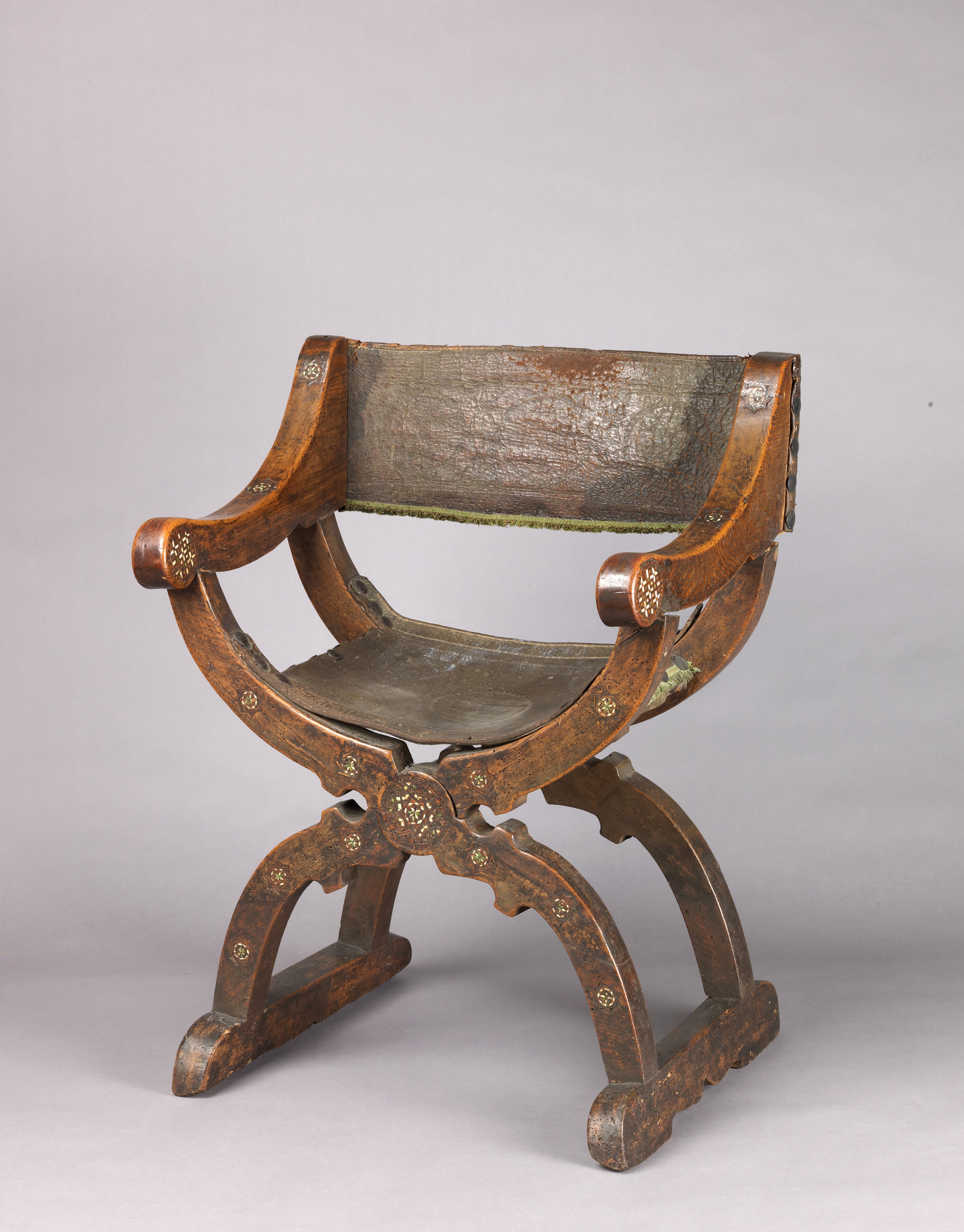
Deconstructing the Dantesca: A Couture Analysis of the Hip-Joint Armchair
Introduction: The Throne of the Intellect
The intersection of furniture design and haute couture may seem, at first glance, an unlikely pairing. Yet, at Katherine Fashion Lab, we recognize that the most profound expressions of craftsmanship—whether in silk or in carved wood—obey the same immutable laws of form, texture, and narrative. The subject of this analysis, an Italian hip-joint armchair of the Dantesca type, is not merely a seat. It is a sculptural manifesto, a piece of furniture-as-couture that speaks to a lineage of artisanal rigor and intellectual ambition. Originating from the Italian Renaissance tradition, this piece, intended for a standalone study, transcends its functional purpose to become a statement of power, contemplation, and exquisite materiality.
To treat this armchair as a couture garment is to dissect its silhouette, construction, and embellishment with the same precision we would apply to a Dior bar jacket or a Schiaparelli evening gown. The Dantesca type, named for the poet Dante Alighieri, evokes a world of scholarly gravitas and poetic drama. Its defining feature—the “hip-joint” or savonarola mechanism—allows the seat to fold and the back to recline, creating a dynamic, almost theatrical posture. This is not passive seating; it is an active engagement with the sitter’s physical and psychological state.
Material Lexicon: Elm, Bone, and the Alchemy of Texture
The armchair’s primary structure is reportedly crafted from elm (Ulmus), a wood historically prized in Italy for its resilience and subtle grain. Unlike the ostentatious walnut or the precious ebony favored in courtly furniture, elm speaks a quieter language of durability and understated elegance. Its warm, honeyed tones provide a neutral canvas for the more dramatic elements of the piece. In couture terms, elm is the equivalent of a heavyweight wool crepe—structurally sound, forgiving, and capable of holding a precise architectural line without shouting.
The application of carved bone as an inlay and appliqué is where the piece ascends into the realm of high ornamentation. Bone, often sourced from cattle or oxen, was a common substitute for ivory in Italian Renaissance workshops, offering a similar luminosity and capacity for intricate carving. Here, it is deployed in geometric patterns and stylized foliate motifs, possibly echoing the grottesche (grotesque) decorative schemes of the period. The contrast between the matte, porous texture of the elm and the polished, almost pearlescent surface of the bone creates a tactile dialogue—a play of light and shadow that shifts with the viewer’s angle. This is the couture equivalent of a trompe-l’œil embroidery, where thread mimics metal or gemstone.
The seat and backrest are upholstered in a composite of materials: tooled leather, silk velvet, and metal. The leather, likely calfskin, is embossed with a pattern that may include heraldic devices or arabesques, its surface darkened and burnished through age. This tooling is not mere decoration; it is a form of structural storytelling, a narrative pressed into the very skin of the chair. The silk velvet, a fabric of immense prestige in Renaissance Italy, likely in a deep crimson or sapphire hue, provides a lush counterpoint to the austerity of the leather. Its pile catches the light, offering a sensation of softness and luxury that is both visual and tactile. The metal elements—perhaps gilded brass or iron—serve as structural reinforcements and decorative accents, their cold, reflective surfaces anchoring the composition.
Silhouette and Structure: The Hip-Joint as a Design Gesture
The Dantesca armchair is defined by its X-frame base, a direct descendant of the Roman curule seat. This structure, with its crossed legs and hinged joints, is a marvel of engineering and aesthetics. When viewed from the side, the chair presents a dynamic, almost kinetic silhouette—the splayed legs create a sense of forward momentum, as if the chair itself is poised to rise. This is not the static, four-square posture of a traditional throne; it is a design that acknowledges the body’s need for movement and adjustment.
The high, sloping backrest, often adorned with a carved crest, echoes the shape of a bishop’s mitre or a courtier’s collar. In the context of a study, this elevation serves a dual purpose: it physically supports the sitter’s spine during long hours of reading, while also projecting an aura of intellectual authority. The armrests, terminating in carved volutes or animal heads, provide a resting place for the forearms, creating a sense of enclosure and focus.
The hip-joint mechanism itself is a couture-level detail. It allows the seat to be folded and the back to be adjusted, transforming the chair from a rigid object into a responsive instrument. This adaptability is a hallmark of sophisticated design, much like the hidden boning in a corset or the adjustable straps of a haute couture gown. It reveals an understanding that true luxury lies in customization and comfort, not merely in ornamentation.
Embellishment and Narrative: The Language of Carving
The carved bone and wood motifs on this armchair are not random; they are a visual lexicon of Renaissance humanism. The foliate patterns, likely acanthus leaves, symbolize resurrection and endurance. The geometric interlaces may represent the harmony of the cosmos, a nod to the Neoplatonic philosophy that permeated Italian intellectual circles. The heraldic devices, if present, would anchor the piece to a specific family or patron, transforming it from a generic object into a personal artifact of lineage.
The tooled leather, with its embossed patterns, adds a layer of textural storytelling. The process of tooling—applying heat and pressure to create a permanent impression—is analogous to the act of writing or drawing. Each impression is a deliberate mark, a signature of the artisan’s hand. The silk velvet, with its rich pile, introduces a chromatic counterpoint, its depth of color evoking the robes of a cardinal or the velvet of a ceremonial mantle. The interplay between the matte leather and the lustrous velvet creates a visual rhythm that guides the eye across the surface of the chair.
Context and Function: The Study as a Stage
Placed in a standalone study, this armchair becomes the central protagonist of a private theater. The study, in Renaissance Italy, was a space of intellectual solitude and creative ferment—a room where the humanist scholar, the poet, or the merchant prince would retreat to read, write, and reflect. The Dantesca armchair, with its imposing presence and adjustable posture, was designed to facilitate this performance of thought.
The chair’s scale and presence command the room. Its X-frame base creates a visual anchor, while its high back rest draws the eye upward, suggesting a connection to higher realms of knowledge. The materials—elm, bone, leather, velvet, metal—are chosen for their durability and their ability to age gracefully, developing a patina of use that tells a story of countless hours of contemplation. This is not a piece for a foyer or a drawing room; it is a piece for a sanctuary, a space where the sitter can engage in the most intimate and demanding of human activities: thinking.
Conclusion: The Armchair as an Heirloom of Intellect
In the lexicon of Katherine Fashion Lab, the hip-joint Dantesca armchair is a masterclass in material storytelling. It is a piece that understands that true luxury is not about ostentation, but about substance, craftsmanship, and narrative resonance. The elm provides the foundation; the bone adds the luminous detail; the leather and velvet offer a tactile embrace; and the metal lends a final note of structural integrity. Together, they create an object that is at once functional and symbolic, a throne for the mind.
This armchair is not merely an antique; it is a design archetype that continues to inform contemporary notions of comfort, authority, and beauty. It reminds us that the most compelling objects are those that speak to the whole person—the body, the intellect, and the spirit. In a world of disposable furniture and fleeting trends, the Dantesca armchair stands as a testament to the enduring power of couture-level design: a piece that is as much a work of art as it is a seat, and as much a companion to the solitary scholar as it is a symbol of an entire civilization’s highest aspirations.