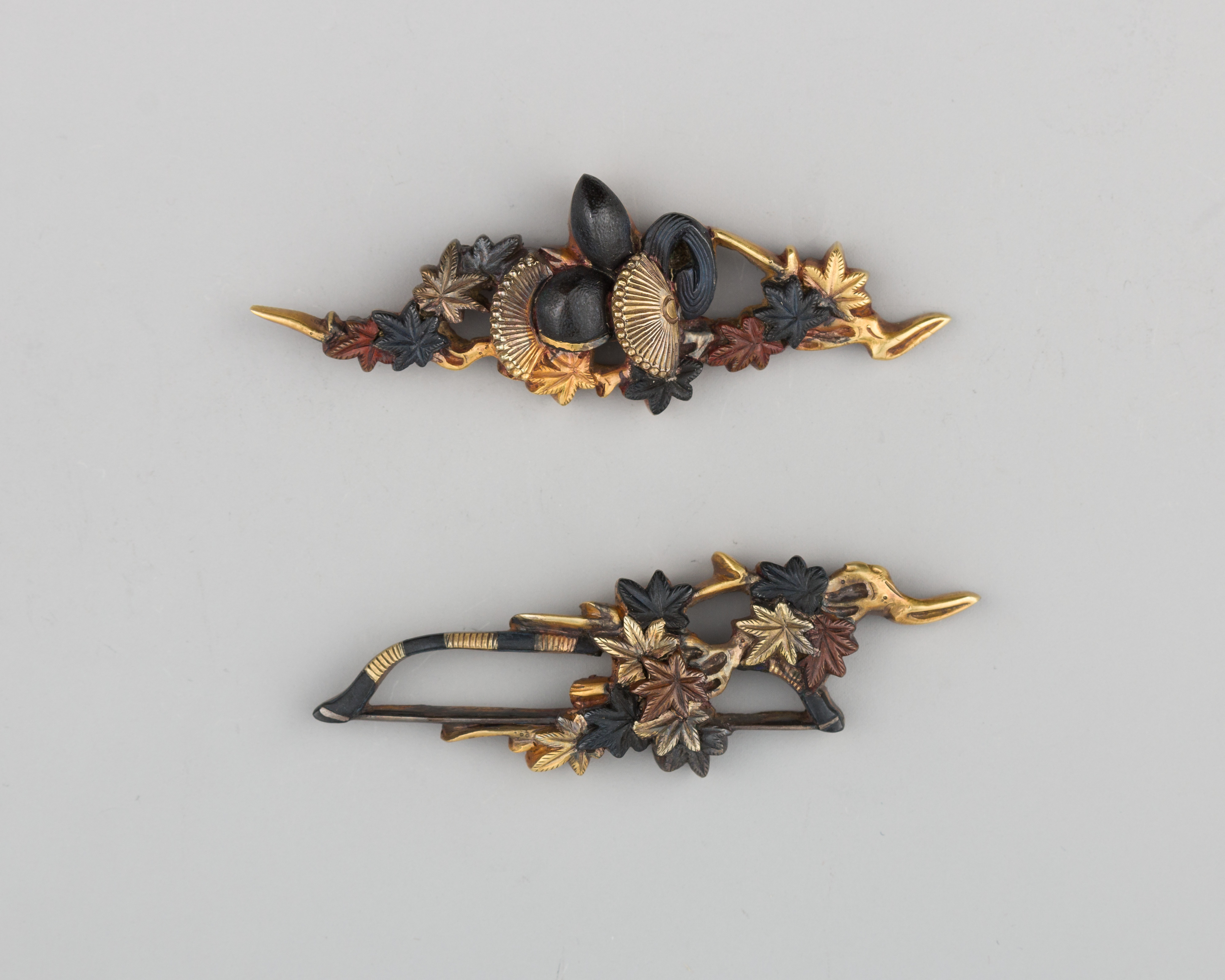
Heritage Analysis: Japanese Menuki as a Strategic Asset for Katherine Fashion Lab
Introduction: The Artifact as a Symbolic and Commercial Nexus
The pair of sword-grip ornaments, or menuki, under analysis represents a confluence of martial utility, spiritual symbolism, and masterful craftsmanship. Crafted from shakudō—a revered copper-gold alloy—alongside pure gold and copper, these objects are not mere decorative accessories but profound carriers of cultural memory. For Katherine Fashion Lab, a luxury brand poised to integrate heritage into high-end strategy, the menuki offers a blueprint for embedding symbolic power, historical adornment, and spiritual meaning into product narratives. This analysis examines the menuki’s layered significance and translates its attributes into actionable insights for a 2026 luxury strategy, where authenticity and storytelling will define market leadership.
Symbolic Power: The Menuki as a Talisman of Authority and Protection
In feudal Japan, the menuki served a dual function: it concealed the mekugi (bamboo peg securing the blade) and provided tactile grip, but its deeper purpose was talismanic. Warriors believed these ornaments channeled kami (spiritual forces) to protect the bearer in battle. The choice of materials—shakudō’s deep indigo-black patina, gold’s radiance, and copper’s grounding energy—imbued the object with cosmic balance. The shakudō alloy, often darkened through a chemical patination process called niiro, symbolized the void of death and the mystery of the unseen, while gold accents represented the sun, life, and divine favor. This duality of protection and authority is central to the menuki’s symbolic power.
For Katherine Fashion Lab, this translates into a design philosophy where each piece carries a narrative of empowerment. In 2026, high-end consumers seek objects that confer not just status but psychic armor—accessories that shield against modern anxieties. By adopting the menuki’s principle of hidden symbolism, the brand can develop collections where motifs (e.g., dragon scales for resilience, lotus petals for rebirth) are embedded into linings, clasps, or interior stitching. This stealth luxury approach appeals to discerning clients who value meaning over ostentation.
Historical Adornment: Craftsmanship as a Marker of Prestige
The menuki’s production process was a closely guarded art. Master metalsmiths, often working in schools like the Gotō lineage, employed techniques such as iroe (color inlay) and takazōgan (high-relief overlay) to achieve intricate designs. The use of shakudō required precise control of copper and gold ratios (typically 1–4% gold) and weeks of patination in a solution of rokushō (verdigris). This labor-intensive method ensured that no two menuki were identical—a hallmark of authenticity and exclusivity. Historically, these ornaments were commissioned by daimyō (feudal lords) as symbols of rank, with motifs like shishi (lion-dogs) or hō-ō (phoenixes) denoting specific clan affiliations.
Katherine Fashion Lab can leverage this heritage by positioning craftsmanship as a luxury differentiator. For 2026, the brand might collaborate with contemporary Japanese metalworkers to create limited-edition hardware elements—belt buckles, bag clasps, or brooch pins—using shakudō or its modern equivalents. Each piece would come with a certificate of provenance detailing the artisan’s lineage, alloy composition, and patination technique. This transforms a commodity into a collectible artifact, aligning with the luxury market’s shift toward heritage-driven scarcity. Additionally, the brand could host atelier immersions where clients witness the patination process, deepening emotional investment.
Spiritual Meaning: The Menuki as a Conduit for Inner Strength
Beyond the physical, the menuki was a spiritual anchor. Samurai adhered to bushidō (the way of the warrior), which emphasized rectitude, courage, and benevolence. The menuki’s motifs—often derived from nature (cranes, pines) or mythology (Fudō Myōō, the wrathful wisdom king)—served as meditative foci. Touching the ornament before battle was a ritual to center the mind and invoke ancestral protection. The shakudō patina, which deepens with age, mirrored the warrior’s own journey of tempering through adversity. This metaphor of transformation is critical: the object was not static but a living testament to the bearer’s spiritual evolution.
For Katherine Fashion Lab, this opens a pathway to ritualistic luxury. In 2026, consumers increasingly seek products that facilitate mindfulness. The brand could design a “Warrior’s Toolkit” collection: a silk pouch containing a menuki-inspired pendant, a miniature scroll with a meditation guide, and a vial of kōdō (incense) for centering. Each piece would be activated by the owner through a simple ritual—a touch, a breath, a whispered intention—borrowing from the samurai’s pre-battle ceremony. This transforms the product from a static object into a dynamic companion, fostering loyalty through emotional resonance.
Strategic Application for 2026 High-End Luxury
Market Positioning: The luxury sector in 2026 will be defined by hyper-personalization and cultural authenticity. Katherine Fashion Lab can position itself as a curator of wearable heritage, bridging Japanese tradition with contemporary design. The menuki’s principles—hidden meaning, artisanal mastery, and spiritual utility—should inform a “Stealth Power” campaign. Visuals might juxtapose a modern executive in a tailored suit with a close-up of a shakudō cufflink, emphasizing the unseen strength beneath the surface.
Product Development: A “Menuki Collection” could include:
- Signature Hardware: Cufflinks and belt buckles in shakudō with gold inlay, each motif (e.g., thunder for decisiveness) matched to the client’s personal archetype via a digital consultation.
- Limited Editions: 100 numbered pairs of “Talisman Rings” with micro-engraved kanji for protection, set in blackened silver.
- Collaborative Series: A capsule with a Kyoto-based menuki master, featuring repurposed antique blades as pendants—a direct link to historical authenticity.
Pricing and Exclusivity: Given the labor intensity, prices should reflect artistic value ($2,000–$15,000 per piece). A “Patina Membership” program could offer clients annual access to new patination colors (e.g., aobuta for blue-black, shibuichi for silver-gray), creating a collector’s ecosystem.
Narrative Strategy: All marketing materials must foreground the spiritual dimension. A series of short films titled “The Armor Within” could profile modern warriors—a CEO, a surgeon, a climate activist—and their relationship with talismanic objects. The brand’s digital platform should include an “Iconography Library” explaining the symbolism of each motif, empowering clients to choose pieces that resonate with their life path.
Conclusion: The Menuki as a Strategic Compass
The Japanese menuki is far more than a historical oddity; it is a strategic archetype for 2026 luxury. Its fusion of symbolic power, historical adornment, and spiritual meaning offers Katherine Fashion Lab a template for creating objects that transcend fashion. By honoring the menuki’s essence—craftsmanship as meditation, ornament as armor, and luxury as transformation—the brand can capture a discerning clientele seeking depth in a surface-driven world. The path forward is clear: embed meaning, elevate craft, and empower the wearer. In doing so, Katherine Fashion Lab will not merely sell products but curate legacies.